Tag: phenomenology

Detailed descriptions of sensations, perceptions, and states

  • Following the Qi: What Practice Taught That Texts Couldn’t

    Classical texts point the way, but the Qi itself became my real teacher. This post gathers lessons that emerged only through practice — corrections to what I had misunderstood, refinements I couldn’t have anticipated, and frontiers I’m still exploring.

    The Guiding Principle: Let the Qi Lead

    Early on, I approached the practice as a student follows instructions: do this, then that, in this sequence, for this duration. The texts seemed authoritative, and I assumed precision meant fidelity to their letter.

    But something shifted when I stopped trying to direct the Qi and started listening to it instead. I inhaled when the Qi seemed to want to enter; I exhaled when it felt ready to leave. This was not technique — it was attunement.

    During the phase of martial fire, I was still pushing and pulling, trying to make things happen. The correction came naturally: when the Qi began moving on its own, I discovered that the best thing I could do was get out of the way. This was my first taste of civil fire — not doing, but allowing.

    Later, a further refinement emerged. Although civil fire is correct most of the time, there are moments when a small nudge is needed — a brief application of martial fire to set the Qi in motion before stepping back. The interplay between the two became intuitive, no longer a rule to follow but a sensitivity to cultivate.


    Things I Misunderstood at First

    The texts led me down several dead ends before I learned to read them differently.

    Breath synchronization. I initially assumed that Qi breathing should match pulmonary breathing — that each inhale and exhale of air should correspond to a movement of Qi. This proved impossible. The cycles of Qi are far longer than the cycles of breath. Once I recognized this, I stopped paying attention to pulmonary respiration altogether. It became background noise, irrelevant to the real work.

    The Microcosmic Orbit. I thought the sensation should rise from root to crown in a single breath. It doesn’t. The process is far slower — node by node, waiting until the sensation fully establishes itself in one location before moving to the next. Rushing the orbit produced nothing but frustration.

    Literal readings. Some classical instructions, taken literally, lead to dangerous or absurd practices. The doctrine of the Three Treasures, for instance, has inspired practitioners to attempt physical reabsorption of semen using devices. I never went there. The Qi itself taught me to read these texts as metaphor, not manual. When a path felt forced or nonsensical, I trusted sensation over scripture.


    The Physical Setup: Posture, Legs, Hands

    My approach to the body has always been minimal. The goal is to reduce noise so that the subtle signal can emerge.

    Posture. I practice lying on my back, fully relaxed, with no deliberate tension anywhere. Sitting postures, lotus positions, spinal alignments — these may serve other purposes, but for detecting and refining Qi, I found them unnecessary and often counterproductive. Tension is noise; stillness is clarity.

    Legs. There are two basic positions, each producing a different perceptual geometry:

    • Extended: The body feels like a column. Qi enters through the feet and exits through the crown, or vice versa. Alternatively, it feels as though the entire vertical axis is receiving or emitting simultaneously.
    • Crossed: The body feels more like a sphere — a central point surrounded by an increasingly porous periphery, exchanging Qi with a space that no longer feels external.

    Hands. The hands offer more possibilities than the legs. The sensation in the palms seems to extend beyond the fingertips, like a subtle fieldThe five gates. When I place my hands on different parts of my body, this finer sensation mingles with the denser, more viscous sensation inside, helping to soften and integrate it. The hands become tools of internal contact.


    The Nocturnal Practice

    I have not paid attention to diet, fasting, or elaborate preparation. My practice is simple in its logistics.

    It begins around midnight, an hour or so after a light dinner. It lasts between one and two hours. When it ends, I let myself fall directly into sleep, still bathed in the sensation.

    This timing is not accidental. In the current phase — where the once-violent energetic surges have softened into quiet blissOn pleasure as signal — the transition from practice to sleep has become seamless. There is no sharp boundary, only a gradual fading of wakefulness while the sensation continues.

    This has opened a new frontier.


    The Current Frontier: Being and Non-Being

    Each stage of practice has presented a duality to dissolve. Male and female. Inside and outside. Self and other. One by one, these oppositions softened and merged.

    Now I face what may be the final pair: being and non-being. Consciousness and its absence.

    I already cross this threshold every night. The transition from waking awareness to sleep is precisely the passage from being to non-being — or at least, from being conscious to not being conscious.

    So I have begun to pay attention to that edge. I try to detect the exact point where consciousness dissolves into sleep. So far, without much success. The transition seems to elude observation by its very nature: the observer disappears in the act of crossing.

    But this is the work now. Not forcing, not straining — just watching, as closely as I can, the moment when watching itself comes to an end.


    What Partnership Can and Cannot Reach

    The interplay of Yin and Yang between two bodies creates a push-pull dynamic that intensifies Qi enormously. When one partner absorbs and the other radiates, then reverses, the sensation between them builds beyond what either could generate alone.

    But there are three domains where this fusion can occur — corresponding to the three Dantians — and not all partnerships can access all three.

    Lower Dantian (sexuality). This is the most accessible. Physical attraction and arousal are enough to establish the energetic exchange. With my second partner, this is where we reached our peak: the fusion of sexual energy was powerful, and it was here that I first experienced the reversal of flow and the simultaneous Yin-Yang state.

    Middle Dantian (love). This requires more than physical connection. It requires unconditional affection — care that asks for nothing, presence that holds without grasping. My second partnership did not reach this level. What we shared was sexual, not loving in the deeper sense. The heart remained closed to fusion.

    Upper Dantian (joy, shared intention). This is the rarest. It requires not only love but alignment of purpose — two people who genuinely want the same thing, whose intentions resonate rather than merely coexist. I touched this only with my first partnerWhere it all began, though neither of us understood what was happening at the time. We had love, and we had some alignment of spirit, but we lacked the energetic skill to work with it consciously.

    The ideal would be to find a partner with whom all three levels could be engaged: sexual polarity, unconditional love, and shared intention. I imagine such a connection would be extraordinary. I also imagine it is rare — and perhaps not necessary. The path continues, with or without a partner. The Qi still leads.
     

  • Integration of the Energy Body: From Conduits to Field

    In earlier entries, I described the discovery of specific nodes—the primary hardware of internal sensation. But a collection of nodes is not yet a system. This post documents the integration of the energy body: not a model of how the body “is,” but a description of how it was perceived at different stages of training.

    Phase I: The Architecture of Conduits

    For a significant period, my internal map was defined by constriction. The connections between nodes solidified into what felt like stable, three-dimensional tubes with distinct “walls.”

    In this phase, the perceived signal behaved like a pressurized fluid in a closed hydraulic system. It could only travel longitudinally, confined by the channel, entering or exiting the body solely through specific terminals—the “Five Gates” of traditional practice (the crown, the palms, and the soles of the feet). If I wanted to energize the solar plexus, for example, I had to “route” the signal from the navel or down from the heart.

    This “tube-vision” is likely an artifact of orbit-based training. By focusing on the Microcosmic or Macrocosmic orbits, I conditioned the nervous system to move energy in series. In this model, every node between the “gates” acts merely as a relay, receiving and delivering signal only to the node above or below it. It is a highly efficient but closed architecture.


    Phase II: The Breach of the Walls

    The transition began when the terminals started to “leak.” It wasn’t just the palm and fingers radiating the feeling anymore; the sensation expanded to the wrists, until the entire forearm felt like an open aperture. Then the entire head began to radiate or absorb, then the feet, calves, and knees “opened” simultaneously.

    This permeability gradually spread to the core. The pivotal moment in this shift was the realization that the “walls” of the central channels were becoming porous. The dependency on linear routing vanished.

    I recall a distinct session where the solar plexus node activated not because I pushed energy into it from a neighboring center, but because it began to draw signal directly from the exterior, through the skin and tissue of the abdomen. The body stopped functioning as a plumbing system and began operating like a mesh network. Every point became capable of independent input and output.


    Phase III: Dissolution and Modular Control

    This openness seems to be the technical prerequisite for what traditions describe as “dissolution.” As I perceived the body more permeable—where the boundary between the internal sensor and the external space became negligible—the structural map became unnecessary. The sensation of “tubes” vanished.

    However, in my experience, this “void” is functional, not empty. It represents a state of zero resistance. It is not an absence of sensation, but the absence of obstruction.

    Crucially, this architecture is reversible. For me, the loss of the rigid map did not equate to a loss of capability. In fact, it offered superior modularity. Even within this open field, I found I could still “instantiate” a tube on demand—narrowing the focus to channel a high-pressure “ray” through the hands, or collapsing the field to concentrate entirely on a single node.

    The difference is that the structure is no longer a cage I live in; it is a tool I deploy.


  • Teresa of Ávila and Qi: Christian Mysticism Meets Daoism

    A comparative exploration of Teresa of Ávila and qi cultivation, revealing how Christian mysticism and Daoist alchemy share stages of inner transformation beyond doctrine.


    Teresa of Ávila, the 16th-century Spanish mystic, described her inner path through a metaphor drawn from agriculture: watering a garden. The soul was the soil, and divine grace the water that allowed it to bear fruit. Read today, this imagery resonates strongly with concepts found in Daoist inner alchemy, particularly the notion of dan tian (丹田). The word tian literally means “field,” and in Daoist practice it refers to specific regions of the body where vital essence is cultivated through sustained attention and embodied discipline.

    What makes Teresa’s metaphor remarkable is not just its poetic force, but its functional precision. Her descriptions unfold as a process, a gradual refinement of effort, structure, and surrender that closely mirrors the stages of energetic cultivation found in Daoist and Tantric traditions.


    The Metaphor of Cultivation: From Effort to Wu Wei

    In her account, Teresa distinguishes four modes of watering the inner garden: drawing water manually from a well; channeling it through mechanical means; allowing it to flow from a river; and finally receiving it as rain from heaven. These stages trace a clear trajectory from exertion to effortlessness.

    “Paréceme a mí que se puede regar de cuatro maneras: o con sacar el agua de un pozo, que es a nuestro gran trabajo; o con noria y arcaduces… o de un río o arroyo… o con llover mucho, que lo riega el Señor sin trabajo ninguno nuestro, y es muy sin comparación mejor que todo lo que queda dicho.”

    A similar progression appears in Daoist internal alchemy (neidan). Practice begins with intentional activation of qi through breath, posture, movement, and focused attention. This phase is laborious and requires persistence, much like hauling water from a deep well. As sensitivity increases, practitioners work on opening and regulating the channels through which energy flows, analogous to building aqueducts or waterwheels that reduce effort while increasing reach. With time, circulation becomes spontaneous: energy moves on its own, like a river following its course. Finally, there is a stage where practice ceases to feel like practice at all. Energy descends, spreads, and permeates without deliberate intervention.

    This final phase corresponds closely to the Daoist principle of wu wei: non-forcing, non-doing. The practitioner no longer directs the process but allows it. Teresa’s “rain” and the Daoist experience of effortless circulation point to the same realization: technique prepares the ground, but completion arrives on its own terms.


    Sensual Pleasure and the Body as a Site of Revelation

    Teresa’s descriptions of union with the divine are intensely bodily. They involve trembling, heat, sweetness, pain, and surrender—sensations that blur the line between spiritual rapture and erotic experience. This dimension of her mysticism has long unsettled interpreters, especially within a tradition wary of bodily pleasure.

    In Daoist alchemy and Tantra, however, such experiences are not anomalous. Sensual intensity is not treated as a distraction but as raw material. The body is not an obstacle to transcendence; it is the medium through which transformation unfolds. Pleasure, when refined and circulated rather than discharged, becomes a vehicle for expanded awareness.

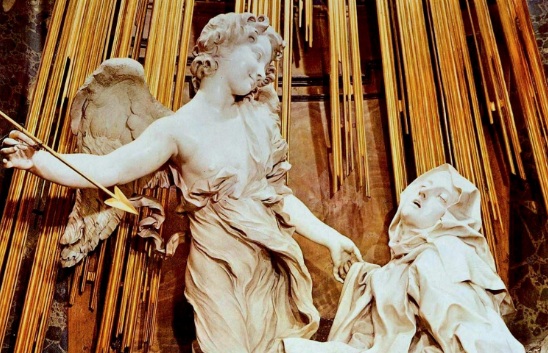
    Bernini’s Ecstasy of Saint Teresa (1652).

    Teresa lacked the conceptual language to frame these sensations outside a theological context, and her historical circumstances demanded caution. Yet her descriptions suggest an embodied knowledge that exceeds doctrine. What she experienced was not abstract belief but a physiological and perceptual transformation, one that aligns closely with energetic traditions where ecstasy, heat, and dissolution of boundaries are recognized stages of inner work.

    “Veíale en las manos un dardo de oro largo… Era tan grande el dolor, que me hacía dar aquellos quejidos, y tan excesiva la suavidad que me pone este grandísimo dolor, que no hay desear que se quite, ni se contenta el alma con menos que Dios.”

    Seen from this angle, her mysticism appears less as an exception within Christianity and more as a culturally constrained expression of a universal embodied process.


    A God One Does Not Ask: Prayer as Presence

    As Teresa’s practice matured, she arrived at a conclusion that quietly subverted the dominant religious model of her time: prayer was no longer about asking, pleading, or negotiating. It became a state of presence rather than an act of will.

    “Ya no se trata de pedir, sino de entender que está Él con el alma y el alma con Él.”

    This shift is crucial. The divine was no longer something external to be persuaded or appeased, but something already present, encountered through stillness and receptivity. Effort gave way to intimacy. Desire softened into attention.

    This understanding closely parallels the Daoist view that alignment with the Tao does not arise through striving, but through yielding. One does not compel harmony; one stops interfering with it. In both cases, the practitioner discovers that the deepest form of communion occurs when intention relaxes and the sense of a separate agent diminishes.

    Teresa’s surprise at this realization suggests how far her lived experience had carried her beyond inherited frameworks. What remained was not doctrine, but a direct mode of knowing—quiet, unmediated, and internally verifiable.


    Conclusion

    Taken together, these elements point toward a shared structure underlying mystical experience across cultures. Whether articulated in the language of divine grace or vital energy, the path follows similar contours: disciplined engagement, bodily transformation, surrender of control and, in some cases, a final resting in what no longer feels separate.

    Teresa’s wells, channels, rivers, and rain are not merely devotional images. They function as a precise cartography of inner change. Read alongside Daoist internal alchemy, they suggest that spiritual realization is not owned by any single tradition, but arises wherever attention, body, and perception are refined enough to meet it.


  • Yin and Yang: Understanding the Mechanics of Embryonic Breathing

    A sober, experiential reflection on how subtle bodily sensations revealed a dynamic of radiating and absorbing, eventually leading to an intuitive understanding of what Daoist texts call Embryonic Breathing.

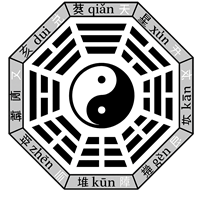
    Yin-yang symbol reflecting how Yin and Yang merge in Embryonic Breathing practice

    Recognizing the Familiar Sensation

    When I first experienced the sensation in my spine, my initial surprise and perplexity gave way to a realization: it was the same sensation I felt in Tantric sex, but manifesting in new locations—a male orgasm, an outward flow. To maintain and enhance it, I had to do the same thing I did with my partner: let it flow, as if something—what one might call Qi—was radiating outward from each node I was exploring.

    However, while practicing the Microcosmic Orbit (MCO), I discovered another strategy that seemed more productive. If the goal was to move the sensation with my attention and intention from one node to the next, it seemed logical that the origin node should radiate while the destination node simultaneously absorbed. I knew how to “exhale” or radiate, but how does one make a point on the spine “inhale”?


    Negative Pressure and the Logic of “Inhaling” Qi

    It seemed to involve creating a kind of vacuum in the receiving node. The most obvious way to achieve this, it seemed to me, was to apply the same intention of creating negative pressure that I used when contracting the perineum—just the intention, since there was no actual muscle to contract there. And it worked.

    Interestingly, perineal contraction is a yoga technique I had seen mentioned on forums, the so-called Mula Bandha. Given the results I obtained, it appears precisely designed for this purpose. The irony is that those who championed it as an essential practice were often the same people who rejected physical sensations as a distraction from the noble goal of purely mental meditation. Funny how that works.


    A Milestone: Holding Two Points at Once

    The truth is, with this strategy I achieved what I later recognized as a major milestone. On one hand, I learned to focus my attention not on a single point, but on two points simultaneously—a key step toward integrating isolated nodes into a unified system. And crucially, I discovered the other polarity, having until then only experienced the radiant, masculine one. The sensation of absorption was as pleasurable as radiating, but directed inward.

    This was exactly how my female partners described their orgasms. Moreover, the sensation I felt when absorbing closely resembled the experience of breathing air after a long apnea, or drinking water after a torrid walk. This subtle body was sending me the same signals my physical body uses when receiving something vitally necessary, like air or water. Since it seemed unlikely that my body would betray me by making me perceive something harmful as necessary, I became convinced that this absorption could not be damaging but was, on the contrary, beneficial. This reasoning is not foolproof — the body can mislead — but in this case, sustained practice over years produced no adverse effects, which reinforced my confidence.


    Understanding Embryonic Breathing (胎息 Tāixī)

    The outcome was the discovery of what Daoist texts call “Embryonic Breathing” (胎息 Tāixī)—breathing Qi in a manner analogous to how we breathe air. This is supposedly what an embryo does in the womb. It implies the concept of something entering (Yin) and leaving (Yang) the organism: we absorb Qi like oxygen and expel something analogous to CO₂, or something we don’t need or is even harmful.

    This parallel can lead to misunderstandings. When the texts speak of “breathing,” what is usually understood as pulmonary respiration often refers to this other type of breathing—one less accessible because the initial requirement is the ability to feel (not imagine) the flow of Qi.


     Beyond Alternation: When Yin and Yang Merge

    And what I discovered much later is that understanding these flows as a breath similar to pulmonary respiration overlooks a crucial detail: there is nothing physical flowing. Therefore, it is possible to “inhale” and “exhale” simultaneously—something impossible in terms of lung breathing but entirely feasible with Qi.


  • Lightning in the Dark – Shifts in Perception

    A recollection of the first glimpses of shifts in perception—moments like lightning in the dark. These reflections capture the raw astonishment of discovering how tantric awakening and dissolution intertwine, written during the early years of my exploration.

    First Flashes

    What I glimpsed was not a new idea, but a different way of being—brief, vivid, impossible to ignore. These moments came like lightning in the dark: sudden illuminations of a reality I hadn’t known, previews of what was to come. My first insights were always confirmed by later experiences, as the intensity and quality of the feeling deepened.


    On Dilution and Death

    The first departure from ordinary experience was a sense of dilution—long before I felt the energy flowing out of my body—and of connection with something much larger. The feeling was like dying, yet instead of fear it brought a quiet hope. Death was no longer perceived as an end, but as a new beginning—like going back home.

    “Imagine that you are in total darkness. Then, for a moment, there is a faint light—and back to the dark again. You try to reconstruct in your mind what you barely perceived. This is what I will try to do now. Not easy, because what I dimly saw, through the windshield and the rearview mirror, looked very much like Death.

    For us, tantric sex means spending ten, fifteen, twenty minutes being traversed by this energy. And I mean it—we both feel the same thing. It feels like a vast and eternal wave of bliss, not the ‘simultaneous orgasm’ where two private experiences happen to coincide. We clearly experience the same flow, with its highs and lows.

    This is a huge departure from any normal experience. Our minds, our whole beings, are connected. And this communion has deep consequences. We dissolve into each other. And we feel dissolved into something immense—like two drops of water merging into one, and then thrown into a river.

    In those moments, when I can drink from that fountain without being pulled toward physical release, I glimpse the real nature of my thirst—the drive we call sex. What I was seeking in the arms of my lovers was this: dissolving into the other, breaking free from the prison of my ego. And through the other, dissolving into… God? If I were Saint Teresa, my cultural lens would surely point to that as the logical answer. As an atheist, I don’t know what to think. This dissolution feels like death—but under that light, the word loses its sting. It feels more like going home. So what I wanted through sex was dying—going home.”


    On the Self

    Being aware without thoughts, even for a short time, made me realize that what I had always understood as “me” was only a bundle of thoughts—memories and desires. My real self was this awareness, silently watching thoughts arise and fade away. The idea—perhaps just wishful thinking—that this “deep self” was the one going back home slowly began to take shape.

    But who’s going home? Again, I’ll try to describe another dim and strange perception.

    Tantric sex with a partner requires some attention to the body—movement, balance, physical awareness. But when I lie back and I’m alone with this energy, the mind truly stops, or nearly so. It has to, or the energy will not flow. In that silence, thoughts are perceived very differently. Our hands and feet are useful tools, but we don’t see them as our ‘self.’ With a still, or nearly still mind, I perceive my thoughts the same way—as tools, but not as me. And that changes everything.

    I dimly perceive that this thing I’ve always called ‘me’ is nothing more than a bundle of thoughts, memories and desires. Yet now they feel like a house I once lived in—a space full of memories, most of them good, but no longer home. The melancholy of those empty rooms is mixed with the excitement of moving on.

    That’s how I feel when I look at that old ‘me’ that no longer feels like me. What I really am is that which moves to a new home. The old self must be left behind; it can’t be carried forward. It cannot survive death—that’s impossible. But then, what is this new ‘me,’ and where is it going? Even considering the possibility of transcending death is a Copernican shift for someone like me—an atheist.”


    On God

    If the real self was free of desire, what could we expect from God—if there was one? A god enslaved by his own desires? I was still deeply skeptical about the very existence of anything we could call “God.” But if such a being existed, it would surely give its grace as the sun gives its light: expecting nothing, asking nothing, shining for all who choose to join it.

    “After all, the trees are not worshipping the Sun—they simply stay away from the dark. And the Sun gives life to the trees by burning herself, but not because she receives any worship. What else could she do? She is the Sun!

    So I don’t see myself praying or worshipping any god. But I’ll try to find a little place under this Sun—she who gives without asking—where I can lay my towel.”

    These were my perceptions in 2015, only three years after the shift began. My interpretation ten years later has evolved — toward greater caution about what these experiences reveal beyond themselves — but the raw glimpses remain as vivid as ever.

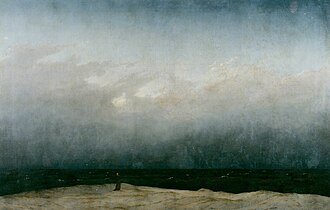
    A solitary monk stands on a barren shore facing an immense, dark sea under a vast gray sky. The figure is tiny against the overwhelming expanse of nature.
    Caspar David Friedrich, Der Mönch am Meer (The Monk by the Sea), 1808–1810. Oil on canvas, Alte Nationalgalerie, Berlin.


  • Detecting Inner Energy: An Engineer’s First Steps

    It began as a simple experiment: detecting a subtle bodily sensation with the mindset of an engineer chasing a faint signal. I had no idea that this experiment in detecting inner energy would lead me to question the boundaries between mind, energy, and consciousness.

    First Steps in Detecting Inner Energy

    The first time I felt the sensation, it appeared spontaneously in specific areas — the tailbone, sacrum, and L4 vertebra. Curious, I decided to explore further to see if I could detect it elsewhere.

    My initial step was obvious from an engineering perspective: to detect a weak signal, you must first reduce background noise.

    At this early stage, I didn’t think of it as meditation. I simply adopted the most favorable position to minimize other sensations: lying on my back, completely relaxed, until all muscular tensions and pressures faded away. This allowed me to focus exclusively on the specific “signal” I was trying to detect.

    Later, when I looked for advice in online forums, everyone insisted that “proper” meditation had to be done sitting in the lotus position. I saw no reason for it beyond tradition. My practical experience showed that the physical strain on my knees and back only created more noise — precisely what I was trying to avoid.

    The only objection that made sense was that I might fall asleep. But by that time, the sensation of this inner energy had grown so intense that falling asleep during the practice had become unthinkable.

    I continued using my chosen stance, which I later learned is a recognized yoga asana: Savasana, the corpse pose.


    Focusing the Signal

    The next step was equally straightforward: I needed to focus my attention on specific points. But where? And how wide or narrow should my focus be?

    After some experimentation, I found the optimal area to be about the size of a ping-pong ball. I began with the locations shown in chakra diagrams, but soon realized they didn’t fully match what I was experiencing.

    When I discovered Daoist energy maps—with their channels running up the spine (Du Mai, the Governing Vessel) and down the front (Ren Mai, the Conception Vessel)—I began exploring both pathways.

    I found the same sensations on the front side of my body, directly opposite the points I had felt in the back. Part of this exploration was already familiar territory: through Tantric sexual practice, I had previously experienced strong sensations at the frontal points corresponding to the first three that had arisen spontaneously in the back.


    The Role of Intention

    The next question was about mental attitude. In Tantric sex, I had learned to let the feeling flow outward—yang—creating a continuous, radiating orgasmic sensation rather than a sudden release.

    When I applied the same gentle “letting go” approach in my solo practice, the same thing happened: a mild orgasmic wave that grew stronger the longer I maintained my focus.

    This led to a practical decision: should I stay at one point until the feeling reached overwhelming intensity – requiring surely some weeks of training – or move on once a moderate sensation confirmed that a point was active?

    Given that the feeling could expand seemingly without limit—and that my primary goal was to map the sources in my body—I chose the latter: to chart the territory before going deeper in any single location.


    The Nature of Attention

    But the most important discovery came not from spatial focus or physical technique—it came from observing the nature of attention itself.

    For most of my life, being “attentive” meant focusing on a task and thinking about it: analyzing, planning, evaluating. Here, that mental activity turned out to be totally counterproductive.

    Of course, I had to think and decide where to focus. But once that decision was made, any thought that followed—“This is fantastic,” or “Maybe I should try something else”—instantly made the sensation vanish.

    The feeling was so compelling that whenever a thought arose and killed it, I would immediately dismiss the thought just to feel it return. Without intending to, I was practicing something that resembled what meditation traditions describe: sustained attention without discursive thought.

    In this practice, the sensation itself became both the driver and the anchor of meditation.


    Recognizing the Practice

    Later, I discovered that this is a core principle of what’s called dual cultivation in internal alchemy — the blending of energy work with meditative awareness.

    Looking back, I realize that what began as an engineer’s curiosity about an unexpected inner ‘signal’ turned into something far deeper. This process of mapping inner energy was not just about technical systems—it was leading me straight somewhere I had no category for yet.

    .

  • The Nature of Prana or Qi — The Sensation Behind Energy Traditions

    This post explores the nature of Prana or Qi — the subtle nervous-system-based sensation that would later become central to my practice — and how ancient Tantric and Daoist sources helped me decode its anatomy and function.

    The Initial Sensation

    The sensation described in the Timeline posts had a precise anatomy worth examining. It all began with a distinct physical feeling that started at the tailbone, rose through the sacrum, and settled around the lumbar vertebra aligned with the navel. When I tried to describe it, the only words that came to mind were: “A ball of light rising up my spine.” I still wonder why light seemed the right word for something happening entirely inside my body.

    It was no ordinary experience, yet it felt not alarming but oddly joyful. I was filled with energy and optimism; my visual field seemed wider, more vivid. I stood at the balcony for several minutes, simply looking at the landscape with new eyes.

    At that time, I had no idea what it could be. But returning to the area with focused attention, it became clearer: this was the same type of sensation I had felt with my partner when practicing — unknowingly — what is known as Tantric sex. It was orgasmic in quality, but localized in unfamiliar regions of the body.

    The feeling coincided precisely with the first three chakras described in Buddhist and Hindu traditions — Muladhara, Swadhisthana, and Manipura. Moreover, it resembled the so-called kundalini experience, often described as a serpent rising along the spine. Skeptical but curious, I decided to test it: I directed my attention to the other chakra points described in the texts, to see if the same sensation appeared there. When the same feeling appeared in the neck and between the eyebrows, I realized I had found a subject worth investigating — one that would occupy me for years to come.


    The First Clue: A Tantric Sutra Confirms the Mechanism

    Suspecting that what I had been practicing aligned with Tantric methods, I began searching for textual confirmation. One of the first texts I turned to was The Book of Secrets, Osho’s commentary on the Vigyan Bhairava Tantra. While not a literal translation, his version of sutra 69 was unexpectedly helpful:

    “At the start of sexual union keep attentive on the fire in the beginning, and so continuing, avoid the embers in the end.”

    “To ignite the fire” meant to awaken the orgasmic energy; “and so continuing” — to sustain it without interruption; “avoiding the embers” — to prevent its dissipation through ejaculation. That, precisely, was what I had been doing — and now it had a clear precedent.


    A Deeper Map: Daoist Physiology and the Three Treasures

    While the Tantric texts provided an initial framework, the Daoist writings offered a more detailed, though sometimes contradictory, physiology. Their language differed, yet the principles were remarkably similar. Central to their model were the Three TreasuresJing, Qi, and Shen.

    In simplified terms: Shen refers to consciousness, Qi to the subtle energy or sensation, and Jing to vital essence — traditionally identified with reproductive fluids.

    Here lies, in my view, the core confusion. Qi is not an abstract “life force” — it is that very sensation, the same one described earlier, inherently orgasmic in nature. Daoist practice seeks to direct this flow upward rather than outward, since downward flow is considered “leakage.”

    The first diagram in the Hui Ming Jing illustrates this vividly: a schematic male torso with energy rising along the spine, while a side branch diverts downward to the genitals — the point of leakage to be prevented.

    Chapter 9 of the same text states it directly:

    Here “Wisdom-Life” (慧命 huì mìng) refers to the union of Shen (consciousness) and Ming (vitality). The key phrase, “the exhaustion of leaks” (漏盡 lòu jìn), defines the goal: to seal the outward flow and redirect that energy inward, transforming it into the fuel for awakening. This passage struck me not as poetry, but as an exact description of what I had felt — the moment the energy reversed and began to rise.


    Modern Interpretation of Qi and Jing

    Of course, these texts were written by and for men — a topic that deserves separate treatment. Observing that ejaculation seemed to extinguish the sensation, they assumed the two were causally linked. The diagram reflects this logic: to prevent energy loss, one must prevent seminal release.

    From a modern perspective, we can reinterpret this. What they described as Qi appears to correspond to a subtle sensation, plausibly mediated by the nervous system; Jing (semen) is a distinct biological product. The correlation between the two is real but not causal. It seems the ancients observed the phenomenon accurately, even if their interpretation of the mechanism differed.

    For me, this distinction clarified much of the confusion: when the classics speak of Qi, they are describing that specific internal sensation.


    A Playful Confirmation

    One line from the Hui Ming Jing adds a touch of humor:

    圓通禪師曰,梅花未發太早生,梅花已發太遲生

    “If the plum has not yet blossomed, it is too early; if it has already blossomed, it is too late.”

    For those unfamiliar with the sensation of Qi, this metaphor invites endless speculation. But for me, the meaning was quite literal: the “plum” represents the male organ, and the text points to a narrow window of opportunity — between the first stirring of orgasm (which must be sustained) and the moment of release (which ends it). The metaphor, plum tree (ciruelo in Spanish), carries a double meaning even in modern slang.


    A Tentative Conclusion

    All of this led me to a conclusion — or, more precisely, a working hypothesis: when the classical texts spoke of Qi, they were referring to that very sensation. It is a perceptible flow that can move in two directions. Outward, it manifests as the familiar male orgasm. Inward, it produces a new experience — equally pleasurable, yet operating in an entirely different physiological and perceptual domain. Whether described as yin and yang or absorption and emission, these appeared less like metaphysical forces than different expressions of a single perceptible process — one still under investigation.

    That inward movement aligned with sensations described by my partners, who spoke of something absorbing and enveloping. Radiant and outward in one case, receptive and inward in the other — the correspondence was unmistakable.

    The polarity mirrored the traditional attributes of yang (radiant, emitting, masculine) and yin (absorbent, enveloping, feminine). In that light, the classical references to yin qi and yang qi began to make practical sense: they described not abstractions, but two complementary modes of the same energetic process — absorption and emission.

  • Tantric Union — Before Words

    Traditional Yab Yum imagery — symbolic representation of unified awareness

    A personal story of how sensual connection became Tantric Union and meditation — the accidental beginning of an inner path. What began as pure feeling unfolded into a wordless communion, where love, joy, and energy merged into a single current.

    A Language Beyond Words

    I didn’t know a single word of her language, and she only knew a few of mine. But despite that—or perhaps because of it—we reached a level of communication beyond words, far deeper than anything I had ever experienced. A smile, a glance, a moan, a shiver—that was all it took to know exactly what the other was feeling. It was as if our bodies were wired together. I could feel her pleasure; she could feel mine. Her delight became my own, and mine became hers. This was how it began — without intention or philosophy, only through feeling, our encounters were the door to tantric union and the unfolding of awareness.


    At First, it Was Just Pleasureand Then Came Love

    It began as simple pleasure, without meaning or mystery, but as our connection deepened and our bodies slipped into this strange communion, something else took hold: pure joy. The first feeling when we met was sheer joy; she leapt with excitement, already anticipating what we were about to share. That joyful anticipation, that shared intention, that sense of oneness, wove itself into the ever-intensifying pleasure between us.

    …And then came love. Not the binding thing but care — the quiet kind that asks for nothing. I wiped her tears when she cried, wrapped her in my arms when sadness found her. She rubbed the pain from my back when it flared. Our spoken words were few —a narrow channel limited by vocabulary— yet our bodies said everything. A glance that lingered, a kiss that asked nothing, a breath drawn in silence, a smile resting between us—each spoke louder than words. Still, we both knew this wasn’t ordinary love.

    Our situation was captured with painful precision in a Tom Waits song, The Bird and the Whale.

    “You cannot live in the ocean,” she said. “You never can live in the sky.”
    “Please don’t cry, let me dry your eyes. Though I know that we both must part, you can live in my heart.”
    Tom Waits, The Bird and the Whale

    That was us—two beings made of different elements, unable to live in the same medium, but who, for a while, danced in the space between. And as we had known from the start—and as she had planned—after two years she returned to her country, on the other side of the world. Knowing it was what we both needed to thrive, we didn’t cling. We let go, gently and without regret.


    What Remained After She Was Gone

    When she left, something remained — not emptiness, but a quiet current that would guide the rest of my journey. Without realizing it, we had touched the three sensations that would later become essential in my practice: the pleasure of intimacy, the joy of unity, and the sweetness of unconditional love —a love that was not transactional, but something far deeper. We were just a man and a woman, sharing the precious moments we could steal, unburdened by expectations or regrets, living in a bubble isolated from the world and its everyday worries.

    Our encounters became a kind of meditation. With subtle movements and no need for words, we simply followed the contours of shared pleasure, spending hours suspended in an eternal now. I would only later learn that what we had stumbled upon resembled Tantric union — the fusion of energy, emotion, and awareness.


    From Memory to Practice

    She is gone now, but she left me two lasting gifts. One is the ability to remain on the edge of climax for as long as I choose —with any partner— which became essential for my energetic training, helping me guide and amplify the ever-deepening flow of this sensation, which I later came to know as Qi On the nature of qi.

    The other is her memory —surely softened and idealized by time— which became central to a powerful practice I discovered years later: a fusion technique known as Yidam, where a visualized deity becomes a conduit for awakening. In my practice, I visualize her as my dakini, the celestial dancer who fuses with me in the deepest embrace, in an explosion of pleasure, joy, and love —sending me into the ultimate energetic experience.