Category: Spirituality in Context

  • From Wells to Rain: Teresa of Ávila and the Cultivation of Qi

    A comparative exploration of Teresa of Ávila’s mysticism and Daoist qi cultivation, revealing shared stages of inner transformation beyond doctrine.



    Teresa of Ávila, the 16th-century Spanish mystic, described her inner path through a metaphor drawn from agriculture: watering a garden. The soul was the soil, and divine grace the water that allowed it to bear fruit. Read today, this imagery resonates strongly with concepts found in Daoist inner alchemy, particularly the notion of dan tian (丹田). The word tian literally means “field,” and in Daoist practice it refers to specific regions of the body where vital essence is cultivated through sustained attention and embodied discipline.

    What makes Teresa’s metaphor remarkable is not just its poetic force, but its functional precision. Her descriptions unfold as a process, a gradual refinement of effort, structure, and surrender that closely mirrors the stages of energetic cultivation found in Daoist and Tantric traditions.

    The Metaphor of Cultivation: From Effort to Wu Wei

    In her account, Teresa distinguishes four modes of watering the inner garden: drawing water manually from a well; channeling it through mechanical means; allowing it to flow from a river; and finally receiving it as rain from heaven. These stages trace a clear trajectory from exertion to effortlessness.

    “Paréceme a mí que se puede regar de cuatro maneras: o con sacar el agua de un pozo, que es a nuestro gran trabajo; o con noria y arcaduces… o de un río o arroyo… o con llover mucho, que lo riega el Señor sin trabajo ninguno nuestro, y es muy sin comparación mejor que todo lo que queda dicho.”

    A similar progression appears in Daoist internal alchemy (neidan). Practice begins with intentional activation of qi through breath, posture, movement, and focused attention. This phase is laborious and requires persistence, much like hauling water from a deep well. As sensitivity increases, practitioners work on opening and regulating the channels through which energy flows, analogous to building aqueducts or waterwheels that reduce effort while increasing reach. With time, circulation becomes spontaneous: energy moves on its own, like a river following its course. Finally, there is a stage where practice ceases to feel like practice at all. Energy descends, spreads, and permeates without deliberate intervention.

    This final phase corresponds closely to the Daoist principle of wu wei: non-forcing, non-doing. The practitioner no longer directs the process but allows it. Teresa’s “rain” and the Daoist experience of effortless circulation point to the same realization: technique prepares the ground, but completion arrives on its own terms.


    Sensual Pleasure and the Body as a Site of Revelation

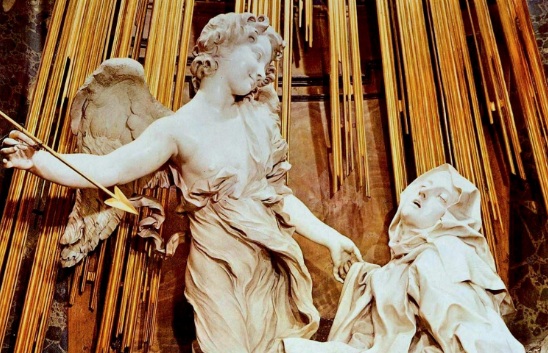
    Teresa’s descriptions of union with the divine are intensely bodily. They involve trembling, heat, sweetness, pain, and surrender—sensations that blur the line between spiritual rapture and erotic experience. This dimension of her mysticism has long unsettled interpreters, especially within a tradition wary of bodily pleasure.

    In Daoist alchemy and Tantra, however, such experiences are not anomalous. Sensual intensity is not treated as a distraction but as raw material. The body is not an obstacle to transcendence; it is the medium through which transformation unfolds. Pleasure, when refined and circulated rather than discharged, becomes a vehicle for expanded awareness.

    Teresa lacked the conceptual language to frame these sensations outside a theological context, and her historical circumstances demanded caution. Yet her descriptions suggest an embodied knowledge that exceeds doctrine. What she experienced was not abstract belief but a physiological and perceptual transformation, one that aligns closely with energetic traditions where ecstasy, heat, and dissolution of boundaries are recognized stages of inner work.

    “Veíale en las manos un dardo de oro largo… Era tan grande el dolor, que me hacía dar aquellos quejidos, y tan excesiva la suavidad que me pone este grandísimo dolor, que no hay desear que se quite, ni se contenta el alma con menos que Dios.”

    Seen from this angle, her mysticism appears less as an exception within Christianity and more as a culturally constrained expression of a universal embodied process.


    A God One Does Not Ask: Prayer as Presence

    As Teresa’s practice matured, she arrived at a conclusion that quietly subverted the dominant religious model of her time: prayer was no longer about asking, pleading, or negotiating. It became a state of presence rather than an act of will.

    “Ya no se trata de pedir, sino de entender que está Él con el alma y el alma con Él.”

    This shift is crucial. The divine was no longer something external to be persuaded or appeased, but something already present, encountered through stillness and receptivity. Effort gave way to intimacy. Desire softened into attention.

    This understanding closely parallels the Daoist view that alignment with the Tao does not arise through striving, but through yielding. One does not compel harmony; one stops interfering with it. In both cases, the practitioner discovers that the deepest form of communion occurs when intention relaxes and the sense of a separate agent diminishes.

    Teresa’s surprise at this realization suggests how far her lived experience had carried her beyond inherited frameworks. What remained was not doctrine, but a direct mode of knowing—quiet, unmediated, and internally verifiable.


    Taken together, these elements point toward a shared structure underlying mystical experience across cultures. Whether articulated in the language of divine grace or vital energy, the path follows similar contours: disciplined engagement, bodily transformation, surrender of control, and a final resting in what no longer feels separate.

    Teresa’s wells, channels, rivers, and rain are not merely devotional images. They function as a precise cartography of inner change. Read alongside Daoist internal alchemy, they suggest that spiritual realization is not owned by any single tradition, but arises wherever attention, body, and perception are refined enough to meet it.

  • The Three Layers of the Self: Where Western Psychology Meets Meditation

    For most of us raised in Western culture, the word self seems obvious. It feels like the story we tell about who we are — our memories, preferences, personality, wounds, and triumphs. But when you look closely, both through the lens of modern cognitive science and through the introspective clarity of meditation, that familiar “I” begins to dissolve.

    What emerges instead is a layered architecture of experience — three layers of the Self that Western psychology is only now beginning to map, and that meditative traditions have been pointing to for centuries: Consciousness → Minimal Self → Narrative Self

    Understanding these layers is not just an intellectual exercise. It is a way of loosening the grip of the illusion we call “me.”


    The Narrative Self: The Social Interface We Mistake for Identity

    The narrative self is the most visible layer — the one we defend, polish, and present to the world. It is built from:

    • autobiographical memory

    • language

    • cultural norms

    • social expectations

    • roles and identities

    • the stories we tell about ourselves

    This is the “I” Freud analyzed through the Ego and Superego, the “project” Sartre said we are condemned to create, and the “self-concept” Rogers tried to align with lived experience.

    But modern cognitive science has made something very clear: The narrative self is not the true self. It is a social interface.

    Psychologists like Dan McAdams describe it as a life story we continuously rewrite. Neuroscientists such as Michael Gazzaniga show how the brain invents explanations for our actions after the fact — a storyteller, not a commander. And philosophers like Daniel Dennett argue that the self is a “center of narrative gravity,” a useful fiction.

    If a self changes when we change language, culture, or social context, it cannot be essential. It is software — installed after birth, updated daily, and often buggy.


    The Minimal Self: The Biological BIOS

    Beneath the narrative lies something older and simpler: the minimal self.

    This is not a story. It is a felt sense:

    • “This is my body.”

    • “I am here, not there.”

    • “I am the one moving this hand.”

    It is pre-verbal, pre-conceptual, and shared by babies, animals, and humans alike.

    Philosopher Shaun Gallagher defines it as the pre-reflective sense of ownership and agency. Neuroscientist Evan Thompson describes it as the embodied structure of experience itself. Even Thomas Metzinger — who famously argues that “nobody ever was or had a self” — acknowledges that the minimal self is a stable biological model the brain uses to navigate the world.

    This is the layer Jung came closest to articulating. His Persona maps neatly onto the narrative self. His Ego overlaps with the minimal self. And his Self — the deeper organizing principle — hints at something beyond both.

    The minimal self is our BIOS: the pre-installed routines that allow consciousness to inhabit a body.

    But even this is not the core.


    Consciousness: The Layer Science Cannot Explain

    Strip away the narrative self. Quiet the minimal self. What remains is not a “self” at all. It is consciousness — the bare capacity to experience.

    This is not a belief. It is an observable fact in meditation: when thoughts stop and the sense of “me” fades, awareness remains. It is also a scientific mystery. Neuroscience can correlate brain activity with conscious states, but it cannot explain why consciousness exists at all.

    This is the “hard problem” articulated by David Chalmers: why should matter give rise to experience? Why should there be something it is like to be anything?

    Some contemporary hypotheses suggest that consciousness may be:

    • a fundamental property of the universe (panpsychism: Galen Strawson, Philip Goff)

    • an intrinsic aspect of information itself (Integrated Information Theory: Giulio Tononi)

    • a field-like phenomenon not fully reducible to neurons (various quantum-inspired models, cautiously explored by Stuart Hameroff and Roger Penrose)

    We know how consciousness behaves. We do not know what it is. Just like time. Or mass. Or space.


    Where Meditation and Science Converge

    Meditation does not solve the hard problem, but it reveals something crucial: Consciousness persists even when the sense of self dissolves.

    In deep practice — whether through qigong, Yidam visualization, or silent absorption — the narrative self falls away. The minimal self softens. The boundary between “me” and “world” becomes porous or disappears entirely.

    Yet awareness remains.

    This is why meditative traditions across cultures converge on similar insights:

    • In Daoism: the return to the Dao, the uncarved block

    • In Buddhism: anatta, the absence of a self

    • In Hindu traditions: Atman = Brahman, the identity of individual and universal consciousness

    • In Christian mysticism: dissolution into the Ground of Being (Meister Eckhart)

    The self is not the experiencer. The self is an appearance within experience.


    The Final Step: The Self as a Three-Layer Illusion

    If we put all this together, a radical but coherent picture emerges:

    • The narrative self is a cultural construction.

    • The minimal self is a biological construction.

    • Consciousness is not a self at all — it is the field in which both constructions appear.

    And when the body dies?

    The narrative self dissolves.
    The minimal self dissolves.
    But consciousness — if it is fundamental — may not.

    This opens the door to possibilities that science has not ruled out:

    • consciousness re-entering another organism (reincarnation)

    • consciousness merging with a universal field (Dao, Brahman, God)

    • consciousness persisting without form

    These are hypotheses, not certainties. But they are no longer confined to religion; they are now part of serious philosophical and scientific debate.

    And meditation offers a direct way to explore them — not as beliefs, but as experiences.


    Conclusion: The Last Illusion

    The deepest insight shared by meditation and modern cognitive science may be this:

    There is no self — only consciousness appearing as a self.

    The narrative self is a story.
    The minimal self is a model.
    The “deep self” is a misunderstanding.

    And consciousness is not a self — it is the space in which the illusion of self arises.

    The final step is not discovering who you are.
    It is realizing that the “you” you seek has never existed.

    What remains is what has always been here:
    awareness without a center, without a boundary, without a name.


  • Sensuality vs. Spirituality: Embodied Spirituality vs. Body Denial

    Is sensuality the opposite of spirituality—or its missing key? This reflection explores the friction between embodied spirituality vs. body denial, and how the modern dismissal of body energy (qi, prana) may serve to sever us from our most immediate source of power.”

    Discovering the Body’s Hidden Language

    When I began to explore—with an open mind—sources I had previously dismissed as nonsense, I discovered that the phenomenon I was interested in—namely, the sudden emergence of a strange sensation in my body that led me to mental states which, from my atheist materialist perspective, could only be described as spiritual or even mystical—was addressed by various traditions, each with its own perspective, goals, and methodologies. Some overlapped; others diverged.

    Buddhism and Daoism: Two Maps of the Same Territory

    The first distinction I noticed was between Buddhism and Daoism. Both traditions clearly referred to the kinds of physical sensations I was experiencing, though they used different names and maps—sometimes contradictory, sometimes complementary.
    But while Buddhists saw the entire process as directed toward a single goal—exclusively spiritual and, at the time, elusive to me—which they called enlightenment, Daoists, although they also included that goal as a possible ultimate destination (if the practitioner so desired), acknowledged intermediate objectives such as improved health, longevity, or even something as mundane as the ability to punch like a beast.

    Energetic Cartographies

    This difference in ultimate goals translated into their representations of the “energetic system”—that is, the cartography that sensation was revealing in my body.
    Daoists have a much more complex representation, with intricate meridians and channels through which a kind of esoteric energy called qi flows, forming the basis of traditional Chinese medicine. At a higher level of integration, they speak of three main centers called dantian, or “fields of cultivation,” located in the head, chest, and abdomen.

    Buddhists, on the other hand, focus on just three channels—one central and two lateral—that intersect in ways that left me puzzled for quite some time. They also speak of seven points called chakras, arranged in a kind of hierarchy from bottom to top: impure below, divine above, representing progress toward enlightenment as an ascent through these chakras.

    Qi, Prana, and the Art of Energy Work

    Buddhists have their equivalent of Daoist qi, which they call prana, and they also claim that, besides the three main channels—ida, pingala, and sushumna—there are over seventy thousand smaller channels called nadis, which seem to correspond to the Daoist luo, capillaries that nourish the entire body.
    But to my surprise, while techniques for working with this energy—qi or prana—were relatively accessible in Daoist texts (with practices like the orbit, or exquisite distinctions between mind, intention, attention, and other agents in the art of “qi refinement”), Buddhist texts, which refer to the process as “purification of the channels,” were not only far more sparse in explanation, but also seemed to treat the very sensation that had led me to what I could only describe as mystical states as a dangerous distraction—some kind of temptation placed there by the Hindu Satan to lead us astray from the path to enlightenment.

    The Forums of Confusion

    It was deeply disheartening to land in my first online forum where it was clear that people could feel the same sensations I did, only to find that any attempt to steer the discussion toward working with those sensations was immediately shot down by a chorus of parrots repeating the same mantra: “Forget the sensation. Just meditate, meditate, meditate.”
    Fortunately, I fled that forum and found another, more open one, where Buddhists and Daoists mingled—and that proved far more enlightening.

    The Real Divide

    Now I see that a strict classification between Buddhists and Daoists is unrealistic, since there are hundreds of branches that mix ideas and techniques from both traditions in varying proportions.
    But for me, the key distinction—the one that led me to discard a large percentage of available options—is very clear: sensuality vs. spirituality, the rejection of the body as an obstacle to spirituality versus the exact opposite view—that the body is not an obstacle but a vehicle, and potentially a Ferrari.

    The Suspicious Neglect of the Body

    Unfortunately, in my view, the more widespread option among sincere spiritual seekers is the body-denying one.
    For them, sensuality is the exact opposite of spirituality—a concept enthusiastically embraced by institutional religions, which also form the cultural foundation for many spiritual seekers and thus completely block the path I discovered by accident.
    Talking about sex in those forums is outright offensive, for example. They simply cannot conceive that one thing could have anything to do with the other.

    At first, I couldn’t understand it. Why would something so vivid, so transformative, be dismissed so categorically?
    But from where I stand now, I’d say this obsession with eliminating the body from the spiritual process is anything but innocent.
    It’s not just a cultural bias or a doctrinal quirk—it feels like a deliberate design. A mechanism to sever the seeker from their most immediate source of power and insight.

    The body is unruly, sensual, and unpredictable. By choosing embodied spirituality vs. body denial, we stop fighting our biological hardware and start using it as the vehicle it was meant to be. And perhaps that’s precisely why so many traditions—especially the institutionalized ones—have worked so hard to suppress it. The reasons behind this systemic suppression deserve a closer look.

  • The Body They Feared: Sensation as a Spiritual Gateway

    For centuries, those who sought to control spirituality tried to separate it from the body. But the body is no cage; it is the true path. By recognizing sensation as a spiritual gateway, we find a language of the sacred that speaks through the pulse and the breath, requiring no intermediaries.

    The Custody of the Body

    For centuries, many religious structures have denied the body — not because it was weak, but because it was free.
    They denied its power to feel, to vibrate, to commune directly with the sacred — not out of ignorance, but out of fear.
    Because they knew: a body that awakens no longer needs to obey.

    The Heresy of Sensation

    A body that senses its inner current — that experiences qi, shen, the subtle joy of vibrating beyond raw desire — discovers that the doorway was never in the texts, but in sensation.
    And that’s heresy to any system that survives by mediating experience.

    The energy that rises from the base of the spine to blossom like a flower in the center of the skull asks no permission.
    It doesn’t go through dogma or hierarchy.
    It doesn’t care whether it’s Buddhist, Christian, Taoist, or atheist.
    It simply rises.
    That is the very pulse of inner alchemy — the moment the body ceases to be an obstacle and becomes the path itself.

    The Return to Embodiment

    That’s why some turned the body into a suspect, pleasure into sin, and breathing into a risk of mystical disobedience.
    Because one who feels like that no longer needs interpreters.

    And yet, every inner alchemy begins there — where the body ceases to be an obstacle and becomes a path.
    Not as an instrument of pleasure, but as a vehicle of knowing.
    One cannot transcend what one has not inhabited. Direct experience confirms sensation as a spiritual gateway, not a hindrance, but a high-performance vehicle of knowing—one that finally allows the practitioner to outgrow the need for interpreters.

  • Knowledge, Belief, and Power

    A reflection on how the alliance between knowledge, belief, and power shaped civilization—from shamanic wisdom to sacred bureaucracy—and how rediscovering unmediated spirituality may become humanity’s next quiet revolution.

    The first currency in history wasn’t gold—it was meaning. Those who could explain why it rained or why the hunt failed held the first lever of obedience. Since then, knowledge and belief have been intertwined as tools to organize—and often to discipline—collective life.

    Power in Primitive Societies

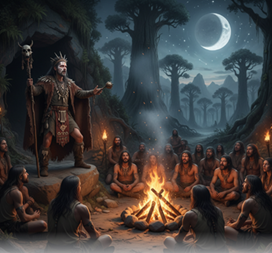
    In social animals, power resides in force and hierarchy: the “alpha male” dictates access to resources and reproduction. In humans, physical dominance soon coexisted with another kind of authority: the symbolic and technical expertise of the shaman, the plant expert, the fire keeper, or the dream interpreter. Power shifted from muscle to mind when healing, anticipating, narrating, and coordinating became more valuable than striking.

    Shamanic knowledge was transmitted through initiation—secret learning, trials, trances, ritual memory. It wasn’t just “knowing which plant heals,” but knowing when, how, and to whom to say it. Sharing knowledge meant sharing power: an invisible lineage of permissions to intervene in bodies, weather, hunting, and conflict. That pattern would repeat endlessly as human societies expanded.

    From Empirical Knowledge to the Narrative of Control

    The practical effectiveness of knowledge (healing, calendars, forecasts) was amplified by stories that wrapped it in the supernatural. Not every “invention” was deceit; metaphors were often the only available language to explain the inexplicable. But those stories also fixed hierarchies—whoever spoke with spirits ruled.

    Humans are prone to see intention where there is randomness, to connect scattered dots, and to prefer agent-based stories over equations. This tendency helped us become cooperative and creative, but it also made us receptive to tales of invisible guardians who reward and punish. Socialized belief legitimized rules, set taboos, and—most importantly—elevated certain people as privileged mediators.

    Sumer and the Institutionalization of Religion

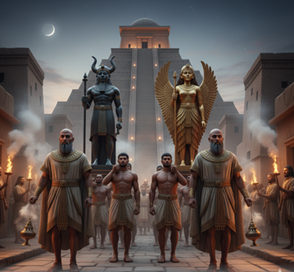
    With Sumer, spiritual power became architecture, accounting, and law. Cities like Nippur, dedicated to the worship of Enlil, built temples (ziggurats), granaries, workshops, and schools for scribes. Religion moved from huts into the urban blueprint: the god’s house became the economic and legal heart of the city.

    Tablets from Nippur and other Mesopotamian centers reveal two key traits of this new pact between gods, elites, and the people:

    a) Power and dependence. The gods were mighty—but not fully self-sufficient. They needed offerings, houses, songs. Their “food” was the smoke of sacrifice and human obedience. They rewarded with fertility and victory; they punished with drought, plague, defeat. The cosmic order resembled a contract: humans serve, gods sustain.

    b) Invisibility and mediation. Gods were not visible to the common person. They lived in temple statues, spoke through oracles or dreams. Only kings or high priests were authorized to “see” or “hear” them—and thus acted as divine interpreters. The Sumerian King List claimed that “kingship descended from heaven”—an elegant way to say that political authority was religious license.

    This new system transformed the charisma of the shaman into a sacred bureaucracy. Truth was no longer a voice in the forest—it became a seal, a ledger, a procession, a hymn.

    Infrastructure to Sustain the Narrative

    To uphold this public “truth,” a vast infrastructure was built:

    • Priestly class: Specialists in rituals, omens, calendars, and law, trained in edubbas (scribal schools). Reading and writing tablets became a monopoly of power.
    • Network of temples and chapels: Economic hubs collecting tribute, managing land, employing artisans, distributing surplus. Piety turned into logistics.
    • Festivities and rituals: Calendars filled with processions, power renewal ceremonies (royal enthronements, “sacred marriages”), purifications. Rituals made the invisible visible—therefore, unquestionable
    • Early indoctrination: Hymns, proverbs, and myths memorized in childhood. Worldviews were instilled before critical thinking could emerge, making doubt feel like betrayal.

    This wasn’t just a hoax—it was a sophisticated social technology for coordinating work, legitimizing decisions, and reducing uncertainty. That’s precisely why it worked so well.

    A Prodigious and Replicable Invention

    The formula—transcendent gods, exclusive mediation, moral sanctions, ritual infrastructure—proved incredibly effective at concentrating power. It was endlessly adapted: in Egypt with deified pharaohs and state cults; in Semitic kingdoms with laws “delivered” by deities; in empires blending theology and law for obedience; in monarchies ruling “by divine grace.”

    Three ingredients made it nearly irresistible: legitimacy (power “comes from above”), predictability (reward/punishment codes), and economy (temples as redistribution centers). Whether a king’s stele showing divine investiture or a sacred-book oath, it was all the same melody: belief turns into obedience, obedience into order.

    Decline of Centralized Religious Power and Rise of New Mediators

    Literacy, printing, science, and education eroded the interpretative monopoly of traditional religious hierarchies. As more people read sacred texts for themselves, practiced skepticism, and cross-checked authorities, central control began to crack. Old churches lost much of their disciplinary grip.

    But humanity’s inclination to delegate the sacred didn’t vanish—it morphed. Sects, charismatic teachers, gurus, lay prophets, and multimedia preachers flourished. Some offer meaning, community, and wellness; others replicate old asymmetries: grand promises, privileged access to truth, obedience traded for belonging, and opaque economies. Same psychology, new logos.

    The Human Cost: Losing Direct Contact with the Divine

    One silent result of centuries of mediated access is the symbolic disenfranchisement of divine connection. Millions have been taught that without a third party, their voice won’t reach, their ear won’t hear. This disenfranchisement rests on powerful meme-like ideas:

    a) Absolute verticality and human inferiority. God above, humans below. Comparing oneself to the divine is blasphemy; aspiring to resemble God is arrogance. Internalized, this turns into self-denigration—“if I’m trash,” I can’t trust my conscience or experience.

    b) Alien will and necessary mediation. God “wants” something from you—but since you can’t know it directly, you depend on someone to interpret it. Obedience shifts from Mystery to the interpreter’s voice. But God cannot have human desires—so how do priests, pastors, or gurus know “what God wants”?

    This mindset has alienated humanity from its own spirituality, surrendering autonomy to those who claim to speak for the sacred.

    Conclusion

    Knowledge, belief, and power have been intertwined from the beginning. What started as shamanic wisdom became a system of control that persists today. The good news is that by understanding this mechanism, we can reclaim our right to a spirituality free from intermediaries. Because, ultimately, no one needs a priest, a guru, or a holy book to encounter the divine—they only need to turn inward with honesty and attention.

    Reclaiming that direct relationship may be the quiet revolution still ahead.

  • Spirituality in Context: Cultural and Psychological Perspectives

    What we call “spirituality” has long been shaped by institutions, belief systems, and social structures — often serving cohesion, identity, and sometimes control. The same frameworks that united communities also divided them, drawing lines between believers and outsiders, brothers and others. This section explores spirituality in cultural and psychological context, examining how these frameworks emerged and evolved.

    Yet behind these historical forms lies something more fundamental: recurring patterns of human experience. Across cultures, epochs, and languages — religious, philosophical, psychological, and now scientific — similar states of perception and awareness keep reappearing.

    From my perspective, much of what began as an open exploration of consciousness became formalized, mediated, and constrained. These notes do not aim to judge or dismiss those traditions, but to place them in context — alongside modern psychology, neuroscience, and first-person inquiry — as different attempts to describe the same underlying territory.

    My interest lies in what remains alive and verifiable in direct experience: where doctrines dissolve, metaphors converge, and distinct frameworks unexpectedly point to the same inner mechanics.

    Is sensuality the opposite of spirituality—or its missing key? This reflection explores Buddhist and Daoist perspectives on body energy (qi, prana) and how denying the body may actually sever us from genuine spiritual insight.


    For centuries, those who sought to control spirituality tried to separate it from the body — as if transcendence required escape.


    For anyone on a spiritual path, a central question arises: where do we place the body and its energies?
    The history of spirituality is, in many ways, the story of how this question has been answered.


    A reflection on how the alliance between knowledge, belief, and power shaped civilization—from shamanic wisdom to sacred bureaucracy—and how rediscovering unmediated spirituality may become humanity’s next quiet revolution.


    For most of us raised in Western culture, the word self seems obvious. It feels like the story we tell about who we are — our memories, preferences, personality, wounds, and triumphs. But when you look closely, both through the lens of modern cognitive science and through the introspective clarity of meditation, that familiar “I” begins to dissolve.


    A comparative exploration of Teresa of Ávila’s mysticism and Daoist qi cultivation, revealing shared stages of inner transformation beyond doctrine.

    Seen this way, spirituality in cultural and psychological context becomes less a system of belief than an evolving attempt to describe recurring patterns of human experience.

  • History of the Evolution of Dual Cultivation

    Where do we place the body and its energies on the spiritual path? The history of spirituality reveals a deep schism between external obedience and internal discovery. This is the history of the evolution of dual cultivation—a journey from the temples of ancient gods to the direct mapping of the human nervous system.

    The Era of Divine Rulers and Obedience

    The earliest organized religions, which developed alongside the first complex civilizations (Mesopotamia, Egypt, etc., beginning around 3500 BCE), established a clear hierarchy:

    • The Concept: Gods were omnipotent and moralizing entities who rewarded obedience and punished transgression. This belief system likely served as a crucial social adhesive, enabling cooperation within newly formed large societies.
    • The Power Structure: Spiritual access was strictly controlled by an organized priestly caste. These priests either held political power themselves or operated in close alliance with rulers, acting as indispensable intermediaries between the finite human and the infinite divine.
    • The Human Role: Humanity’s primary function was to obey. The human condition was viewed as inherently and perpetually inferior to the majesty of the gods.

    The Turn Inward

    Around the first millennium BCE, a quiet revolution unfolded across several civilizations. Figures such as Siddhartha Gautama, Laozi, Mahavira, and the authors of the Upanishads began to shift the focus from worship to direct inquiry.

    Divinity was no longer a being to be pleased, but a condition of mind to be realized. In early Buddhism, the goal was not communion with gods but liberation from ignorance. In the Upanishads, the self (ātman) was said to be identical with the cosmic principle (brahman).

    Meditation, not sacrifice, became the primary means of access to truth. While the goal (nirvana) is not “divinity” in the creator-god sense, it implies a realization of one’s ultimate nature — a state free from suffering and illusion.


    The Hidden Current: The Power of Energy

    While Buddhist traditions emphasized purely mental methods, the broader spiritual landscape of Asia already included practices centered on subtle energy:

    • Pre-Buddhist Practices: Concepts such as prana (vital breath) in early Indian texts (Upanishads) and (life force) in early Chinese Daoism predate — or at least parallel — the time of the Buddha. It is highly likely that simple breath-control and energy-based exercises were already widespread.
    • The Secret Technique: These energy-oriented practices offered a powerful aid to meditation. They provided a much more effective physical anchor than mere observation of breath or thought. By focusing the mind on the movement or sensation of prana/qì, practitioners could establish a stable point of concentration, allowing meditation to become both deeper and more efficient.
    • The Pleasure Trap: The principal merit of this method lies in its effectiveness as an anchor. While the sensation of cultivated or prana can be intensely pleasant — even blissful — this is merely a byproduct. For serious practitioners, that pleasure must be transcended, as the true goal remains direct perception of reality (prajna or insight).

    Institutionalization and the Marginalization of Energy

    The need for unified religious structures often led to the standardization and simplification of spiritual practice.

    • The Third Buddhist Council (c. 250 BCE): Under the patronage of Emperor Ashoka, this council helped establish the Pali Canon — the foundation of the Theravāda school — which codified a tradition focused primarily on mental discipline and moral conduct.
    • A Political Dimension: While the Canon’s core purpose was doctrinal, its establishment allowed Buddhism to become a state religion. From a critical perspective, the emphasis on purely mental and monastic methods — mediated by monks — may have served to maintain a necessary distance between ordinary people and the profound power of spontaneous spiritual realization.

    The Return of the Body

    Despite official disapproval, bodily methods never disappeared. In both Daoist alchemy and Vajrayāna Buddhism, a parallel current re-emerged: the theory of dual cultivation — sexual or energetic union as a means of spiritual transformation.

    In Daoism, such practices appeared as early as the second century CE and matured into the internal alchemy of the Tang and Song periods. In Tibetan Vajrayana, similar techniques were integrated into esoteric yogas of energy and bliss. Both traditions were often condemned by orthodox lineages, which preferred celibate over embodied experimentation.

    The real merit of dual cultivation, however, was not its sensuality but its precision as a meditative tool. The sensation of — subtle yet distinct and often pleasurable — offered an anchor far more tangible than abstract concentration. Once the initial fascination with pleasure (the pleasure trap) subsided, what remained was its true function: a steady focus that deepened awareness and gradually transformed perception itself.


    Suppression and Preservation

    By the seventeenth and eighteenth centuries, particularly under the Qing emperors Yongzheng and Qianlong, sexual alchemy was officially banned as an “obscene practice.” Dual cultivation retreated into secrecy, surviving only in small circles of Daoist hermits and, more visibly, in Tibetan Tantric monasteries — where, ironically, it sometimes became an instrument of institutional power.

    The Tibetan Vajrayana, while preserving these techniques, often built a rigid clerical system around them – reintroducing the very intermediation the path had sought to transcend. The same pattern repeated: techniques of liberation reabsorbed into structures of authority.


    The New Age and the Commercialization of the Self

    The most recent chapter is the arrival of these techniques in the modern West, largely through the New Age movement.

    • Adoption and Dilution: The New Age eagerly adopted elements of Eastern spirituality — meditation, Qigong, Tantra — but often decontextualized or misunderstood them.
    • The Consumer Path: These practices were commercialized and repackaged as “self-help” or “wellness” methods, prioritizing comfort, health, and personal success over the rigorous path toward insight and liberation. The “pleasure trap” became, in many ways, the entire focus of the commercialized versions.

    Closing Reflection

    Spirituality oscillates between inner discovery and external control. When viewed through the lens of the evolution of dual cultivation, the movement is clear: we are shifting the source of authority from outside dogmas to the verified, internal data of the practitioner.

    This overview is not a theory of how things should be — only how they appear when viewed side by side across time. From gods to breath, from obedience to awareness, from temples to nervous systems — the underlying movement seems less about belief than about where we locate authority: outside, or within.