A reflection on how the alliance between knowledge, belief, and power shaped civilization—from shamanic wisdom to sacred bureaucracy—and how rediscovering unmediated spirituality may become humanity’s next quiet revolution.






The first currency in history wasn’t gold—it was meaning. Those who could explain why it rained or why the hunt failed held the first lever of obedience. Since then, knowledge and belief have been intertwined as tools to organize—and often to discipline—collective life.
Power in Primitive Societies
In social animals, power resides in force and hierarchy: the “alpha male” dictates access to resources and reproduction. In humans, physical dominance soon coexisted with another kind of authority: the symbolic and technical expertise of the shaman, the plant expert, the fire keeper, or the dream interpreter. Power shifted from muscle to mind when healing, anticipating, narrating, and coordinating became more valuable than striking.
Shamanic knowledge was transmitted through initiation—secret learning, trials, trances, ritual memory. It wasn’t just “knowing which plant heals,” but knowing when, how, and to whom to say it. Sharing knowledge meant sharing power: an invisible lineage of permissions to intervene in bodies, weather, hunting, and conflict. That pattern would repeat endlessly as human societies expanded.
From Empirical Knowledge to the Narrative of Control
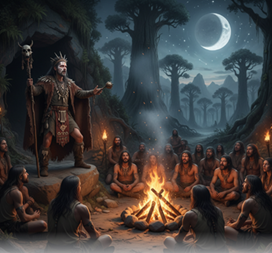
The practical effectiveness of knowledge (healing, calendars, forecasts) was amplified by stories that wrapped it in the supernatural. Not every “invention” was deceit; metaphors were often the only available language to explain the inexplicable. But those stories also fixed hierarchies—whoever spoke with spirits ruled.
Humans are prone to see intention where there is randomness, to connect scattered dots, and to prefer agent-based stories over equations. This tendency helped us become cooperative and creative, but it also made us receptive to tales of invisible guardians who reward and punish. Socialized belief legitimized rules, set taboos, and—most importantly—elevated certain people as privileged mediators.
Sumer and the Institutionalization of Religion
With Sumer, spiritual power became architecture, accounting, and law. Cities like Nippur, dedicated to the worship of Enlil, built temples (ziggurats), granaries, workshops, and schools for scribes. Religion moved from huts into the urban blueprint: the god’s house became the economic and legal heart of the city.
Tablets from Nippur and other Mesopotamian centers reveal two key traits of this new pact between gods, elites, and the people:
a) Power and dependence. The gods were mighty—but not fully self-sufficient. They needed offerings, houses, songs. Their “food” was the smoke of sacrifice and human obedience. They rewarded with fertility and victory; they punished with drought, plague, defeat. The cosmic order resembled a contract: humans serve, gods sustain.
b) Invisibility and mediation. Gods were not visible to the common person. They lived in temple statues, spoke through oracles or dreams. Only kings or high priests were authorized to “see” or “hear” them—and thus acted as divine interpreters. The Sumerian King List claimed that “kingship descended from heaven”—an elegant way to say that political authority was religious license.
This new system transformed the charisma of the shaman into a sacred bureaucracy. Truth was no longer a voice in the forest—it became a seal, a ledger, a procession, a hymn.
Infrastructure to Sustain the Narrative
To uphold this public “truth,” a vast infrastructure was built:
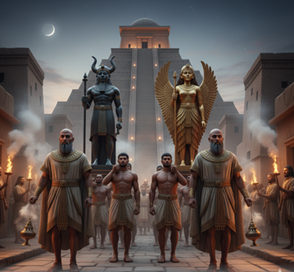
- Priestly class: Specialists in rituals, omens, calendars, and law, trained in edubbas (scribal schools). Reading and writing tablets became a monopoly of power.
- Network of temples and chapels: Economic hubs collecting tribute, managing land, employing artisans, distributing surplus. Piety turned into logistics.
- Festivities and rituals: Calendars filled with processions, power renewal ceremonies (royal enthronements, “sacred marriages”), purifications. Rituals made the invisible visible—therefore, unquestionable
- Early indoctrination: Hymns, proverbs, and myths memorized in childhood. Worldviews were instilled before critical thinking could emerge, making doubt feel like betrayal.
This wasn’t just a hoax—it was a sophisticated social technology for coordinating work, legitimizing decisions, and reducing uncertainty. That’s precisely why it worked so well.
A Prodigious and Replicable Invention
The formula—transcendent gods, exclusive mediation, moral sanctions, ritual infrastructure—proved incredibly effective at concentrating power. It was endlessly adapted: in Egypt with deified pharaohs and state cults; in Semitic kingdoms with laws “delivered” by deities; in empires blending theology and law for obedience; in monarchies ruling “by divine grace.”
Three ingredients made it nearly irresistible: legitimacy (power “comes from above”), predictability (reward/punishment codes), and economy (temples as redistribution centers). Whether a king’s stele showing divine investiture or a sacred-book oath, it was all the same melody: belief turns into obedience, obedience into order.
Decline of Centralized Religious Power and Rise of New Mediators
Literacy, printing, science, and education eroded the interpretative monopoly of traditional religious hierarchies. As more people read sacred texts for themselves, practiced skepticism, and cross-checked authorities, central control began to crack. Old churches lost much of their disciplinary grip.
But humanity’s inclination to delegate the sacred didn’t vanish—it morphed. Sects, charismatic teachers, gurus, lay prophets, and multimedia preachers flourished. Some offer meaning, community, and wellness; others replicate old asymmetries: grand promises, privileged access to truth, obedience traded for belonging, and opaque economies. Same psychology, new logos.
The Human Cost: Losing Direct Contact with the Divine
One silent result of centuries of mediated access is the symbolic disenfranchisement of divine connection. Millions have been taught that without a third party, their voice won’t reach, their ear won’t hear. This disenfranchisement rests on powerful meme-like ideas:
a) Absolute verticality and human inferiority. God above, humans below. Comparing oneself to the divine is blasphemy; aspiring to resemble God is arrogance. Internalized, this turns into self-denigration—“if I’m trash,” I can’t trust my conscience or experience.
b) Alien will and necessary mediation. God “wants” something from you—but since you can’t know it directly, you depend on someone to interpret it. Obedience shifts from Mystery to the interpreter’s voice. But God cannot have human desires—so how do priests, pastors, or gurus know “what God wants”?
This mindset has alienated humanity from its own spirituality, surrendering autonomy to those who claim to speak for the sacred.
Conclusion
Knowledge, belief, and power have been intertwined from the beginning. What started as shamanic wisdom became a system of control that persists today. The good news is that by understanding this mechanism, we can reclaim our right to a spirituality free from intermediaries. Because, ultimately, no one needs a priest, a guru, or a holy book to encounter the divine—they only need to turn inward with honesty and attention.
Reclaiming that direct relationship may be the quiet revolution still ahead.
Leave a Reply