Tag: visualization

Working with imagery, inner figures, yidam-style practice

  • Limits of Visualization: When Even Luminous Forms Dissolve

    After the initial discovery of visualization as a functional interface, the practice evolved into a daily discipline. This post documents the consolidation of that experience and the gradual realization of the limits of this practice—where even the most compelling internal figures must eventually dissolve.

    A Pleasant Stage — Containing the Seeds of Its Own Ending

    After discovering the overwhelming mental states induced by this visualization practice—which might be called Yidam, though it may not align perfectly with canonical definitions—I repeated the procedure daily. Soon, I realized the being I was fusing with was not a goddess, but the idealized memory of my first Tantric lover — the woman who had introduced me to those states long before I had any conceptual framework for them.

    Day after day, I saw her running toward me—her eyes filled with joy, her heart with love, her belly with lust—exactly the feelings I had experienced with her, and in my first visualization experiment. We fused in the deepest embrace, but this time, skin was no barrier. Our bodies overlapped, and every cell within me danced with the cell within hers, from head to toe. What followed had no adequate name — it contained lust, love, and joy, but dissolved the boundaries between them.

    This was an extremely pleasant stage in my journey, yet it contained the seeds of its own ending. As the practice evolved and reshaped my perception, the truth became evident: I was not fusing with anything—goddess or lover. I was simply discovering the real nature of this subtle body, hidden all my life and now unveiled. There was no “other” interacting with me. It was just me—to be precise, this pure consciousness free from thoughts, which had always been there and had nothing to do with the “mundane me” made of thoughts, fears, and desires. This seemed to be a different mode of ‘me’ — one less entangled in narrative — finally integrating with the felt sense of the body.


    Changes in Perception

    As the fusion extended across what internal alchemy traditions call the three dantians, distinct perceptual shifts became apparent.

    At the level of the lower dantian, sexuality lost its binary character. The energetic body revealed itself as neither male nor female — or perhaps as containing both polarities simultaneously. Biological sex remained a fact, but it no longer defined the structure of experience.

    At the level of the middle dantian, what had initially appeared as intensified love transformed into something more spatial than emotional. A strange feeling of spaciousness—like watching the starry sky from a mountaintop, yet feeling I could touch the stars, as if a subtle veil separating near from far had been removed. Love, typically structured as a relation between self and other, shifted toward a perception of inevitable interconnection once experiential space ceased to function as a barrier.

    At the level of the upper dantian, fusion expressed itself as joy — not private satisfaction, but shared exhilaration. The closest ordinary analogue would be the collective surge when a team scores a decisive goal, or when a crowd sings in unison. In those moments, individual identity briefly relaxes and a larger coherence takes precedence. The joy was of that nature: distributed rather than owned.

    These shifts did not prove anything metaphysical. They demonstrated how radically perception can reorganize when identity becomes fluid.


    Taking Possession of the Energy Body

    Eventually, however, the figure faded.

    The lover, the goddess, the dakini — all dissolved. What remained was a persistent sense of energetic coherence without a relational counterpart. One duality had collapsed: there was no longer an “other” to fuse with. The qualities previously attributed to her were now recognized as intrinsic potentials within my own experiential field.

    Yet this resolution generated a new tension. From this expanded, less localized mode of embodiment, there emerged an impulse to extend the same fusion outward — not toward a human partner, but toward reality as a whole. Energy no longer seemed directional. It appeared to arise from everywhere at once.

    It would have been easy to interpret this as movement toward something “divine.”

    More cautiously, I would say this: the configuration began to resemble what many traditions describe as divine — boundaryless, sexless, interconnected. Whether that resemblance reflects ontological truth or the nervous system’s capacity for large-scale integration remains an open question.

    The experience was convincing. Convincing experiences, however, are not the same as verified conclusions.


    Balancing Yin and Yang

    A final corrective emerged in a later internal image of my dakini. This time, she was not the soft, feminine lover of the first stage, but a warrior princess wielding her sword, full of power, boldness, and assertiveness. The symbolism was transparent: in leaning deeply into receptive (yin) qualities, I had overcorrected. If androgyny was the goal, it required dynamic balance, not identification with one pole.

    That marked the end of this pleasant but incomplete stage.

    The scaffold evolved into a powerful reinforcement loop before dissolving. Recognizing the limits of this practice led to a clearer understanding of how imagery and identity co-construct one another, and why even the most luminous forms must be relinquished.


  • Imagery as Energetic Interface: Visualization Without Belief

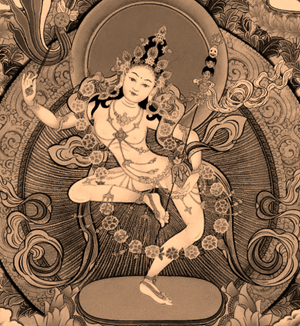
    After the internal architecture of sensation dissolved into a more permeable, field-like structure, new forms of practice became possible. This post documents one such experiment. What Tibetan traditions would call a yidam entered my practice not as an object of devotion or visualization, but as the use of imagery as an energetic interface—an imaginal scaffold that allowed overwhelming energetic dynamics to integrate coherently.

    The Initial Skepticism

    When I first encountered the concept of a yidam, I understood it as a visualization practice—imagining something until it eventually became experiential. This clashed with my perspective on several levels.

    First, I was already experiencing extraordinarily intense sensations through my Tantric sex practice. Why imagine something when I had direct access to the experience itself? Second, my own observation was that mental activity tended to suppress sensation; so deliberately engaging the mind—after having learned to quiet it—felt like a step backward. Third, my stubborn atheism made “deity worship” unthinkable. The practice seemed entirely out of reach.

    Then came a pivot point. A respected friend on a forum offered a technical clarification:

    “True deity practices are not about visualizing an imaginary being, but actually connecting to one. The energy of the being manifests in your local mind-space. Any images or visions arise naturally as the mind gives form to overwhelming energetic flows.”

    This description of “connection” resonated immediately. In 2017, with my partner-based practice on hold, I decided to experiment by using imagery to bridge the gap. I focused on one stand-out principle: “Your own essence and the deity’s essence are indivisible.”


    The Fusion Protocol

    So I decided to experiment with fusion using the figure of a goddess. I did not place her on a pedestal to worship her. Instead, I approached the exercise as an operational test: could I reproduce, internally, the same kind of fusion I had previously experienced in Tantric sex — the only phenomenological framework I truly understood?

    The effects were immediate and intense. The familiar yin–yang dynamics I had experienced with my human partner re-emerged with remarkable clarity. However, the usual sense of bodily separation began to dissolve. Rather than two distinct bodies interacting, there was a shared experiential field: I felt her within my perceptual space, and myself within hers.

    Visualization soon became unstable. When attention shifted toward the expansive, outward (yang) component, she appeared distinctly external — clearly “out there.” Yet the simultaneous presence of the contractive, inward (yin) component inverted the frame of reference, as if the experience were unfolding from within her perspective. The conventional distinction between inside and outside gradually lost structural coherence.

    This led to a significant realization. The “feminine” sensations I had previously attributed to my partner were not imported from outside. They were accessible within my own system. No external proxy was required to enter that androgynous configuration.


    From Sex to Love to Joy

    As in Tantric practice, the fusion was initially strongest from the diaphragm downward — what internal alchemy traditions call the Lower Dantian. The next step was deliberate: extend the fusion upward, toward the heart.

    If the lower register operates at the frequency of sex, the heart operates at the frequency of love. Not domesticated affection, not attachment, but something less conditioned. I attempted to isolate the pure “signal” of love, abstracted from any specific person, narrative, or memory. Stripped of biography, what remained was a quality — an open, non-defensive warmth without an object.

    When attention stabilized on that signal, a powerful wave propagated through the chest. The experience was intense, almost overwhelming — a systemic surge rather than a localized sensation. The two presences no longer felt like interacting bodies, but like differentiated aspects within a single energetic configuration. If I saw her as a goddess, one might call it prayer. Operationally, it was resonance.

    Weeks later, however, a structural asymmetry remained. From the heart downward the fusion felt coherent, but above that level it resembled a single organism with two cognitive centers. The question became almost technical: what human analogue corresponds to fusion at the level of the head?

    The answer emerged through the eyes. In the inner representation, her eyes were the only sharply defined feature. In a brief, almost magical shift, I perceived a spark of joy there. The reaction was immediate: a powerful surge entered through my own visual field and flooded the head — not as sexuality, not as love, but as unfiltered joy.

    The key realization was simple and destabilizing at once: her joy and my joy were not two events in exchange. They felt like the same event, perceived from different reference points. This shared joy was the missing parameter.


    The Scaffold

    I still wonder what truly happened. Against my own convictions, I undeniably perceived those eyes — as if something external were addressing me. The experience carried a persuasive realism that remains difficult to dismiss.

    My working hypothesis remains conservative: this was likely a biological interface through which the nervous system metabolized intensity. Regardless of its ontological status, the temporary assumption of duality — myself and the goddess — proved operationally effective. Using imagery as an energetic interface functioned as a scaffold, a provisional structure that allowed the system to stabilize and reorganize under conditions of high charge. Once integration was achieved, the scaffold was no longer necessary.

    Years later, that dual framing dissolved on its own. There was no goddess and no separate self, only a unified process without internal division — at least at the level of experience. But that development belongs to another discussion.