Tag: sources

Analysis of traditional texts and historical maps

  • Teresa of Ávila and Qi: Christian Mysticism Meets Daoism

    A comparative exploration of Teresa of Ávila and qi cultivation, revealing how Christian mysticism and Daoist alchemy share stages of inner transformation beyond doctrine.


    Teresa of Ávila, the 16th-century Spanish mystic, described her inner path through a metaphor drawn from agriculture: watering a garden. The soul was the soil, and divine grace the water that allowed it to bear fruit. Read today, this imagery resonates strongly with concepts found in Daoist inner alchemy, particularly the notion of dan tian (丹田). The word tian literally means “field,” and in Daoist practice it refers to specific regions of the body where vital essence is cultivated through sustained attention and embodied discipline.

    What makes Teresa’s metaphor remarkable is not just its poetic force, but its functional precision. Her descriptions unfold as a process, a gradual refinement of effort, structure, and surrender that closely mirrors the stages of energetic cultivation found in Daoist and Tantric traditions.


    The Metaphor of Cultivation: From Effort to Wu Wei

    In her account, Teresa distinguishes four modes of watering the inner garden: drawing water manually from a well; channeling it through mechanical means; allowing it to flow from a river; and finally receiving it as rain from heaven. These stages trace a clear trajectory from exertion to effortlessness.

    “Paréceme a mí que se puede regar de cuatro maneras: o con sacar el agua de un pozo, que es a nuestro gran trabajo; o con noria y arcaduces… o de un río o arroyo… o con llover mucho, que lo riega el Señor sin trabajo ninguno nuestro, y es muy sin comparación mejor que todo lo que queda dicho.”

    A similar progression appears in Daoist internal alchemy (neidan). Practice begins with intentional activation of qi through breath, posture, movement, and focused attention. This phase is laborious and requires persistence, much like hauling water from a deep well. As sensitivity increases, practitioners work on opening and regulating the channels through which energy flows, analogous to building aqueducts or waterwheels that reduce effort while increasing reach. With time, circulation becomes spontaneous: energy moves on its own, like a river following its course. Finally, there is a stage where practice ceases to feel like practice at all. Energy descends, spreads, and permeates without deliberate intervention.

    This final phase corresponds closely to the Daoist principle of wu wei: non-forcing, non-doing. The practitioner no longer directs the process but allows it. Teresa’s “rain” and the Daoist experience of effortless circulation point to the same realization: technique prepares the ground, but completion arrives on its own terms.


    Sensual Pleasure and the Body as a Site of Revelation

    Teresa’s descriptions of union with the divine are intensely bodily. They involve trembling, heat, sweetness, pain, and surrender—sensations that blur the line between spiritual rapture and erotic experience. This dimension of her mysticism has long unsettled interpreters, especially within a tradition wary of bodily pleasure.

    In Daoist alchemy and Tantra, however, such experiences are not anomalous. Sensual intensity is not treated as a distraction but as raw material. The body is not an obstacle to transcendence; it is the medium through which transformation unfolds. Pleasure, when refined and circulated rather than discharged, becomes a vehicle for expanded awareness.
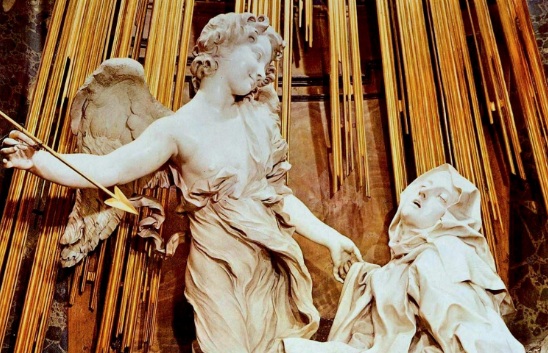
    Bernini’s Ecstasy of Saint Teresa (1652).

    Teresa lacked the conceptual language to frame these sensations outside a theological context, and her historical circumstances demanded caution. Yet her descriptions suggest an embodied knowledge that exceeds doctrine. What she experienced was not abstract belief but a physiological and perceptual transformation, one that aligns closely with energetic traditions where ecstasy, heat, and dissolution of boundaries are recognized stages of inner work.

    “Veíale en las manos un dardo de oro largo… Era tan grande el dolor, que me hacía dar aquellos quejidos, y tan excesiva la suavidad que me pone este grandísimo dolor, que no hay desear que se quite, ni se contenta el alma con menos que Dios.”

    Seen from this angle, her mysticism appears less as an exception within Christianity and more as a culturally constrained expression of a universal embodied process.


    A God One Does Not Ask: Prayer as Presence

    As Teresa’s practice matured, she arrived at a conclusion that quietly subverted the dominant religious model of her time: prayer was no longer about asking, pleading, or negotiating. It became a state of presence rather than an act of will.

    “Ya no se trata de pedir, sino de entender que está Él con el alma y el alma con Él.”

    This shift is crucial. The divine was no longer something external to be persuaded or appeased, but something already present, encountered through stillness and receptivity. Effort gave way to intimacy. Desire softened into attention.

    This understanding closely parallels the Daoist view that alignment with the Tao does not arise through striving, but through yielding. One does not compel harmony; one stops interfering with it. In both cases, the practitioner discovers that the deepest form of communion occurs when intention relaxes and the sense of a separate agent diminishes.

    Teresa’s surprise at this realization suggests how far her lived experience had carried her beyond inherited frameworks. What remained was not doctrine, but a direct mode of knowing—quiet, unmediated, and internally verifiable.


    Conclusion

    Taken together, these elements point toward a shared structure underlying mystical experience across cultures. Whether articulated in the language of divine grace or vital energy, the path follows similar contours: disciplined engagement, bodily transformation, surrender of control and, in some cases, a final resting in what no longer feels separate.

    Teresa’s wells, channels, rivers, and rain are not merely devotional images. They function as a precise cartography of inner change. Read alongside Daoist internal alchemy, they suggest that spiritual realization is not owned by any single tradition, but arises wherever attention, body, and perception are refined enough to meet it.


  • The Three Layers of the Self: Where Western Psychology Meets Meditation

    This post proposes a model of the three layers of the self, synthesizing Western cognitive science with meditative phenomenology. The model is offered as a useful map, not as established fact. Where the post moves into speculation — particularly regarding the persistence of consciousness beyond biological death — I mark those as open questions, not conclusions.


    The Narrative Self: The Social Interface We Mistake for Identity

    The narrative self is the most visible layer — the one we defend, polish, and present to the world. It is built from autobiographical memory, language, cultural norms, social expectations, roles and identities, the stories we tell about ourselves.

    This is the “I” Freud analyzed through the Ego and Superego, the “project” Sartre said we are condemned to create, and the “self-concept” Rogers tried to align with lived experience.

    But modern cognitive science has made something very clear: The narrative self is not the true self. It is a social interface.

    Psychologists like Dan McAdams describe it as a life story we continuously rewrite. Neuroscientists such as Michael Gazzaniga show how the brain invents explanations for our actions after the fact — a storyteller, not a commander. And philosophers like Daniel Dennett argue that the self is a “center of narrative gravity,” a useful fiction.

    If a self changes when we change language, culture, or social context, it cannot be essential. It is software — installed after birth, updated daily, and often buggy.


    The Minimal Self: The Biological BIOS

    Beneath the narrative lies something older and simpler: the minimal self. This is not a story. It is a felt sense: “This is my body.” “I am here, not there.” “I am the one moving this hand.” It is pre-verbal, pre-conceptual, and shared by babies, animals, and humans alike.

    Philosopher Shaun Gallagher defines it as the pre-reflective sense of ownership and agency. Neuroscientist Evan Thompson describes it as the embodied structure of experience itself. Even Thomas Metzinger — who famously argues that “nobody ever was or had a self” — acknowledges that the minimal self is a stable biological model the brain uses to navigate the world.

    This is the layer Jung came closest to articulating. His Persona maps neatly onto the narrative self. His Ego overlaps with the minimal self. And his Self — the deeper organizing principle — hints at something beyond both.

    The minimal self is our BIOS: the pre-installed routines that allow consciousness to inhabit a body.

    But even this is not the core.


    Consciousness: The Layer Science Cannot Explain

    Strip away the narrative self. Quiet the minimal self. What remains is not a “self” at all. It is consciousness — the bare capacity to experience.

    This is not a belief. It is an observable fact in meditation: when thoughts stop and the sense of “me” fades, awareness remains. It is also a scientific mystery. Neuroscience can correlate brain activity with conscious states, but it cannot explain why consciousness exists at all.

    This is the “hard problem” articulated by David Chalmers: why should matter give rise to experience? Why should there be something it is like to be anything?

    Some contemporary hypotheses suggest that consciousness may be:

    • A fundamental property of the universe (panpsychism: Galen Strawson, Philip Goff).
    • An intrinsic aspect of information itself (Integrated Information Theory: Giulio Tononi).
    • A field-like phenomenon not fully reducible to neurons (various quantum-inspired models, cautiously explored by Stuart Hameroff and Roger Penrose).

    We know how consciousness behaves. We do not know what it is. Just like time. Or mass. Or space.


    Where Meditation and Science Converge

    Meditation does not solve the hard problem, but it reveals something crucial: Consciousness persists even when the sense of self dissolves.

    In deep practice — whether through qigong, Yidam visualization, or silent absorption — the narrative self falls away. The minimal self softens. The boundary between “me” and “world” becomes porous or disappears entirely.

    Yet awareness remains.

    This is why meditative traditions across cultures converge on similar insights. In Daoism: the return to the Dao, the uncarved block. In Buddhism: anatta, the absence of a self. In Hindu traditions: Atman = Brahman, the identity of individual and universal consciousness. In Christian mysticism: dissolution into the Ground of Being (Meister Eckhart).

    What these traditions share is a common observation: The self is not the experiencer. The self is an appearance within experience.


    The Final Step: The Self as a Three-Layer Illusion

    If we put all this together, a radical but coherent picture emerges: The narrative self is a cultural construction. The minimal self is a biological construction. Consciousness is not a self at all — it is the field in which both constructions appear.

    And when the body dies?

    The narrative self dissolves.
    The minimal self dissolves.
    But consciousness — if it is fundamental — may not.

    And here the mind begins to speculate — perhaps to hope:

    Could consciousness re-enter another organism ?
    Could it merge with something larger?
    Could it persist without form?

    I notice the pull toward these possibilities. I cannot claim they are more than that: a pull.


    Conclusion: The Last Illusion

    The deepest insight shared by meditation and modern cognitive science may be this: what we call “self” appears to be a construction — narrative and biological — within a field of awareness whose nature remains unexplained.

    Whether that awareness is fundamental, universal, or simply the last illusion before silence — I do not know. But the question, once seen, does not disappear.


  • The Chakra System Symbolism: Beyond the Standard Map

    When I first experienced the sensation, the Buddhist chakra system seemed to be the right map of what I was feeling. But as my practice unfolded, I realized that interpreting the chakra system symbolism was the only way to reconcile ancient texts with the far more complex, 15-level network I was actually feeling. What follows is not a refutation of tradition, but an attempt to understand where experience aligned with the texts, where it didn’t, and what that might mean for the way we read them.

    When Maps Seemed to Fit

    Like many, I was familiar with the popular New Age Buddhist chakra system: seven neatly stacked chakras (seven being a “cool” number, though traditional texts vary), each with a distinctive color, running from the perineum to the crown. According to this model, they are aligned along the spine and promise miraculous effects once they are “opened.” The practice was presented as a linear progression: open them one by one, starting with Muladhara, and when you finally reached the crown, enlightenment was supposedly attained.

    I was also aware of the three channels — the central Sushumna, flanked by Ida and Pingala with their peculiar crisscrossing pattern, often associated with the caduceus and other esoteric interpretations.


    The First Discrepancies

    When I first felt the sensation exactly where the Buddhist chakra system depicts the first three chakras, I believed my experience fit this schema perfectly. But discrepancies soon emerged.

    As my practice progressed, I discovered far more nodes where I could feel the sensation — not only along the spine but throughout the body. Furthermore, the clear feeling of flow suggested these “chakras” were open, yet no miracles occurred. I was particularly apprehensive about moving the sensation to the crown; if this constituted “opening” it, I expected something extraordinary, for better or worse. When I reluctantly directed my attention there and felt the sensation, nothing special happened. I heard no Tibetan trumpets of the Apocalypse.

    This led me to a critical realization: either I wasn’t “opening” them correctly, or the supposed effects were not to be taken literally.


    The Crisscrossing Mystery

    Another source of confusion was the distinctive crisscrossing of Ida and Pingala. When I discovered my own lateral energy channels, they appeared as straight lines. The energy flowed vertically from one node to the next, up or down; it did not jump from right to left or vice versa.


    A Body of Many Levels

    Now, seeing that at each supposed chakra level there isn’t a single node but a constellation of eight — and discovering a total of fifteen levels instead of seven (including the extremities, which are entirely neglected in the classic model) — I concluded that the chakras are indeed located where the sensations occur, but their common descriptions are largely symbolic.

    To me, they map stages of progress, but each stage must be cultivated throughout the entire network of the body, not at a single point.


    The Elements Revisited

    The first clue was the qualities attributed to the lower chakras: Muladhara to earth, Swadhisthana to water, Manipura to fire, and so on. This progression mirrored the evolving quality of the sensation itself as it refined — first viscous like lava, then fluid like water, next like a burning fire, then like air clearing the ashes, until it became so subtle that “ether” seemed a fitting description.

    But this refinement was not confined to specific chakras. Muladhara, like all the others, began viscous and, through years of training, became ethereal. Swadhisthana did not begin fluid; it too followed the same path of refinement. The same was true for every node in the system.


    Beyond Miracles

    Similarly, the supposed miraculous effects were not tied to specific body areas but to stages in the perception of the energy body. I would say that “Levitation” was not physical but the internal sensation of zero gravity. The experience of being “as large as a mountain or as small as a grain of sand” described profound shifts in spatial perception.


    The Missing Legs

    Another puzzling omission was the neglect of the chakras in the legs, sometimes called the “lower chakras” in rare references and often linked to our primal, animal nature. Reading these texts felt like seeing Hic Sunt Dracones — here be dragons — a territory better avoided. Had I followed that advice, I would never have achieved the full integration of energy throughout my body.

    My interpretation is again symbolic: before serious practice, one must master the basic instincts. This is the spirit of the often-skipped yamas and niyamas, which instruct us to approach practice without desires for power, recognizing our shared identity with others, and cultivating empathy and compassion.


    The Practical Purpose of the Crossing

    Finally, the classic crisscrossing of Ida and Pingala does not match my direct experience, where energy flows straight along the path of least resistance. In light of the procedures necessary for more advanced stages, I now see this is not an anatomical map, but a functional instruction. Interpreting the chakra system symbolically was for me the way from looking for miracles to mastering the practical procedures that awaken the central channel. It see it not as an anatomical description but as a practical instruction: to get results, don’t just move energy straight up the sides; consciously cross it from one lateral channel to the other.

    This trains two opposing nodes simultaneously, a necessary condition for activating sensation in the central channel — where, in my experience, the practice shifted qualitatively. If you follow a straight path, you’ll miss the party.


  • History of the Evolution of Dual Cultivation

    Where do we place the body and its energies on the spiritual path? The history of spirituality reveals a deep schism between external obedience and internal discovery. This is the history of the evolution of dual cultivation—a journey from the temples of ancient gods to the direct mapping of the human nervous system.

    The Era of Divine Rulers and Obedience

    The earliest organized religions, which developed alongside the first complex civilizations (Mesopotamia, Egypt, etc., beginning around 3500 BCE), established a clear hierarchy:

    • The Concept: Gods were omnipotent and moralizing entities who rewarded obedience and punished transgression. This belief system likely served as a crucial social adhesive, enabling cooperation within newly formed large societies.
    • The Power Structure: Spiritual access was strictly controlled by an organized priestly caste. These priests either held political power themselves or operated in close alliance with rulers, acting as indispensable intermediaries between the finite human and the infinite divine.
    • The Human Role: Humanity’s primary function was to obey. The human condition was viewed as inherently and perpetually inferior to the majesty of the gods.

    The Turn Inward

    Around the first millennium BCE, a quiet revolution unfolded across several civilizations. Figures such as Siddhartha Gautama, Laozi, Mahavira, and the authors of the Upanishads began to shift the focus from worship to direct inquiry.

    Divinity was no longer a being to be pleased, but a condition of mind to be realized. In early Buddhism, the goal was not communion with gods but liberation from ignorance. In the Upanishads, the self (ātman) was said to be identical with the cosmic principle (brahman).

    Meditation, not sacrifice, became the primary means of access to truth. While the goal (nirvana) is not “divinity” in the creator-god sense, it implies a realization of one’s ultimate nature — a state free from suffering and illusion.


    The Hidden Current: The Power of Energy

    While Buddhist traditions emphasized purely mental methods, the broader spiritual landscape of Asia already included practices centered on subtle energy:

    • Pre-Buddhist Practices: Concepts such as prana (vital breath) in early Indian texts (Upanishads) and (life force) in early Chinese Daoism predate — or at least parallel — the time of the Buddha. It is highly likely that simple breath-control and energy-based exercises were already widespread.
    • The Secret Technique: These energy-oriented practices offered a powerful aid to meditation. They provided a much more effective physical anchor than mere observation of breath or thought. By focusing the mind on the movement or sensation of prana/qì, practitioners could establish a stable point of concentration, allowing meditation to become both deeper and more efficient.
    • The Pleasure Trap: The principal merit of this method lies in its effectiveness as an anchor. While the sensation of cultivated or prana can be intensely pleasant — even blissful — this is merely a byproduct. For serious practitioners, that pleasure must be transcended, as the true goal remains direct perception of reality (prajna or insight).

    Institutionalization and the Marginalization of Energy

    The need for unified religious structures often led to the standardization and simplification of spiritual practice.

    • The Third Buddhist Council (c. 250 BCE): Under the patronage of Emperor Ashoka, this council helped establish the Pali Canon — the foundation of the Theravāda school — which codified a tradition focused primarily on mental discipline and moral conduct.
    • A Political Dimension: While the Canon’s core purpose was doctrinal, its establishment allowed Buddhism to become a state religion. From a critical perspective, the emphasis on purely mental and monastic methods — mediated by monks — may have served to maintain a necessary distance between ordinary people and the profound power of spontaneous spiritual realization.

    The Return of the Body

    Despite official disapproval, bodily methods never disappeared. In both Daoist alchemy and Vajrayāna Buddhism, a parallel current re-emerged: the theory of dual cultivation — sexual or energetic union as a means of spiritual transformation.

    In Daoism, such practices appeared as early as the second century CE and matured into the internal alchemy of the Tang and Song periods. In Tibetan Vajrayana, similar techniques were integrated into esoteric yogas of energy and bliss. Both traditions were often condemned by orthodox lineages, which preferred celibate over embodied experimentation.

    The real merit of dual cultivation, however, was not its sensuality but its precision as a meditative tool. The sensation of — subtle yet distinct and often pleasurable — offered an anchor far more tangible than abstract concentration. Once the initial fascination with pleasure (the pleasure trap) subsided, what remained was its true function: a steady focus that deepened awareness and gradually transformed perception itself.


    Suppression and Preservation

    By the seventeenth and eighteenth centuries, particularly under the Qing emperors Yongzheng and Qianlong, sexual alchemy was officially banned as an “obscene practice.” Dual cultivation retreated into secrecy, surviving only in small circles of Daoist hermits and, more visibly, in Tibetan Tantric monasteries — where, ironically, it sometimes became an instrument of institutional power.

    The Tibetan Vajrayana, while preserving these techniques, often built a rigid clerical system around them – reintroducing the very intermediation the path had sought to transcend. The same pattern repeated: techniques of liberation reabsorbed into structures of authority.


    The New Age and the Commercialization of the Self

    The most recent chapter is the arrival of these techniques in the modern West, largely through the New Age movement.

    • Adoption and Dilution: The New Age eagerly adopted elements of Eastern spirituality — meditation, Qigong, Tantra — but often decontextualized or misunderstood them.
    • The Consumer Path: These practices were commercialized and repackaged as “self-help” or “wellness” methods, prioritizing comfort, health, and personal success over the rigorous path toward insight and liberation. The “pleasure trap” became, in many ways, the entire focus of the commercialized versions.

    Closing Reflection

    Spirituality oscillates between inner discovery and external control. When viewed through the lens of the evolution of dual cultivation, the movement is clear: we are shifting the source of authority from outside dogmas to the verified, internal data of the practitioner.

    This overview is not a theory of how things should be — only how they appear when viewed side by side across time. From gods to breath, from obedience to awareness, from temples to nervous systems — the underlying movement seems less about belief than about where we locate authority: outside, or within.

  • Interpreting the Three Treasures

    Ancient Daoist texts described the “Three Treasures” as essence, energy, and spirit. However, for the modern practitioner, interpreting the three treasures is a task of decoding biological metaphors rather than taking ancient language at face value. This piece explores how misunderstanding these symbols distorts genuine cultivation—and how returning to direct experience restores their meaning.

    According to the classics, the Three Treasures—or San Bao (三宝) in Chinese—are three essential energies or substances that sustain human life and represent the foundational layers of our existence. They are:

    • Jing ()Essence / Vital Base: The most fundamental, dense, and physical form of energy.
    • Qi ()Energy / Life Force: The vital force that flows through the body.
    • Shen ()Spirit / Consciousness: Our awareness, mind, and emotional balance.

    Jing is the foundation for Qi, and Qi is the foundation for Shen. A weak Jing leads to deficient Qi, which in turn results in an unanchored or disturbed Shen. The ultimate goal in many internal alchemy (Neidan) practices is to refine and transmute these substances upward: to conserve Jing and transform it into Qi, and to purify Qi to nourish and refine Shen—leading to spiritual awakening and longevity.


    Energy, Orgasm, and Misunderstanding

    In practical terms, Qi corresponds to the neural activity perceived as an orgasmic sensation, and Jing refers to the seminal fluid. The practice consists of maintaining the feeling while avoiding ejaculation (in men) and guiding that sensation upward along the spine — a process described in the classics as the reversal.

    This ascending sensation feels like a current. The authors of these theories — unaware of the nervous system — observed that ejaculation ended the feeling. From this correlation, they concluded that the sensation was sublimated Jing, renamed Qi. Modern physiology clarifies the misunderstanding: what they perceived as a “flow of energy” is in fact the propagation of neural and autonomic signals along the spine. The emission of semen merely ends the feedback loop that sustains the feeling. Correlation was mistaken for causation.


    The True Function: Training Consciousness

    Once the decoupling of orgasm from ejaculation is achieved, Jing is out of the game. The only remaining actors are the feeling and the awareness—Qi and Shen, or however one prefers to name them. The sensation acts as a powerful anchor for meditation, training awareness to focus and release thought. This concentrated awareness, in turn, amplifies the sensation — a virtuous cycle. This is the essence of dual cultivation. The goal, as these traditions describe it, is a refined Shen — a consciousness less entangled in narrative and reactivity. Whether this reveals a ‘true nature’ or simply a different mode of processing remains an open question.

    As focused attention is the key, overthinking the theoretical concept of “Jing” becomes a distraction that halts progress.


    Literalism and Its Dangers

    Yet even today, some take the ancient writings literally — with disastrous consequences. I’ve seen online forums where self-proclaimed teachers advise “reabsorbing” semen, inspecting urine for turbidity, or even inserting a cannula into the urethra to “train the bladder to absorb fluids,” citing legendary masters who allegedly ingested mercury. No further comment is needed on this level of absurdity.


    The Myth of Loss

    A related misreading concerns the classic injunction to “avoid losses.” The real message was simple: avoid ejaculation to sustain the feeling. This is the meaning of the phrase, “If the plum has not yet blossomed, it is too early; if it has already blossomed, it is too late.” There is a narrow window of opportunity to “catch” the Qi — during the first stirrings of orgasm, before ejaculation. If ejaculation occurs, it is not a catastrophe; it is merely a missed opportunity. There will be many more, as Jing (semen) is continually replenished by the body.

    Once the skill is stable, occasional losses are inconsequential. In my Tantric practice, such episodes simply made my body temporarily more yin — more receptive — in the next session, which was actually beneficial. Yet many practitioners treat ejaculation as a disaster, believing it erases weeks of effort. In my opinion, this anxiety is unfounded. The body naturally releases excess fluid during nocturnal emissions when full — a physiological fact, not a spiritual failure.


    The Gender Bias and Its Origins

    The distortions reach their peak when addressing women. Since women do not ejaculate, ancient theorists asked: what, then, is their Jing? The answer they proposed was menstrual blood. From there arose the absurd conclusion that women, because of their “monthly losses,” were less capable — or even incapable — of spiritual attainment.

    Beyond its misogyny, this reasoning may have been politically convenient. In ancient China, dual cultivation was often linked to martial training — a strategic resource before gunpowder. Women commonly married into other clans, sometimes potential rivals. Restricting their access to energetic techniques was a form of secrecy, not metaphysics.

    Yet this bias persisted for centuries, despite the evident fact that women are often better suited to sustaining the orgasmic flow. Their physiology supports multiple orgasmic modes — the clitoral (explosive, similar to male ejaculation), the G-spot (absorptive), and the cervical (deeply enveloping).


    A Grounded Conclusion

    From my experience, the principle is simple:

    • The essence of the practice is to sustain the energetic current as long as possible and move it with the attention.
    • This requires avoiding ejaculation while maintaining the feeling. If it happens, you will have plenty of opportunities, simply start again.
    • Seminal losses are natural. Don’t worry, your body replenishes it continuously for many years, and losses don’t harm your abilities once you get them.
    • Far from being a limitation, the female physiology offers a head start in inner alchemy. 

    In the end, correctly interpreting the three treasures reveals they are not substances to be hoarded, but stages in what feels like a refinement of awareness—from gross sensation to subtler perception, from agitation to relative stillness.


  • The Huiming Jing (慧命經) – On Weaving Consciousness and Vital Energy

    The Huiming Jing (慧命經), written by Liu Huayang in 1794, is a rare synthesis of Buddhism and Daoism. It bridges the cultivation of awareness and the refinement of the body, proposing that weaving consciousness and vital energy is the primary ‘warp’ of human realization.

    The Meaning of 慧命經

    A literal translation of 慧命經 (Huì Mìng Jīng) would be The Canon of Wisdom and Life. However, as is often the case in classical Chinese, a deeper meaning is hidden within its characters—each carrying layers of symbolic and philosophical nuance.

    • 慧 (Huì) means “wisdom,” equivalent to prajñā in Buddhist terminology. In this context, however, it does not refer to intellectual understanding but to transcendent, non-conceptual awareness—the Primordial Spirit (元神, Yuánshén). To cultivate Huì is to purify and stabilize Shén (神), which in practical terms refers to consciousness itself.
    • 命 (Mìng) is usually translated as “life,” “destiny,” or “vitality.” In neidan (internal alchemy), it represents the vital aspect of being—the manifestation of our essential energies, rooted in Essence (精, Jīng) and Vital Force (氣, ). To cultivate Mìng is to strengthen, refine, and preserve these energies—the life of the body and its animating principle.
    • 經 (Jīng), commonly rendered as “classic” or “scripture,” originally meant “warp,” the fixed, lengthwise threads in a loom upon which the weft is woven. Its later use to denote canonical texts is metaphorical: these teachings are the warp onto which the threads of practice are interwoven.

    Thus, the title Huiming Jing could also be understood as “Weaving consciousness and vital energy.” Interestingly, the Sanskrit word Tantra (तन्त्र) literally means “loom,” “warp,” or “weave.” Tantra, too, is defined by integration—of the mundane and the sacred, the masculine and the feminine, wisdom (prajñā) and method (upāya). These are the “threads” woven into a single fabric of realization.

    This bold integrative vision—uniting body and spirit—was the path championed by Liu Huayang, who called it “dual practice.” It stood in contrast to the prevailing Chan orthodoxy of his time, which, although rooted in the Mahāyāna ideal of non-duality, often emphasized an ascetic, mind-only approach reminiscent of Theravāda.


    The Historical Context: A Banned Practice

    The Huiming Jing was published in 1794, sixty-two years after the Yongzheng Emperor’s edict of 1732, which banned what he termed the “Dual Practice of the Mind School and the Law School” (心智雙修 / 宗教雙修). The emperor—himself a devout Buddhist—favored a highly orthodox form of Chan. He argued that dual cultivation led to “disregarding the monastic rules and neglecting the teachings of the patriarchs,” framing it as a moral and spiritual corruption that threatened both religious and social order.


    Liu Huayang’s Response and Vision

    In response, Liu Huayang composed the Huiming Jing to demonstrate that both the Chan and Daoist paths ultimately aimed at the same realization, and that dual practice was in fact the more effective means. In his introduction, he cites his teacher Hu Yun:

    “The dual cultivation of Buddhism has now been severed and extinguished. You must continue its lifeline, in order to ferry across those who have affinity.”
    (佛教雙修,今已斷滅,子當續其命脈,以度有緣)

    He then openly criticizes the degeneration of Chan orthodoxy:

    “I have observed that those who seek the Dao mostly take the Recorded Sayings (Yulu) as their authority. Yet within these records, there are truthful words and reckless words. Those of shallow learning, not knowing the Tathāgata’s Dao of Huiming, mistakenly cling to slogan-Chan (taoyu Chan), becoming the lowest of fools and harming themselves through these recorded sayings.”
    (余見世之求道者,多宗語錄,而語錄中有實語者,有妄語者,彼下學不知如來慧命之道,誤入套語禪,終為下愚,轉受語錄之害)

    Declaring his purpose, Liu Huayang writes:

    “I have drawn diagrams and established images, opening the secrets of the ancient Buddhas and revealing the primordial pivot of the patriarchs. It is truly a ladder and a raft to receive and guide later learners.”
    (故纂集是書,命曰慧命經,畫圖立相,開古佛之秘密,洩師祖之元機,洵接引後學之梯筏也)

    He even goes so far as to claim that his book alone is sufficient for enlightenment:

    “Using simple and direct words, I have taken the treasure of the Buddha and laid it all out completely. Learners who encounter this 慧命經 will feel as though it were a personal transmission. They need only to strengthen their will, refine their energy, and practice diligently; it will not be necessary to seek other teachers. Thus, Buddhahood can be realized immediately.”
    (今以淺率之言,將佛寶流傳,和盤托出,俾世之學者,睹此慧命經,即若親口相傳,只須勵志精勤,不必他山求助,則佛果可以立証,此余苦心求師悟道之本願也)

    In other words, Liu claims that the Huiming Jing contains all the necessary teachings for realization—an assertion both bold and controversial. Personally, I find this unlikely, much more for those who have not directly experienced (rather than merely imagined) the energy dynamics he describes. Still, it is a remarkable and audacious statement of spiritual autonomy.


    Finding the Text Today

    I first encountered the text through James Michael Nicholson’s 2000 master’s thesis, The Huiming Jing: A Translation and Discussion (University of British Columbia), available through UBC Library Open Collections. The full classical Chinese text is also accessible on ctext.org, where it can be read online, machine-translated, or copied into an AI translator for study.

    Unfortunately, the ctext.org version omits the eight essential diagrams with their handwritten annotations, which illustrate the key stages of the alchemical process:

    • Path of the End of Leakage
    • Chart of the Six Phases of the Dharma-Wheel
    • Chart of the Two Meridians: Conception and Governing
    • Chart of the Embryo of the Tao
    • Chart of Sending Forth the Embryo
    • Chart of the Transformation Body
    • Chart of Facing the Wall
    • Chart of Dissolution into Empty Void

    I plan to reproduce and discuss these figures in future posts.