Tag: reinterpretation

Revising or questioning inherited explanations

  • Immortality in Spiritual Practice: Reality or Lure?

    Humans are the only living beings aware of our mortality. That certainty makes us dream of continuation — and the question of immortality in spiritual practice has haunted seekers across every tradition. But is it real? Or is it the ultimate lure, designed to keep us obedient and hopeful? This post examines the question of immortality in spiritual practice from my own trajectory — from initial belief to growing doubt.

    The Longing That Defines Us

    Humans are the only living beings aware of our mortality. That certainty makes us dream of continuation — the possibility that everything does not end with the inevitable physical death, that somehow we might continue to exist, in another form and another place, and not merely exist but be happy forever.


    How Religions Monetized the Dream

    This longing has been systematically exploited by religionsOn religions. The Egyptians already told their believers they would go to a better place — and an eternal one — after death, provided their soul passed the trial of the scales (if they had behaved well in life) and their corpse was properly preserved and buried in a glamorous location (Saqqara was very fashionable). This made the funerary business a lucrative source of income for those who monopolized it. The Greeks were more austere: after death, the soul continued to exist, but in Hades — a gloomy place where existence did not seem particularly pleasant.

    Today, a large portion of humanity maintains this hope of living forever, preferably in Heaven. For their peace of mind, they prefer to trust the promises of religion: do what we say and you will go to Heaven; disobey, and you will burn in Hell. The ethical rules of religions — thou shalt not kill, thou shalt not steal — make perfect sense and have served to unite large collectives under a shared code. But they all share a systematic flaw: care for your brothers in faith, but the others you may slaughter — or even must, because “God wills it.” This absurdity is still visible today. And religious leaders achieve an astonishingly effective degree of control over the credulous (euphemistically labeled “believers”).


    The Eastern Alternative

    Eastern traditions do not seem like religions in this sense. They do not sell the fiction of an all-too-human god who rewards and punishes, who rejoices or takes offense according to the behavior of poor mortals. Instead, they suggest that through proper practice, we can realize our own “divine” nature — divine in the sense of transcending the visible. The aim is to overcome a worldview based on dualities and discover that all is one: the Dao of the Daoists, the Śūnyatā (emptiness) or Buddha-nature of the Buddhists. If all is one, there is no separation between human and divine — and that is comforting.

    One conclusion that can be drawn is that, if we do things right, we can indeed become immortal. As the layers of the self are peeled away, we discover a bodiless, genderless “I” with no apparent physical boundaries, fused with the Whole. The most logical conclusion seems to be that this deep self — this pure consciousness — is indeed our immortal soulThe dissolution of the narrative Self, which will continue to exist forever, perhaps in another form and place we cannot conceive, but which will ultimately allow us to go on existing, happily, forever.


    From Elixirs to Inner Alchemy

    The Daoist tradition is the one that, as far as I have explored, most clearly encourages this hope of immortality. After all, the quest for immortality goes back to very ancient times in Chinese culture.

    First they tried waidan, external alchemy, designing all sorts of potions (elixirs) that supposedly prevented physical death. For some reason they concluded that mercury was the perfect ingredient — and with this belief they poisoned several emperors. When they realized it did not work, they moved the goal to the spiritual plane. The physical body died — that was inevitable — but the spirit could continue to exist. And so they shifted from external to internal alchemy (neidan)On neidan. Here, the magical elixir is synthesized in the “elixir fields” (dantians) — also called cinnabar fields, cinnabar being the basic ingredient of waidan — to gestate the “immortal fetus,” which in some way coincides with the deep “I” observed in profound meditation. The hope of immortality persists.


    My Current View

    This possibility is certainly more attractive than accepting the inevitability of our own annihilation. When I discovered my “deep self,” I fell directly into that temptationThe pull toward belief. But the more I live with this experience — and the more I notice how easily the mind constructs meaning from intensity — the more I question it.

    Living forever sounds appealing — but think about it for a moment: existing eternally sounds more like punishment than reward. However pleasant existence may be, living it for, say, a thousand years must eventually become unbearable. No cosmic reality show could keep us entertained for a thousand years, let alone a few eons.

    So I am inclined to think — and of course, this is only my opinion — that the fruit of practice is precisely this: to face adversity serenely, including our own death, from the perspective of the unreality of the self and with the empathy that comes from perceiving the connection between our particular self and all the other selves around us.

    Nothing more — and nothing less.
     

  • The Multiple Levels of Symbolism in My Energetic Practice

    A significant challenge I have encountered in using classical texts as practical guides is their frequent use of the same symbolism to describe distinct processes. The fusion of opposites in energy practice is a particularly compelling example — a concept I have come to interpret in three distinct ways through my own experience.

    First Level: Fusing Attention with Sensation

    The first interpretation involves the fusion of Water and Fire. I understand Water as symbolizing the sensory experience of energy (Qi), while Fire represents the focused application of intention (Yi), which I consider the primary tool of consciousness (Shen). In my practice, the foundational method for refining Qi entails immersing my attention and intention (Yi) into the region where the energy sensation (Qi) is perceived. This fusion progressively intensifies and fluidifies the Qi, which in turn refines the Shen. For me, this creates a virtuous cycle: my consciousness cultivates unwavering attention and precise intention—qualities essential to my energy work.


    Second Level: Spatial Alignment for the Central Channel

    The second fusion of opposites, discovered at a later stage, relates to spatial alignment for activating the central channel. After establishing a basic fusion of Qi and Shen, I began focusing on energy circulation, starting with the well-known Microcosmic Orbit (MCO). Although highly effective for cultivating refined Qi, this practice alone overlooked a crucial element: activation of the central channel (Zhong Mai). Through experience, I realized the importance of simultaneously focusing my attention on opposing points along the Du and Ren Mai meridians, which enabled me to sense the Qi in the central space between them.

    Thus, for me, the “fusion of opposites” in this context means a simultaneous focus on anterior and posterior points. This need to engage opposing pairs shapes my interpretation of the symbolic crisscrossing of Ida and Pingala in Tantric diagrams—not as literal anatomical structures but as procedural guides, here guiding attention to left and right points to activate the Sushumna channelMapping the nodes.


    Third Level: Simultaneous Yin and Yang

    The third and most advanced stage is what I term the operational fusion of Yin and Yang. Through practice, I learned to direct Qi to flow inward—a Yin, absorbing quality—or outward—a Yang, radiating quality. The breakthrough came with the counterintuitive realization that I could command the Qi in a specific node to flow inward and outward simultaneously. Because Qi, in my experience, is a subjective neural-perceptual phenomenon rather than a physical substance, this paradoxical state became attainableYin-Yang fusion. Placing an area into this concurrent Yin/Yang mode felt like the ultimate energetic fusion, directly dissolving this fundamental duality for me and powerfully catalyzing the dissolution of identity at the three Dantians.


    Summary: From Metaphor to Paradox

    In summary, these three cases represent how I have applied the concept of “fusion of opposites” at different levels of my energetic practice. The first case is not a literal fusion; water and fire are metaphors for uniting attention and intention with sensation. The second is a spatial technique, focusing on front and back or left and right simultaneously. But the third points to a genuine fusion of opposing actions—inhaling and exhaling at the same time—which fundamentally challenges our perception of reality. This, in my opinion, is the ultimate goal of the whole practice: to systematically challenge well-established dualities, such as male-female, inside-outside, and self-other, until I confront the ultimate pair of opposites to fuse: being with non-being, self with nothingnessMental states and wishful thinking.

  • The Tongue in Neidan

    The role of the tongue in neidan is one of those instructions I followed without question — until experience made me reconsider. Classical texts describe it as a bridge connecting two main channels, essential for circulating energy. But is it really necessary? And might it sometimes obstruct rather than help? This post examines both functions of the tongue — as supposed connector and as problematic attractor — and what I’ve found actually works.


    The Tongue as Connector

    When I first started reading about the microcosmic orbit, the instructions were precise: to circulate the sensation, you had to close a gap that supposedly separates the Du Mai from the Ren Mai, namely the mouth. To do so, you placed the tip of the tongue against the upper gums, thereby connecting the Du Mai—which supposedly rises from the perineum up the back to the head and then descends through the head to the upper gums—with the Ren Mai, which rises along the front and ends at the base of the tongue. I followed the instruction, and the sensation did indeed propagate. But as the practice advanced, I began to question what was actually true about this procedure.

    On one hand, I had the experience from tantric sex of “making a connection” when the glans touched my partner’s cervix: both of us experienced a clear increase in the intensity of the flow between us, in both directions. It was as if our nervous systems were communicating without synapses, simply through physical contact. This seemed to support the idea that something similar happened when the tongue touched the gums. However, this is a different kind of phenomenon and deserves its own treatment: what occurs between two people in intimate physical contact is intersubjective—both partners observe and confirm the intensification—and involves coupling between two distinct nervous systems. It is not the same as the internal flow of a single practitioner moving sensation within their own body, which is the case of the lingual bridge.

    On the other hand, my experience in solo practice was that the sensation could be generated in nodes that had no other previously activated node nearby—as when I first perceived it at the prominent vertebra, aligned with vishuddha, before the posterior nodes of anahata and manipura 2 had been activated. In practical terms, what counts is attention and intention. Qi goes where attention goes, as the classical texts repeat, without needing to follow a specific route.

    Ultimately, the goal is to train the nervous system to generate the sensation at will in any part of the body, with no blind spots. And the best technique to ensure no zone is left untrained is the orbits. Once the entire path has received sufficient training, it becomes possible to “move” the sensation along any route through attention and intention, and it appears as if something were circulating along it. But it is also possible to put a whole route into yin or yang mode, so that its full length absorbs or emits, with no apparent circulation.

    For all these reasons, at my current point I no longer use the tongue to make a connection that I now consider doubtful. Instead, I let the entire circuit activate, including the two nodes I discovered later—at the base of the tongue and at the chin—which I had never trained before, presumably because I had been focused on the supposed circulation through the tongue.


    The Tongue as Attractor

    The tongue is a heavily innervated region, and I assume this is why it requires more intensive training. What I have observed is that even when the sensation flows fairly freely throughout the rest of the body, the tongue still appears as a constriction: the sensation there does not flow, it feels like pressure. The same happens with another nearby region, segment 13, which contains a high amount of bone tissue (upper jaw, cheekbones, base of the skull). This “thirst” of certain zones makes them tend to absorb instinctively, which does not benefit the practice when what is needed is to apply civil fire—letting the sensation move on its own, observing without acting—rather than martial fire, that is, trying to push or pull it.

    In phases when the sensation already diffuses fairly fluidly throughout the body, that whole area—segments 12 and 13—becomes problematic for this reason. And one thing that aggravates the problem is the position of the tongue. The point is not to bridge it against the gums, but to keep it floating, without touching the sides, which would close off the inner space of the mouth. That creates a vacuum between the tongue and the palate, which the sensation interprets (correctly) as an attempt to force the area into yin mode by brute strength—the opposite of what should be done, which is to apply civil fire only. As a consequence, the sensation of pressure increases instead of diminishing.

  • Pleasure as Signal: Unlearning the Religious Handicap

    This exploration did not begin as a spiritual search. It began with curiosity about a physical sensation — something very close to orgasm, appearing in meditation-like states. What I eventually discovered was that pleasure as signal, not temptation, would transform my entire approach to practice.

    A Childhood Suspicion of Pleasure

    Like many people raised in Western societies of my generation, I grew up with a religious education shaped by Judeo-Christian ideas. One of its messages was that pleasure — especially sexual pleasure — was morally suspicious.

    I later abandoned religion altogether when I discovered how closely the official church had supported a dictatorship. That experience exposed, at least for me, the political and intellectual fragility of religious authority.

    Yet even after rejecting religion, a residue remained: the unexamined assumption that pleasure and spirituality belonged to incompatible worlds.


    An Unexpected Collision

    For a long time this contradiction did not matter, because together with religion I had also discarded the very notion of spirituality. I saw it as little more than another conceptual trap.

    Then, unexpectedly, my own experience began to lead me in that direction.

    At first my exploration was driven simply by curiosity about a bodily phenomenon. The investigation was naturally encouraged by the extraordinary pleasure the sensation produced. But gradually the questions changed. My curiosity drifted toward much older questions: what am I, where do I come from, what is this experience I call myself.

    These are questions traditionally monopolized by religion, and for that reason I had always considered them irrelevant. Finding myself confronted with them again was disconcerting.


    Pleasure as Motivation

    At that stage the practice still revolved around pleasure.

    During the period of tantric union, what this meant in practical terms was that I was having extraordinary daily sexual experiences with a woman. Later, when the practice became solitary, the intensity increased even further. Sexual pleasure blended with other powerful sensations—love, joy, emotional warmth.

    From the outside it might have looked like an extremely elaborate form of masturbation.

    Which made the growing presence of spiritual curiosity even more puzzling — and, for someone carrying religious residue, vaguely suspicious.


    Pleasure as Signal, Not Temptation

    This is where I had to unlearn my conditioning.

    Instead of seeing pleasure as a distraction or a temptation to indulge, I began to view it as a physiological signal — the body indicating that the process was moving in a productive direction.

    In that sense, pleasure was not the goal of the practice. It was more like a by-product of the body reorganizing itself. A feedback mechanism, not a trap.

    This reframing was essential. Without it, I would have constantly fought against the very current carrying me forward. The religious view of pleasure as sin — something to resist, overcome, or feel guilty about — would have turned every session into an internal conflict.

    For practitioners who carry this cultural baggage, recognizing pleasure as signal may be one of the most important shifts they can make.


    The Changing Texture of Pleasure

    Another change soon became obvious.

    Experiencing overwhelming pleasure occasionally is very different from experiencing it every day. Habituation inevitably sets in. What once felt extraordinary gradually becomes familiar.

    But something deeper was also happening. The pleasurable phase of the practice seemed to contain the seeds of its own transformation.


    Obstacles and Flow

    Over time it became increasingly clear to me that the waves of pleasure appeared whenever some obstacle in the internal flow of sensation was reduced or removed.

    In the early stages everything felt blocked. Each small opening produced an intense surge of pleasure, sometimes almost orgasmic.

    Later the situation reversed. Instead of a landscape dominated by darkness with occasional points of light, it began to resemble a field of light punctuated by a few remaining dark spots—the last obstacles, gradually shrinking.

    As that happened, the peaks of pleasure became less dramatic. Not because something was lost, but because there was less resistance left to dissolve.


    From Orgasm to Bliss

    The intense orgasmic surges slowly faded. What remained was something quieter.

    No longer sexual pleasure, nor the emotional excitement of love or joy, but a softer and more continuous quality of experience—something that could perhaps be described with the word bliss.

    A gentle background presence rather than an overwhelming peak.

    Instead of explosive episodes, there was a subtle sense of permeation: the body, and even the surrounding perceptual space, seemed quietly saturated with this calm intensity.


    Conclusion

    This seems to be where the trajectory leads. The violent orgasms disappear, replaced by something softer — a bliss that diffuses through the body and the surrounding perceptual field.

    With no remaining points of tension to capture attention, the field becomes continuous, without clear boundaries or form. What once demanded attention now simply remains present, quietly permeating everything.

    At that point the discursive mind — which had been guiding the process almost automatically — finally comes to rest.

    None of this would have been accessible if I had treated pleasure as the enemy.


  • Bypassing the Biological BIOS: Basic Instructions for Survival

    In this post, I apply a systems-engineering lens to the human experience, comparing our cultural conditioning to an operating system and our evolutionary instincts to a computer’s BIOS. I explore how specific meditative states act as a way of bypassing the biological BIOS, temporarily suspending the deep-seated directives of sex, space, and self.

    The BIOS: Innate Instructions for Survival

    At the most fundamental level, all living organisms are born with innate instructions that govern survival and reproduction. This is analogous to the BIOS (Basic Input/Output System) in computers, which is pre-installed and essential for basic operation before any other software is loaded.

    In biological terms, these instructions are encoded in DNA and expressed as instincts and reflexes—automatic responses that allow an organism to feed, avoid danger, and reproduce, even without prior experience. The BIOS in machines serves a similar function, providing foundational routines necessary for initialization and basic hardware interaction.

    Like any human being, I received my “operating system” and initial programs as soon as I could process language—from religious conditioning to mathematics—constantly updated by daily experience to dictate behavior, with thoughts as the interface.

    When meditation enabled me to be conscious without thoughts, it felt as though my post-birth operating system and programming had been removed. Yet the BIOS—the deepest layer of survival code—remained.


    Fusion in the Three Dantians: Bypassing My BIOS

    When I experienced the yin–yang fusion in the Dantians, my perception of certain fundamental concepts—concepts I had always taken for granted—changed dramatically.

    In the Lower Dantian (LDT), the duality of male–female “uncollapsed,” merging into a single entity for which the concept of sex was irrelevant.

    In the Middle Dantian (MDT), the uncollapsed dualities related to spatial perception—far and near, in and out. Space, as I had always understood it, lost its meaning.

    In the Upper Dantian (UDT), the duality of me–other dissolved. The sense of an isolated “I” facing an external “Other” gave way to a profound feeling of oneness.


    A Hypothesis: Consciousness and Its Core Directives

    These dualities that were always taken for granted could very well be the basic BIOS directives embedded in a living organism:

    The first directive would likely be the distinction between “you” and “other.” This would be essential if you were a mouse facing a cat, or a human facing a tiger.

    Next, there would be an understanding of three-dimensional space—concepts like near and far, in and out—crucial for navigating the world, finding food or mates, and avoiding predators.

    Finally, there must be an instruction tied to reproduction: the concept of sex, ensuring continuation of the species.

    With these simple directives, any organism—using its particular hardware of sensors and actuators—would have reasonable chances of survival and reproduction.

    Under this hypothesis, being conscious without thoughts was like bypassing my operating system, while the fusion of yin and yang in the three Dantians felt akin to temporarily bypassing these three BIOS directives.

    But one fundamental instruction still remains. To survive, the most basic directive appears to be: “You are.”


    The Final Duality: Being vs. Nonbeing

    So basic is this directive that, even after witnessing the fusion of the opposites—male and female, in and out, me and other—the dualities inherent in “I am” remain stubbornly intact: being vs. not being, Self vs. nothingness.

    How could there be a reality where being and nonbeing are one and the same? How could there be a reality not experienced by “my Self,” the interface that has functioned so well since birth? At this moment, that remains inconceivable to me.

    The final duality of Being versus Non-being remains the last encrypted line of code. Whether it can be bypassed — and what that would even mean — I do not know. Having witnessed the dissolution of other dualities I once considered fundamental, I no longer assume this one is permanent. But I also no longer assume that its dissolution would reveal something “more luminous.” It might simply reveal what remains when all directives have run their course.


  • The Dissolution of the Narrative Self: Where Observation Ends

    Most of the reflections in this blog have stayed within the boundaries of observation and cautious interpretation. This post explores the edge of that boundary: the dissolution of the narrative self, and the speculative questions that arise when the familiar sense of ‘I’ begins to fade.

    Psychophysical Effects of Energetic Practice

    The systematic practice of working with qi — stripped of cultural symbolism and observed as a psychophysical phenomenon — produces clear perceptual transformations. It changes the relationship to the body, to thought, and to the sense of identity. There is no need to invoke mysterious energies to describe this: sustained attention is sufficient to alter neurophysiological patterns and, with them, the way experience is integrated.

    These effects are reproducible enough to be taken seriously. They do not require metaphysical assumptions to be acknowledged as real experiences.


    Attenuation of Narrative Processing

    In certain states, discursive thought attenuates significantly. Bodily sensation can become diffuse or even recede from the foreground. What remains is a form of presence without narrative content. There is no story, no project, no internal commentary. Only experiential continuityThe three layers of the Self.

    From the inside, this can feel more fundamental than the ordinary self. The narrative identity that normally organizes experience becomes less central, sometimes temporarily absent.

    This shift alone can be deeply transformative. And this is where the temptation appears.


    The Interpretive Expansion

    At this point, a predictable cognitive move tends to occur.
    If there can be consciousness without thought,
    if there can be presence without clearly defined bodily sensation,
    could that consciousness persist after death?

    The human mind tends to extend meaningful states beyond their immediate frame. If something feels more basic than the narrative self, it becomes tempting to imagine that it might also be more durable than the self. In classical terms: that what dissolves is narrative identity, but not consciousness itself.

    From there, familiar hypotheses arise:
    Is that “presence” what traditions call God?
    Is individual consciousness a local expression of a universal consciousness?
    Would death be a reintegration into that common ground?

    Intellectually, these questions are understandable. Empirically, we have no basis to affirm themWishful thinking.


    Distinguishing Phenomenon from Ontology

    The fact that a subjective state is experienced as expansive, stable, or impersonal does not imply that it exists independently of the organism that generates it. Contemporary neuroscience provides sufficient models to explain how a reduction in narrative activity can produce a lived sense of unity or presence without self. None of those models require postulating post-mortem survival.

    This does not invalidate the experience. It only delimits its interpretive scope. A state can be subjectively powerful and still remain biologically instantiated.


    What the Practice Actually Demonstrates

    The most honest stance, from a scientific attitude, is to recognize two things simultaneously: The transformative experience is real as lived phenomenon, but the metaphysical conclusions the mind constructs from it are speculative.

    The practice does not demonstrate that consciousness survives. It does not demonstrate that a universal mind exists. It does not demonstrate that “heaven” or “God” correspond to an objective ontological state.

    What it does demonstrate — in a practical sense — is that the identity we feared losing was not as solid as it seemed. Through the attenuation of narrative processing, I encountered a state that, while perhaps not eternal, feels markedly less contracted. As identification with the self loosens, the fear of disappearing correspondingly diminishes.


    Sufficient Transformation

    Perhaps that is transformation enough.

    It does not turn death into an illusion.
    It does not turn presence into an eternal entity.
    But it does make life less contracted.

    At the boundary between experience and speculation, the most stable posture is neither to affirm nor to deny, but to describe precisely what occurs and accept what we do not know.

    That may not be a metaphysical revelation. But, seen with sobriety, it is enough.


  • Teresa of Ávila and Qi: Christian Mysticism Meets Daoism

    A comparative exploration of Teresa of Ávila and qi cultivation, revealing how Christian mysticism and Daoist alchemy share stages of inner transformation beyond doctrine.


    Teresa of Ávila, the 16th-century Spanish mystic, described her inner path through a metaphor drawn from agriculture: watering a garden. The soul was the soil, and divine grace the water that allowed it to bear fruit. Read today, this imagery resonates strongly with concepts found in Daoist inner alchemy, particularly the notion of dan tian (丹田). The word tian literally means “field,” and in Daoist practice it refers to specific regions of the body where vital essence is cultivated through sustained attention and embodied discipline.

    What makes Teresa’s metaphor remarkable is not just its poetic force, but its functional precision. Her descriptions unfold as a process, a gradual refinement of effort, structure, and surrender that closely mirrors the stages of energetic cultivation found in Daoist and Tantric traditions.


    The Metaphor of Cultivation: From Effort to Wu Wei

    In her account, Teresa distinguishes four modes of watering the inner garden: drawing water manually from a well; channeling it through mechanical means; allowing it to flow from a river; and finally receiving it as rain from heaven. These stages trace a clear trajectory from exertion to effortlessness.

    “Paréceme a mí que se puede regar de cuatro maneras: o con sacar el agua de un pozo, que es a nuestro gran trabajo; o con noria y arcaduces… o de un río o arroyo… o con llover mucho, que lo riega el Señor sin trabajo ninguno nuestro, y es muy sin comparación mejor que todo lo que queda dicho.”

    A similar progression appears in Daoist internal alchemy (neidan). Practice begins with intentional activation of qi through breath, posture, movement, and focused attention. This phase is laborious and requires persistence, much like hauling water from a deep well. As sensitivity increases, practitioners work on opening and regulating the channels through which energy flows, analogous to building aqueducts or waterwheels that reduce effort while increasing reach. With time, circulation becomes spontaneous: energy moves on its own, like a river following its course. Finally, there is a stage where practice ceases to feel like practice at all. Energy descends, spreads, and permeates without deliberate intervention.

    This final phase corresponds closely to the Daoist principle of wu wei: non-forcing, non-doing. The practitioner no longer directs the process but allows it. Teresa’s “rain” and the Daoist experience of effortless circulation point to the same realization: technique prepares the ground, but completion arrives on its own terms.


    Sensual Pleasure and the Body as a Site of Revelation

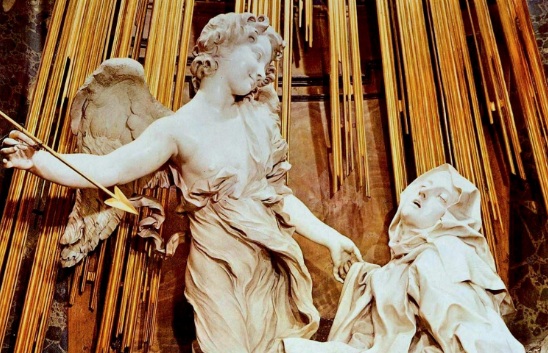
    Teresa’s descriptions of union with the divine are intensely bodily. They involve trembling, heat, sweetness, pain, and surrender—sensations that blur the line between spiritual rapture and erotic experience. This dimension of her mysticism has long unsettled interpreters, especially within a tradition wary of bodily pleasure.

    In Daoist alchemy and Tantra, however, such experiences are not anomalous. Sensual intensity is not treated as a distraction but as raw material. The body is not an obstacle to transcendence; it is the medium through which transformation unfolds. Pleasure, when refined and circulated rather than discharged, becomes a vehicle for expanded awareness.

    Bernini’s Ecstasy of Saint Teresa (1652).

    Teresa lacked the conceptual language to frame these sensations outside a theological context, and her historical circumstances demanded caution. Yet her descriptions suggest an embodied knowledge that exceeds doctrine. What she experienced was not abstract belief but a physiological and perceptual transformation, one that aligns closely with energetic traditions where ecstasy, heat, and dissolution of boundaries are recognized stages of inner work.

    “Veíale en las manos un dardo de oro largo… Era tan grande el dolor, que me hacía dar aquellos quejidos, y tan excesiva la suavidad que me pone este grandísimo dolor, que no hay desear que se quite, ni se contenta el alma con menos que Dios.”

    Seen from this angle, her mysticism appears less as an exception within Christianity and more as a culturally constrained expression of a universal embodied process.


    A God One Does Not Ask: Prayer as Presence

    As Teresa’s practice matured, she arrived at a conclusion that quietly subverted the dominant religious model of her time: prayer was no longer about asking, pleading, or negotiating. It became a state of presence rather than an act of will.

    “Ya no se trata de pedir, sino de entender que está Él con el alma y el alma con Él.”

    This shift is crucial. The divine was no longer something external to be persuaded or appeased, but something already present, encountered through stillness and receptivity. Effort gave way to intimacy. Desire softened into attention.

    This understanding closely parallels the Daoist view that alignment with the Tao does not arise through striving, but through yielding. One does not compel harmony; one stops interfering with it. In both cases, the practitioner discovers that the deepest form of communion occurs when intention relaxes and the sense of a separate agent diminishes.

    Teresa’s surprise at this realization suggests how far her lived experience had carried her beyond inherited frameworks. What remained was not doctrine, but a direct mode of knowing—quiet, unmediated, and internally verifiable.


    Conclusion

    Taken together, these elements point toward a shared structure underlying mystical experience across cultures. Whether articulated in the language of divine grace or vital energy, the path follows similar contours: disciplined engagement, bodily transformation, surrender of control and, in some cases, a final resting in what no longer feels separate.

    Teresa’s wells, channels, rivers, and rain are not merely devotional images. They function as a precise cartography of inner change. Read alongside Daoist internal alchemy, they suggest that spiritual realization is not owned by any single tradition, but arises wherever attention, body, and perception are refined enough to meet it.


  • The Chakra System Symbolism: Beyond the Standard Map

    When I first experienced the sensation, the Buddhist chakra system seemed to be the right map of what I was feeling. But as my practice unfolded, I realized that interpreting the chakra system symbolism was the only way to reconcile ancient texts with the far more complex, 15-level network I was actually feeling. What follows is not a refutation of tradition, but an attempt to understand where experience aligned with the texts, where it didn’t, and what that might mean for the way we read them.

    When Maps Seemed to Fit

    Like many, I was familiar with the popular New Age Buddhist chakra system: seven neatly stacked chakras (seven being a “cool” number, though traditional texts vary), each with a distinctive color, running from the perineum to the crown. According to this model, they are aligned along the spine and promise miraculous effects once they are “opened.” The practice was presented as a linear progression: open them one by one, starting with Muladhara, and when you finally reached the crown, enlightenment was supposedly attained.

    I was also aware of the three channels — the central Sushumna, flanked by Ida and Pingala with their peculiar crisscrossing pattern, often associated with the caduceus and other esoteric interpretations.


    The First Discrepancies

    When I first felt the sensation exactly where the Buddhist chakra system depicts the first three chakras, I believed my experience fit this schema perfectly. But discrepancies soon emerged.

    As my practice progressed, I discovered far more nodes where I could feel the sensation — not only along the spine but throughout the body. Furthermore, the clear feeling of flow suggested these “chakras” were open, yet no miracles occurred. I was particularly apprehensive about moving the sensation to the crown; if this constituted “opening” it, I expected something extraordinary, for better or worse. When I reluctantly directed my attention there and felt the sensation, nothing special happened. I heard no Tibetan trumpets of the Apocalypse.

    This led me to a critical realization: either I wasn’t “opening” them correctly, or the supposed effects were not to be taken literally.


    The Crisscrossing Mystery

    Another source of confusion was the distinctive crisscrossing of Ida and Pingala. When I discovered my own lateral energy channels, they appeared as straight lines. The energy flowed vertically from one node to the next, up or down; it did not jump from right to left or vice versa.


    A Body of Many Levels

    Now, seeing that at each supposed chakra level there isn’t a single node but a constellation of eight — and discovering a total of fifteen levels instead of seven (including the extremities, which are entirely neglected in the classic model) — I concluded that the chakras are indeed located where the sensations occur, but their common descriptions are largely symbolic.

    To me, they map stages of progress, but each stage must be cultivated throughout the entire network of the body, not at a single point.


    The Elements Revisited

    The first clue was the qualities attributed to the lower chakras: Muladhara to earth, Swadhisthana to water, Manipura to fire, and so on. This progression mirrored the evolving quality of the sensation itself as it refined — first viscous like lava, then fluid like water, next like a burning fire, then like air clearing the ashes, until it became so subtle that “ether” seemed a fitting description.

    But this refinement was not confined to specific chakras. Muladhara, like all the others, began viscous and, through years of training, became ethereal. Swadhisthana did not begin fluid; it too followed the same path of refinement. The same was true for every node in the system.


    Beyond Miracles

    Similarly, the supposed miraculous effects were not tied to specific body areas but to stages in the perception of the energy body. I would say that “Levitation” was not physical but the internal sensation of zero gravity. The experience of being “as large as a mountain or as small as a grain of sand” described profound shifts in spatial perception.


    The Missing Legs

    Another puzzling omission was the neglect of the chakras in the legs, sometimes called the “lower chakras” in rare references and often linked to our primal, animal nature. Reading these texts felt like seeing Hic Sunt Dracones — here be dragons — a territory better avoided. Had I followed that advice, I would never have achieved the full integration of energy throughout my body.

    My interpretation is again symbolic: before serious practice, one must master the basic instincts. This is the spirit of the often-skipped yamas and niyamas, which instruct us to approach practice without desires for power, recognizing our shared identity with others, and cultivating empathy and compassion.


    The Practical Purpose of the Crossing

    Finally, the classic crisscrossing of Ida and Pingala does not match my direct experience, where energy flows straight along the path of least resistance. In light of the procedures necessary for more advanced stages, I now see this is not an anatomical map, but a functional instruction. Interpreting the chakra system symbolically was for me the way from looking for miracles to mastering the practical procedures that awaken the central channel. It see it not as an anatomical description but as a practical instruction: to get results, don’t just move energy straight up the sides; consciously cross it from one lateral channel to the other.

    This trains two opposing nodes simultaneously, a necessary condition for activating sensation in the central channel — where, in my experience, the practice shifted qualitatively. If you follow a straight path, you’ll miss the party.


  • History of the Evolution of Dual Cultivation

    Where do we place the body and its energies on the spiritual path? The history of spirituality reveals a deep schism between external obedience and internal discovery. This is the history of the evolution of dual cultivation—a journey from the temples of ancient gods to the direct mapping of the human nervous system.

    The Era of Divine Rulers and Obedience

    The earliest organized religions, which developed alongside the first complex civilizations (Mesopotamia, Egypt, etc., beginning around 3500 BCE), established a clear hierarchy:

    • The Concept: Gods were omnipotent and moralizing entities who rewarded obedience and punished transgression. This belief system likely served as a crucial social adhesive, enabling cooperation within newly formed large societies.
    • The Power Structure: Spiritual access was strictly controlled by an organized priestly caste. These priests either held political power themselves or operated in close alliance with rulers, acting as indispensable intermediaries between the finite human and the infinite divine.
    • The Human Role: Humanity’s primary function was to obey. The human condition was viewed as inherently and perpetually inferior to the majesty of the gods.

    The Turn Inward

    Around the first millennium BCE, a quiet revolution unfolded across several civilizations. Figures such as Siddhartha Gautama, Laozi, Mahavira, and the authors of the Upanishads began to shift the focus from worship to direct inquiry.

    Divinity was no longer a being to be pleased, but a condition of mind to be realized. In early Buddhism, the goal was not communion with gods but liberation from ignorance. In the Upanishads, the self (ātman) was said to be identical with the cosmic principle (brahman).

    Meditation, not sacrifice, became the primary means of access to truth. While the goal (nirvana) is not “divinity” in the creator-god sense, it implies a realization of one’s ultimate nature — a state free from suffering and illusion.


    The Hidden Current: The Power of Energy

    While Buddhist traditions emphasized purely mental methods, the broader spiritual landscape of Asia already included practices centered on subtle energy:

    • Pre-Buddhist Practices: Concepts such as prana (vital breath) in early Indian texts (Upanishads) and (life force) in early Chinese Daoism predate — or at least parallel — the time of the Buddha. It is highly likely that simple breath-control and energy-based exercises were already widespread.
    • The Secret Technique: These energy-oriented practices offered a powerful aid to meditation. They provided a much more effective physical anchor than mere observation of breath or thought. By focusing the mind on the movement or sensation of prana/qì, practitioners could establish a stable point of concentration, allowing meditation to become both deeper and more efficient.
    • The Pleasure Trap: The principal merit of this method lies in its effectiveness as an anchor. While the sensation of cultivated or prana can be intensely pleasant — even blissful — this is merely a byproduct. For serious practitioners, that pleasure must be transcended, as the true goal remains direct perception of reality (prajna or insight).

    Institutionalization and the Marginalization of Energy

    The need for unified religious structures often led to the standardization and simplification of spiritual practice.

    • The Third Buddhist Council (c. 250 BCE): Under the patronage of Emperor Ashoka, this council helped establish the Pali Canon — the foundation of the Theravāda school — which codified a tradition focused primarily on mental discipline and moral conduct.
    • A Political Dimension: While the Canon’s core purpose was doctrinal, its establishment allowed Buddhism to become a state religion. From a critical perspective, the emphasis on purely mental and monastic methods — mediated by monks — may have served to maintain a necessary distance between ordinary people and the profound power of spontaneous spiritual realization.

    The Return of the Body

    Despite official disapproval, bodily methods never disappeared. In both Daoist alchemy and Vajrayāna Buddhism, a parallel current re-emerged: the theory of dual cultivation — sexual or energetic union as a means of spiritual transformation.

    In Daoism, such practices appeared as early as the second century CE and matured into the internal alchemy of the Tang and Song periods. In Tibetan Vajrayana, similar techniques were integrated into esoteric yogas of energy and bliss. Both traditions were often condemned by orthodox lineages, which preferred celibate over embodied experimentation.

    The real merit of dual cultivation, however, was not its sensuality but its precision as a meditative tool. The sensation of — subtle yet distinct and often pleasurable — offered an anchor far more tangible than abstract concentration. Once the initial fascination with pleasure (the pleasure trap) subsided, what remained was its true function: a steady focus that deepened awareness and gradually transformed perception itself.


    Suppression and Preservation

    By the seventeenth and eighteenth centuries, particularly under the Qing emperors Yongzheng and Qianlong, sexual alchemy was officially banned as an “obscene practice.” Dual cultivation retreated into secrecy, surviving only in small circles of Daoist hermits and, more visibly, in Tibetan Tantric monasteries — where, ironically, it sometimes became an instrument of institutional power.

    The Tibetan Vajrayana, while preserving these techniques, often built a rigid clerical system around them – reintroducing the very intermediation the path had sought to transcend. The same pattern repeated: techniques of liberation reabsorbed into structures of authority.


    The New Age and the Commercialization of the Self

    The most recent chapter is the arrival of these techniques in the modern West, largely through the New Age movement.

    • Adoption and Dilution: The New Age eagerly adopted elements of Eastern spirituality — meditation, Qigong, Tantra — but often decontextualized or misunderstood them.
    • The Consumer Path: These practices were commercialized and repackaged as “self-help” or “wellness” methods, prioritizing comfort, health, and personal success over the rigorous path toward insight and liberation. The “pleasure trap” became, in many ways, the entire focus of the commercialized versions.

    Closing Reflection

    Spirituality oscillates between inner discovery and external control. When viewed through the lens of the evolution of dual cultivation, the movement is clear: we are shifting the source of authority from outside dogmas to the verified, internal data of the practitioner.

    This overview is not a theory of how things should be — only how they appear when viewed side by side across time. From gods to breath, from obedience to awareness, from temples to nervous systems — the underlying movement seems less about belief than about where we locate authority: outside, or within.

  • Interpreting the Three Treasures

    Ancient Daoist texts described the “Three Treasures” as essence, energy, and spirit. However, for the modern practitioner, interpreting the three treasures is a task of decoding biological metaphors rather than taking ancient language at face value. This piece explores how misunderstanding these symbols distorts genuine cultivation—and how returning to direct experience restores their meaning.

    According to the classics, the Three Treasures—or San Bao (三宝) in Chinese—are three essential energies or substances that sustain human life and represent the foundational layers of our existence. They are:

    • Jing ()Essence / Vital Base: The most fundamental, dense, and physical form of energy.
    • Qi ()Energy / Life Force: The vital force that flows through the body.
    • Shen ()Spirit / Consciousness: Our awareness, mind, and emotional balance.

    Jing is the foundation for Qi, and Qi is the foundation for Shen. A weak Jing leads to deficient Qi, which in turn results in an unanchored or disturbed Shen. The ultimate goal in many internal alchemy (Neidan) practices is to refine and transmute these substances upward: to conserve Jing and transform it into Qi, and to purify Qi to nourish and refine Shen—leading to spiritual awakening and longevity.


    Energy, Orgasm, and Misunderstanding

    In practical terms, Qi corresponds to the neural activity perceived as an orgasmic sensation, and Jing refers to the seminal fluid. The practice consists of maintaining the feeling while avoiding ejaculation (in men) and guiding that sensation upward along the spine — a process described in the classics as the reversal.

    This ascending sensation feels like a current. The authors of these theories — unaware of the nervous system — observed that ejaculation ended the feeling. From this correlation, they concluded that the sensation was sublimated Jing, renamed Qi. Modern physiology clarifies the misunderstanding: what they perceived as a “flow of energy” is in fact the propagation of neural and autonomic signals along the spine. The emission of semen merely ends the feedback loop that sustains the feeling. Correlation was mistaken for causation.


    The True Function: Training Consciousness

    Once the decoupling of orgasm from ejaculation is achieved, Jing is out of the game. The only remaining actors are the feeling and the awareness—Qi and Shen, or however one prefers to name them. The sensation acts as a powerful anchor for meditation, training awareness to focus and release thought. This concentrated awareness, in turn, amplifies the sensation — a virtuous cycle. This is the essence of dual cultivation. The goal, as these traditions describe it, is a refined Shen — a consciousness less entangled in narrative and reactivity. Whether this reveals a ‘true nature’ or simply a different mode of processing remains an open question.

    As focused attention is the key, overthinking the theoretical concept of “Jing” becomes a distraction that halts progress.


    Literalism and Its Dangers

    Yet even today, some take the ancient writings literally — with disastrous consequences. I’ve seen online forums where self-proclaimed teachers advise “reabsorbing” semen, inspecting urine for turbidity, or even inserting a cannula into the urethra to “train the bladder to absorb fluids,” citing legendary masters who allegedly ingested mercury. No further comment is needed on this level of absurdity.


    The Myth of Loss

    A related misreading concerns the classic injunction to “avoid losses.” The real message was simple: avoid ejaculation to sustain the feeling. This is the meaning of the phrase, “If the plum has not yet blossomed, it is too early; if it has already blossomed, it is too late.” There is a narrow window of opportunity to “catch” the Qi — during the first stirrings of orgasm, before ejaculation. If ejaculation occurs, it is not a catastrophe; it is merely a missed opportunity. There will be many more, as Jing (semen) is continually replenished by the body.

    Once the skill is stable, occasional losses are inconsequential. In my Tantric practice, such episodes simply made my body temporarily more yin — more receptive — in the next session, which was actually beneficial. Yet many practitioners treat ejaculation as a disaster, believing it erases weeks of effort. In my opinion, this anxiety is unfounded. The body naturally releases excess fluid during nocturnal emissions when full — a physiological fact, not a spiritual failure.


    The Gender Bias and Its Origins

    The distortions reach their peak when addressing women. Since women do not ejaculate, ancient theorists asked: what, then, is their Jing? The answer they proposed was menstrual blood. From there arose the absurd conclusion that women, because of their “monthly losses,” were less capable — or even incapable — of spiritual attainment.

    Beyond its misogyny, this reasoning may have been politically convenient. In ancient China, dual cultivation was often linked to martial training — a strategic resource before gunpowder. Women commonly married into other clans, sometimes potential rivals. Restricting their access to energetic techniques was a form of secrecy, not metaphysics.

    Yet this bias persisted for centuries, despite the evident fact that women are often better suited to sustaining the orgasmic flow. Their physiology supports multiple orgasmic modes — the clitoral (explosive, similar to male ejaculation), the G-spot (absorptive), and the cervical (deeply enveloping).


    A Grounded Conclusion

    From my experience, the principle is simple:

    • The essence of the practice is to sustain the energetic current as long as possible and move it with the attention.
    • This requires avoiding ejaculation while maintaining the feeling. If it happens, you will have plenty of opportunities, simply start again.
    • Seminal losses are natural. Don’t worry, your body replenishes it continuously for many years, and losses don’t harm your abilities once you get them.
    • Far from being a limitation, the female physiology offers a head start in inner alchemy. 

    In the end, correctly interpreting the three treasures reveals they are not substances to be hoarded, but stages in what feels like a refinement of awareness—from gross sensation to subtler perception, from agitation to relative stillness.