The Ten Ox Diagrams are a classic series of images of Zen-Chan Buddhism representing the stages of the spiritual journey toward enlightenment. While my own practice has used a dual body-mind framework, this ‘mind-only’ allegory offers a profound look at how the practitioner’s relationship with the self evolves from pursuit to total transcendence.






The series, traditionally attributed to the Chinese Zen master Kuòān Shīyuǎn (廓庵師遠) from the 12th century, consists of ten images accompanied by poems. The ox represents the untamed mind, the herdsman the practitioner, and the progressive search for, taming of, and eventual transcendence of the ox symbolizes the Zen path to awakening.
The Ten Ox Diagrams articulate a mind-only approach characteristic of the Zen tradition, which differs from the dual body–mind framework I have followed in my own practice.
In this post, I present the images, the associated Chinese poems, and a set of contextual comments. The aim is not to map these stages onto my personal experience, but to read them on their own terms—as a classical contemplative model that has shaped, and continues to inform, later understandings of the path.
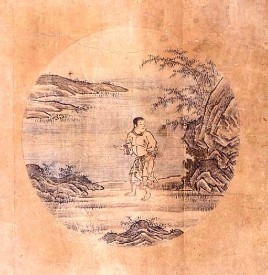
Stage 1: Searching for the Ox (尋牛)
The herdsman begins his search in the wilderness, representing the initial stirring of the spiritual quest amid confusion.
從來不失,何用追尋?(From the very beginning, it has never been lost—so why search for it?)
The ox (one’s true nature) has never actually been lost. It is inherently present, complete, and unchanging. The problem is not one of absence, but of ignorance and confusion.
由背覺以成疏,在向塵而遂失。(Turning away from awakening, one becomes estranged; facing toward the dust [of the senses], one then loses track)
By “facing toward the dust,” we become obsessed with external phenomena and the ego’s dramas, thereby “losing” our intrinsic awareness.
家山漸遠,歧路俄差。(The homeland mountains grow ever more distant, the forked roads suddenly diverge)
The practitioner feels a sense of spiritual homesickness, but is not yet able to find the road back home.
得失熾然,是非鋒起。(Thoughts of “gain” and “loss” blaze fiercely; judgments of “right” and “wrong” clash like spears)
And is paralyzed by endless philosophical choices, intellectual debates, and the burning agitation of desire and aversion.
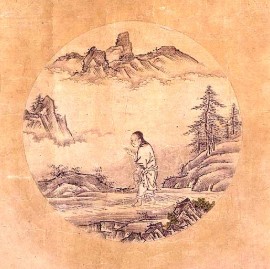
Stage 2: Seeing the Tracks (見跡)
This stage marks a critical turning point from blind groping to finding direction. The “tracks” (跡) are the traces of truth found in spiritual teachings, scriptures, and the examples of enlightened beings.
依經解義,閱教知蹤 (Relying on the sutras, he understands the meaning; studying the teachings, he knows the tracks)
The practitioner, through study (“依經解義, 閱教知蹤”), begins to see a coherent map.
明眾器為一金,悟萬物由自己 (He becomes clear that the myriad vessels are all of one gold; he awakens to the fact that all things arise from the Self)
Just as various vessels are all made from the same gold, all phenomena arise from the one true nature, the “Self” (自己, here meaning Buddha-nature, not the ego).
正邪不辨,真偽奚分? ([Yet] right and wrong are not yet distinguished, truth and falsehood how can they be divided?)
The tracks confirm the ox’s existence and general direction, but the ox itself is still not seen. The practitioner still operates in duality (“正邪不辨, 真偽奚分” – right/wrong, true/false aren’t fully discerned). He has the map, but haven’t set foot on the real terrain.
未入斯門,權為見跡 (He has not yet entered the gate; for now, it is merely seeing the tracks)
The “gate” is the direct, non-conceptual experience of reality. Here, one is still outside, analyzing the description of the gate rather than passing through it.
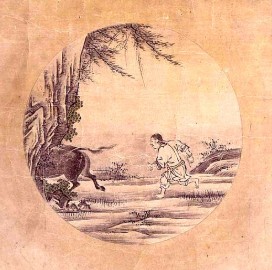
Stage 3: Seeing the Ox (見牛)
This stage represents the first direct, experiential glimpse of the true nature. It is a moment of profound, non-conceptual insight—a sudden “aha!” that goes far beyond the intellectual understanding of the tracks.
從聲入得,見處逢源 (Through the sound, he enters and attains; at the place of seeing, he encounters the source)
The description “從聲入得” (through the sound, he enters and attains) signifies a shift from thinking about reality to perceiving it directly, perhaps triggered by a sound, a sight, or a moment of silent awareness.
六根門著著無差,動用中頭頭顯露 (At the gates of the six senses, nothing is amiss; in every movement and action, it is clearly revealed)
The ox (true nature) is now seen as never truly separate. It is manifest in every sense experience (“六根門著著無差”) and in every action (“動用中頭頭顯露”).
水中鹽味,色裏膠青 (Like salt in water, like pigment in indigo)
The absolute is completely infused in the relative, inseparable yet distinct. It’s not a thing to see, but the very nature of seeing itself.
眨上眉毛,非是他物 (Lift your eyebrows and see—it is no other thing)
It’s an exhortation to realize that what you are seeing is you. The seeker and the sought begin to merge in this moment of recognition.
But this is just a glimpse. The ox is “seen” but not yet held or stabilized. The experience may be brief, soon obscured again by habitual thought. Yet, it is transformative and irreversible. Having seen it once, the practitioner’s doubt is shattered. It’s the transition from belief to knowing, from hearsay to witness. The practitioner has “entered the gate.” The quest now changes from “Is it there?” to “How do I abide in this always?”
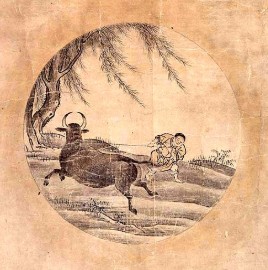
Stage 4: Catching the Ox (得牛)
Having had a glimpse of the ox (true nature) in Stage 3, the practitioner now attempts to “catch” it—to hold that awareness steadily and make it their own, rather than a fleeting visitor. This is often the longest and most arduous phase of the path.
竭盡神通獲得渠,心強力壯卒難 (Exhausting all his strength and cunning to seize it, its will is fierce, its power robust—finally, it’s hard to subdue)
This symbolizes the tenacity of habitual energies—old patterns of thought, emotional reactions, and egoic grasping that reassert themselves
有時纔到高原上,又入煙雲深處居 (At times it wanders onto a high plain, but then again retreats to dwell deep within the misty clouds)
There are moments of brilliant clarity and expansive vision (“high plain”), where the mind is open and awareness is steady. But just as quickly, one can be plunged back into confusion, obscuration, and doubt (“misty clouds”). The ox, symbolizing the liberated mind, keeps escaping into the fog of delusion.
In essence, Stage 4 is the gritty, hands-on work of spiritual practice after initial insight. The initial euphoria of “seeing” gives way to the sobering realization that the ego’s habits are deeply entrenched. The goal is gradually lengthening the periods on the “high plain” and shortening the retreats into the “misty clouds.”
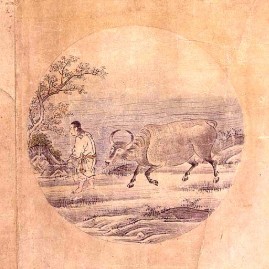
Stage 5: Taming the Ox (牧牛)
Stage 5 represents the crucial transition from struggle to mastery, from forced effort to cultivated harmony. The ox has been caught, but now it must be patiently and consistently trained.
鞭索時時不離身,恐伊縱步入埃塵 (Whip and rope never leave his hand, lest the ox stray off down paths of dust)
The “whip” is diligent awareness; the “rope” is mindful concentration. Without them, the mind goes back to the same old seductions of sensory distraction and egoic thought (the “paths of dust”).
相將牧得純和也,羈鎖無拘自逐人 (When at last it is gently nurtured into purity and docility, even without tether or constraint, it follows the man of itself)
Through continuous, patient practice, our own turbulent mind is gradually “tamed.” It becomes “pure and docile,” meaning the mind naturally settles into clarity. Mindfulness is no longer a task, but a natural state. In essence, Stage 5 is the cultivation of effortless practice. The Zen master speaks about mental states but this change has ressemblances to the change in dual practice from martial fire to civil fire, from effort to wu-wei.
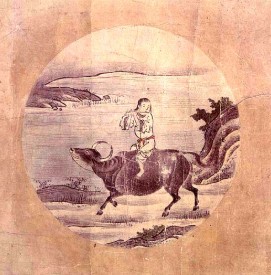
Stage 6: Riding the Ox Home (騎牛歸家)
This stage depicts the joyful and effortless integration of realization into the flow of ordinary life. The struggle is over; the practitioner and his true nature move as one, returning to the source from which they never truly departed.
騎牛迤邐欲還家,羌笛聲聲送晚霞 (Astride the ox, he leisurely wends his way home, the herdsman’s flute carries the notes of the evening clouds)
The practitioner is no longer searching, striving, or taming. He is simply going home—returning to his inherent nature in a relaxed, unhurried journey, to the “marketplace” of everyday life.
一拍一歌無限意,知音何必鼓唇 (In every beat and song, a boundless meaning, a friend who knows the tune needs no chattering words)
This “music” is his actions, speech, and presence in the world—now in harmony with the dharma. Every beat and song of his life carries “boundless meaning,” infused with the wisdom he has realized. Intellectual explanation and doctrinal debate (“chattering words”) are superfluous between those who share the direct experience.
In essence, Stage 6 is the embodiment of enlightenment in daily activity. It is often seen as the culmination of the “gradual path” of cultivation. The practitioner is at peace, united with his true self, and his life becomes a natural, artistic expression of wisdom. However, a subtle duality remains: there is still a rider and an ox, a person “having” enlightenment.
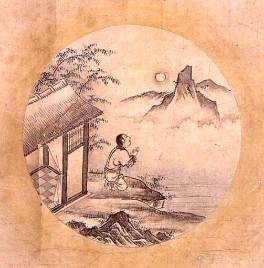
Stage 7: Ox Forgotten, Self Alone (忘牛存人)
This stage marks a profound internal shift from attainment to transcendence. The previous stage was one of harmonious unity, but here, the very concept of the “ox” (the sought-after true nature) as a separate object dissolves.
騎牛已得到家山,牛也空兮人也 (Astride the ox, he has already reached home, the ox is now empty, the man at ease)
Having fully realized and integrated his true nature, the instrument of seeking is no longer needed (the ox is “empty”). It was a conceptual construct for the journey. Similarly, the man is “at ease”, utterly free from the striving of a seeker.
紅日三竿猶作夢,鞭繩空頓草堂 (The red sun is three poles high, yet he’s still as if dreaming, whip and rope lie idle in the thatched hut)
The sun is high—everything is clear and illumined—yet he is “as if dreaming.” This does not mean delusion, but the disappearance of solid, separate reality. The whip and rope—the disciplines of mindfulness and effort—have served their purpose and are gratefully let go. “The raft is for crossing; once across, one does not carry it on one’s head.”
In essence, Stage 7 is the transcendence of enlightenment as an achieved state. The practitioner no longer identifies as “someone who has attained something.” The external form of practice falls away.
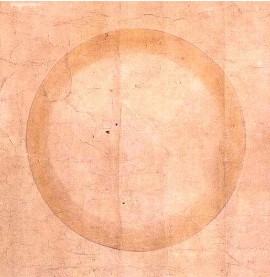
Stage 8: Both Ox and Self Forgotten (人牛俱忘)
This stage represents the ultimate point of non-duality and absolute emptiness (śūnyatā). All distinctions, all concepts, and even the most refined sense of a realized “self” utterly dissolve. It is the consummation of the inward journey.
鞭索人牛盡屬空,碧天遼闊信難通 (Whip, rope, man, and ox—all merge into emptiness, the vast blue sky is boundless; no message can be sent)
Every element of the journey—the tools (whip/rope), the seeker (man), and the sought (ox) were all provisional names for aspects of the one reality. With the realization of their emptiness, they “merge” into the undifferentiated ground of being. The boundless sky describes this emptiness. No “message” (concept, teaching, or experience) can be sent from or about it. All communication falls short.
紅爐焰上爭容雪,到此方能合祖宗 (How can a snowflake survive atop a red-hot furnace? Only upon reaching this can one merge with the Ancestors)
The “red-hot furnace” is the absolute, non-dual reality. Any separate, conceptual entity—even the most pure and beautiful thought, is instantly vaporized upon contact. Nothing dualistic can exist here. Merge with the Ancestors means to fully unite with the primordial source, the Buddha-mind of all patriarchs and masters throughout time and see what they saw: absolute, unobstructed emptiness.
Yet, from the Zen perspective, to linger here is to fall into the stagnation of “emptiness.” True wisdom is not an endpoint, but a turning point. The empty circle must give birth to the world of form.
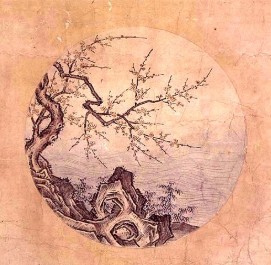
Stage 9: Returning to the Source (返本還源)
This stage marks the return to the phenomenal world after the absolute emptiness of Stage 8. It is not a regression, but a rebirth into a completely new way of perceiving.
返本還源已費功,爭如直下若盲聾 (Returning to the Source required exhausting effort, but how is it compared to the direct way of being like one blind and deaf?)
The “blind and deaf” state is not ignorance, but non-discrimination. It means not being led astray by conceptual labels and preferences. The long struggle of seeking is now seen as secondary to this immediate, non-grasping presence.
庵中不見庵前物,水自茫茫花自紅 (In the hut, he sees not a thing before the hut, the water flows of itself, boundless; the flowers bloom crimson)
From within the hut (the abode of enlightened mind), he “does not see” the things before the hut. This means he does not perceive them through the filter of a separate self, with its desires, judgments, and projections. The subject-object division has collapsed. Water is just water, flowing boundlessly. Flowers are just flowers, vibrantly red. Everything is vividly present, self-existent, and self-luminous, “of itself”. The purified, empty mind (the hut) now rests in and perceives the world just as it is.
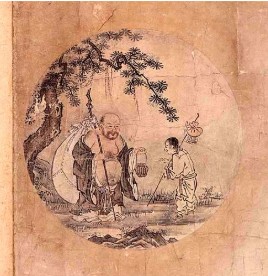
Stage 10: Entering the Marketplace, Hands Hanging Down (入鄽垂手)
This is the culmination of the journey: the full embodiment of wisdom as boundless, active compassion. The practitioner, utterly free from self-consciousness, re-enters the world of dust (the “marketplace”). With a humble appearance and hands resting at his side, he acts spontaneously—without intention, doctrine, or a sense of being a “helper.” His very presence, now an expression of non-dual awareness, naturally benefits all beings.
露胸跣足入鄽來,抹土塗灰笑滿腮 (Bare-chested and barefooted, he enters the marketplace, smearing his face with dirt and ashes, a smile fills his cheeks)
This is the antithesis of a messianic figure. It is a radical divestment of all specialness, status, and holiness. He appears as a fool, a beggar, a simpleton. The “smile” is not one of a benevolent king, but of someone who has nothing to protect, nothing to prove, and finds joy in the sheer act of being.
不用神仙真祕訣,直教枯木放花開 (No need for the secret methods of the immortals, he directly causes withered trees to burst into bloom)
He uses no esoteric rituals (secret methods of the immortals). His very presence—his unconditional compassion, his words, his actions—has transformative power, the power of awakened activity to heal, inspire, and awaken the Buddha-nature in others. This is not a regal, aloof sage, but a figure of utter non-attachment to form and status.
The final stage warns us that the ‘savior’ role is a profound ego trap. In the stages of the spiritual journey, the ultimate goal isn’t to become a holy figure, but to return to the marketplace as a simple human—one who has bypassed the BIOS and found joy in the sheer act of being.