Author: juan

  • Bypassing the Biological BIOS: Basic Instructions for Survival

    In this post, I apply a systems-engineering lens to the human experience, comparing our cultural conditioning to an operating system and our evolutionary instincts to a computer’s BIOS. I explore how specific meditative states act as a way of bypassing the biological BIOS, temporarily suspending the deep-seated directives of sex, space, and self.

    Control Systems: The Nervous System and Beyond

    The control system is the core of any organism’s ability to coordinate sensory input and motor output. In animals, this is embodied by the nervous system, ranging from simple nerve nets in jellyfish to the highly evolved brains of mammals. In machines, the control system can take the form of a simple microcontroller or a complex computer running algorithms that process sensor data and control actuators.

    Operating Systems and Learning: Programs Loaded After Birth

    Beyond basic hardware, both organisms and machines rely on “software” to function effectively.

    For machines, this means operating systems and programs loaded into memory—code that dictates how the machine interacts with its environment and performs tasks.

    For living organisms, this corresponds to learning and cultural transmission. Lion cubs, for example, learn hunting techniques from their mothers, while humans acquire language, social norms, and specialized skills through education and experience. These learned behaviors and cultural “programs” are not present at birth; they are “installed” as the organism interacts with its environment.

    The BIOS: Innate Instructions for Survival

    At the most fundamental level, all living organisms are born with innate instructions that govern survival and reproduction. This is analogous to the BIOS (Basic Input/Output System) in computers, which is pre-installed and essential for basic operation before any other software is loaded.

    In biological terms, these instructions are encoded in DNA and expressed as instincts and reflexes—automatic responses that allow an organism to feed, avoid danger, and reproduce, even without prior experience. The BIOS in machines serves a similar function, providing foundational routines necessary for initialization and basic hardware interaction.

    Fusion in the Three Dantians: Bypassing My BIOS

    When I experienced the yin–yang fusion in the Dantians, my perception of certain fundamental concepts—concepts I had always taken for granted—changed dramatically.

    In the Lower Dantian (LDT), the duality of male–female “uncollapsed,” merging into a single entity for which the concept of sex was irrelevant.

    In the Middle Dantian (MDT), the uncollapsed dualities related to spatial perception—far and near, in and out. Space, as I had always understood it, lost its meaning.

    In the Upper Dantian (UDT), the duality of me–other dissolved. The sense of an isolated “I” facing an external “Other” gave way to a profound feeling of oneness.

    Like any human being, I received my “operating system” and initial programs as soon as I could process language—from religious conditioning to mathematics—constantly updated by daily experience to dictate behavior, with thoughts as the interface.

    When meditation enabled me to be conscious without thoughts, it felt as though my post-birth operating system and programming had been removed. Yet the BIOS—the deepest layer of survival code—remained.

    A Hypothesis: Consciousness and Its Core Directives

    I began to entertain a hypothesis: suppose we are all fragments of a shared consciousness that, for some reason, embodies itself in living organisms—descending from a realm where consciousness is collective, timeless, and unbound by fragile physical form. This is, of course, speculative, but it provided a useful framework for thinking about what followed. What would be the basic instructions for survival in such a case?

    The first directive would likely be the distinction between “you” and “other.” This would be essential if you were a mouse facing a cat, or a human facing a tiger.

    Next, there would be an understanding of three-dimensional space—concepts like near and far, in and out—crucial for navigating the world, finding food or mates, and avoiding predators.

    Finally, there must be an instruction tied to reproduction: the concept of sex, ensuring continuation of the species.

    With these simple directives, any organism—using its particular hardware of sensors and actuators—would have reasonable chances of survival and reproduction.

    Under this hypothesis, being conscious without thoughts was like bypassing my operating system, while the fusion of yin and yang in the three Dantians felt akin to temporarily bypassing these three BIOS directives.

    But one fundamental instruction still remains. To survive, the most basic directive appears to be: “You are.”

    The Final Duality: Being vs. Nonbeing

    So basic is this directive that, even after witnessing the fusion of the opposites—male and female, in and out, me and other—the dualities inherent in “I am” remain stubbornly intact: being vs. not being, Self vs. nothingness.

    How could there be a reality where being and nonbeing are one and the same?

    Perhaps this touches on the nature of Time vs. Eternity—and after all, even Einstein called time an illusion.

    Yet how could there be a reality not experienced by “my Self,” the interface that has functioned so well since birth? At this moment, that remains inconceivable to me.

    The final duality of Being versus Non-being remains the last encrypted line of code. Yet, having succeeded in bypassing the biological BIOS at other levels, I remain hopeful that even this fundamental instruction can eventually be integrated into a more luminous reality.


  • Beyond the Narrative Self: The Ego as a Cognitive Tool

    In previous posts I have tried to describe certain experiential aspects of dual practice in strictly operational terms: the sensation often referred to as qi, the dynamics of absorption and radiation, and the way these processes can stabilize attention.

    Yet beyond the physiological and phenomenological descriptions, the practice sometimes leads into territory that is harder to frame within the usual scientific language. What follows is not a claim or a conclusion, but simply an attempt to reflect honestly on some of those experiences and the questions they raise. Beyond the sensation of qi, the experience leads to a fundamental questioning of identity—revealing the narrative self as a cognitive tool rather than my fundamental essence.

    Unfamiliar Territory

    Dual practice has taken me into unfamiliar territory, altering my perception of my body and, more importantly, of my identity.

    The physical sensation commonly referred to as qi often appears as if a subtle substance were entering through specific points in the body, then flowing along channels, and eventually expanding until it fills the entire perceptual field. As this happens, the ordinary sense of bodily boundaries begins to dissolve. The distinction between inside and outside, near and far, becomes less clear. The experience resembles what I imagine the state of a disembodied consciousness might be like.

    Yet the most striking effect is not the sensation itself, but the way it anchors attention. The flow is so absorbing that the usual stream of thought can come to a complete stop. When this happens, the structure we normally identify as “myself” begins to fade.

    When the Narrative Self Falls Silent

    The narrative self — the ongoing story constructed by the brain, closely associated with what neuroscience calls the default mode network — temporarily disappears. That narrative normally connects memories of the past with projections into the future, maintaining the sense of a continuous personal identity. When the process falls silent, what remains is simply awareness observing itself.

    In that state, stripped of narrative and largely detached from bodily representation, consciousness appears strangely connected with everything else. The fundamental duality of self versus other begins to look less like an intrinsic feature of reality and more like a functional construct — a mechanism shaped by evolution to help the organism survive in a complex environment.

    The Scientific Interpretation

    From a rational and scientific perspective, the most straightforward explanation is that dual practice induces altered states of consciousness. In those states perception is reorganized in ways that feel profound but ultimately reflect nothing more than changes in neural dynamics. Seen this way, the experience would be comparable to the mental “journeys” produced by psychedelic substances: interesting, perhaps even meaningful, but essentially illusions generated by the brain.

    Under that interpretation, such states are best confined to the context of practice. Taking them literally while interacting with the world could easily become maladaptive.

    A Persistent Question

    And yet, once I return to ordinary awareness, I cannot completely dismiss the possibility that something else might be involved.

    One aspect in particular seems difficult to ignore: the distinction between the narrative self and the awareness that observes it. For most of my life I assumed that the narrative voice in my head was “me.” But closer inspection suggests otherwise. The observing awareness appears to remain constant while the narrative continually changes.

    The Narrative Self as a Cognitive Tool

    Curiously, recent developments in artificial intelligence offer an unexpected illustration of this distinction. It is now possible to construct systems that generate a convincing narrative self — systems that can pass variants of the Turing test and engage in complex conversation. They do so through layers of artificial neural networks that transform language and knowledge into high-dimensional vectors, processing those representations through billions of weighted connections to produce coherent responses.

    From a functional perspective, the process is mechanical. It resembles, at least in broad terms, the way biological neural networks might produce the stream of thoughts that we experience as our inner narrative. If that analogy holds, the narrative self may be less like an essence and more like a tool — a highly sophisticated cognitive instrument that evolution has given us, much as it gave us hands or eyes.

    Useful, even indispensable for navigating the world — but perhaps not identical with what we fundamentally are.

    The Observer Behind the Story

    What feels closer to an essence is the bare awareness that has been present throughout my life, silently observing events from within. When attention turns toward that awareness itself, it seems strangely unaffected by the passage of time. It appears prior to the stories that the mind constructs about the past and the future.

    And when, in certain moments of practice, that awareness seems to merge with a wider field of experience — as if it were part of something larger — it becomes difficult not to wonder whether the experience might point to something real.

    Perhaps it is only a temporary neurochemical state, a surge of endorphins and neurotransmitters reorganizing perception in unusual ways. That explanation is entirely plausible.

    But it is also possible — just possible — that such states reveal a latent potential of consciousness, hinting at forms of experience that our ordinary cognitive framework rarely allows.

    A Space for Speculation

    At this point speculation inevitably begins. Or, stated more charitably, one starts forming tentative hypotheses.

    After all, despite the extraordinary progress of science, our understanding of some fundamental aspects of reality remains limited. We still do not know what consciousness ultimately is. Our grasp of matter and time, although extraordinarily precise mathematically, does not yet explain their underlying nature.

    An Uncomfortable Possibility

    If we acknowledge that ignorance with some humility, then the possibility — long explored in mystical traditions across cultures — that consciousness might extend beyond the narrow framework of individual identity cannot be entirely ruled out.

    I find myself inclined to consider that possibility, even if cautiously. Not the anthropomorphic God of institutional religion, modeled after earthly rulers, but something closer to what mystics have described in very different languages: the God of Teresa of Ávila, the Dao of Daoism, or the Brahman of Indian philosophy.

    Accepting such a possibility would place me, somewhat reluctantly, among believers — a position that has never felt entirely comfortable to me. For most of my life I associated belief with intellectual laziness, with the human tendency to replace uncertainty with comforting narratives.

    Perhaps the mind is rarely as consistent as it likes to imagine. Even someone deeply shaped by skepticism can find himself wishing that certain possibilities might be true. Recognizing the narrative self as a cognitive tool allowed me to hold my stories lightly, leaving space for the silent observer that remains when the story ends.


  • Yin–Yang Fusion: Achieving Simultaneous Yin and Yang

    In the previous post, I described how the discovery of energetic “breathing” — alternating absorption (Yin) and radiation (Yang) — led to what Daoist texts call Embryonic Breathing. At that stage, the process still appeared sequential: inhale, exhale; receive, emit.

    What I did not anticipate was that this alternation was merely an intermediate step toward simultaneous Yin and Yang. With closer observation, the transitional moment between Yin and Yang revealed itself not as a gap, but as an overlap. What follows is an account of how that overlap became the central focus of practice — and how Yin and Yang gradually ceased to behave as opposites.

    The Sensation as Flow

    My energetic practice can be summarized as learning to manage a physical sensation. Initially, this sensation appears as a flow — as if a fluid, seemingly corresponding to what Daoists call qi, were entering or leaving specific areas of the body in a controlled way.

    Discovering the Complementary Polarity

    When this experience first arose spontaneously, it manifested as expansive — yang. Over time, I discovered its complementary polarity: the sensation of inhalation, yin — just as pleasurable as the outward flow, but directed inward. Eventually, however, I came to understand that the aim of the practice was not to alternate the “breathing” of qi between exhalation and inhalation, but to allow both processes to occur simultaneously.

    Alternation and Flow Reversal

    The idea of inhaling and exhaling at the same time is, of course, completely counterintuitive. It would never have occurred to me independently. The insight emerged during Tantric sexual practice, after mastering what I call “flow reversal.” My partner and I alternated roles: for several minutes I would radiate (yang) while she absorbed (yin); then she would radiate while I absorbed. Each reversal intensified the sensation and the associated pleasure. Crucially, it was my intention that triggered the shift, and her nervous system responded accordingly.

    The Technical Question: Can Opposites Coexist?

    Observing the sensations associated with each polarity, an inevitable question arose: what would happen if both polarities could be activated simultaneously?

    After all, everything depended on intention. Although the experience felt like a flow, nothing physical was actually moving. If fusion were possible, it would require applying both types of intention — yin and yang — at the same time. The logical place to explore this possibility was the transitional moment, the instant when intention shifted from yin to yang or vice versa.

    The Physics of Transition

    Until then, I had treated the process as mutually exclusive. Yin intention produced absorption; to switch, I would “cut” that intention and, after a brief pause, activate yang. Between them was a neutral gap. But no physical process changes state instantaneously. There is always a decay time as one state fades, and a rise time as another emerges. That observation provided the key.

    By placing attention precisely at the point of transition, I learned to detect the fading of one mode and to initiate the opposite intention before the first had completely dissipated. In that brief overlap, I could perceive — subtly but unmistakably — the simultaneous presence of yin and yang: one decaying, the other arising.

    From Overlap to Fusion

    From there, the process became one of gradually increasing the overlap, strengthening the coexistence of both intentions. What began as a faint superposition evolved into a stable, immersive yin–yang simultaneity.

    Reading the Vijñāna Bhairava Technically

    Interestingly, this technique closely resembles early instructions found in the Vijñāna Bhairava Tantra. Sutras 24, 25, and 26 describe awareness at the turning points of the breath — or, in Osho’s freer translation, the moment “when in-breath and out-breath fuse.”

    Not Enlightenment — Just a New Phase

    For me, these instructions make limited sense if applied solely to pulmonary respiration. They become technically coherent only when understood in terms of energetic flow — not imagined, but directly felt. Achieving simultaneous yin and yang does not produce instantaneous enlightenment, but it does mark a transition to a more advanced phase of energy management.

    Nothing more — and nothing less.

  • Discovery, Fusion, and the Limits of My Yidam Practice

    After the initial discovery of visualization as a functional interface, the practice evolved into a daily discipline. This post documents the consolidation of that experience and the gradual realization of the limits of my yidam practice—where even the most compelling internal figures must eventually dissolve.

    A Pleasant Stage — Containing the Seeds of Its Own Ending

    After discovering the overwhelming mental states induced by this practice—which I’ll still call Yidam, though it may not align perfectly with canonical definitions—I repeated the procedure daily. Soon, I realized the being I was fusing with was not a goddess, but the idealized memory of my first Tantric lover — the woman who had introduced me to those states long before I had any conceptual framework for them.

    Day after day, I saw her running toward me—her eyes filled with joy, her heart with love, her belly with lust—exactly the feelings I had experienced with her, and in my first Yidam experiment. We fused in the deepest embrace, but this time, skin was no barrier. Our bodies overlapped, and every cell within me danced with the cell within hers, from head to toe, in a dance that tasted of lust beyond lust, love beyond love, and joy beyond joy—all blended into a cocktail far greater than the sum of its parts.

    This was an extremely pleasant stage in my journey, yet it contained the seeds of its own ending. As the practice evolved and reshaped my perception, the truth became evident: I was not fusing with anything—goddess or lover. I was simply discovering the real nature of this subtle body, hidden all my life and now unveiled. There was no “other” interacting with me. It was just me—to be precise, this pure consciousness free from thoughts, which had always been there and had nothing to do with the “mundane me” made of thoughts, fears, and desires. This seemed to be the real “me” finally taking possession of its energy body.

    Changes in Perception

    As the fusion extended across what internal alchemy traditions call the three dantians, distinct perceptual shifts became apparent.

    • At the level of the lower dantian, sexuality lost its binary character. The energetic body revealed itself as neither male nor female — or perhaps as containing both polarities simultaneously. Biological sex remained a fact, but it no longer defined the structure of experience..
    • At the level of the middle dantian, what had initially appeared as intensified love transformed into something more spatial than emotional. A strange feeling of spaciousness—like watching the starry sky from a mountaintop, yet feeling I could touch the stars, as if a subtle veil separating near from far had been removed. Love, typically structured as a relation between self and other, shifted toward a perception of inevitable interconnection once experiential space ceased to function as a barrier.
    • At the level of the upper dantian, fusion expressed itself as joy — not private satisfaction, but shared exhilaration. The closest ordinary analogue would be the collective surge when a team scores a decisive goal, or when a crowd sings in unison. In those moments, individual identity briefly relaxes and a larger coherence takes precedence. The joy was of that nature: distributed rather than owned.

    These shifts did not prove anything metaphysical. They demonstrated how radically perception can reorganize when identity becomes fluid.

    Taking Possession of the Energy Body

    Eventually, however, the figure faded.

    The lover, the goddess, the dakini — all dissolved. What remained was a persistent sense of energetic coherence without a relational counterpart. One duality had collapsed: there was no longer an “other” to fuse with. The qualities previously attributed to her were now recognized as intrinsic potentials within my own experiential field.

    Yet this resolution generated a new tension. From this expanded, less localized mode of embodiment, there emerged an impulse to extend the same fusion outward — not toward a human partner, but toward reality as a whole. Energy no longer seemed directional. It appeared to arise from everywhere at once.

    It would have been easy to interpret this as movement toward something “divine.”

    More cautiously, I would say this: the configuration began to resemble what many traditions describe as divine — boundaryless, sexless, interconnected. Whether that resemblance reflects ontological truth or the nervous system’s capacity for large-scale integration remains an open question.

    The experience was convincing. Convincing experiences, however, are not the same as verified conclusions.

    Balancing Yin and Yang

    A final corrective emerged in a later internal image of my dakini. This time, she was not the soft, feminine lover of the first stage, but a warrior princess wielding her sword, full of power, boldness, and assertiveness. The symbolism was transparent: in leaning deeply into receptive (yin) qualities, I had overcorrected. If androgyny was the goal, it required dynamic balance, not identification with one pole.

    That marked the end of this pleasant but incomplete stage.

    The Yidam, once discovered as a scaffold, evolved into a powerful reinforcement loop before dissolving. Recognizing the limits of my yidam practice led to a clearer understanding of how imagery and identity co-construct one another, and why even the most luminous forms must be relinquished.


  • My First Yidam Experience: Imagery as an Energetic Interface

    After the internal architecture of sensation dissolved into a more permeable, field-like structure, new forms of practice became possible. This post documents one such experiment. What Tibetan traditions would call a yidam entered my practice not as an object of devotion or visualization, but as the use of imagery as an energetic interface—an imaginal scaffold that allowed overwhelming energetic dynamics to integrate coherently.

    What follows is not an endorsement of deity practice, nor a metaphysical claim. It is a technical account of how imagery, sensation, and identity briefly reorganized under specific conditions of openness.

    When I first encountered the concept of a yidam, I understood it as a visualization practice—imagining something until it eventually became experiential. This clashed with my perspective on several levels.

    First, I was already experiencing extraordinarily intense sensations through my Tantric sex practice. Why imagine something when I had direct access to the experience itself? Second, my own observation was that mental activity tended to suppress sensation; so deliberately engaging the mind—after having learned to quiet it—felt like a step backward. Third, my stubborn atheism made “deity worship” unthinkable. The practice seemed entirely out of reach.

    Then came a pivot point. A respected friend on a forum offered a technical clarification:

    “True deity practices are not about visualizing an imaginary being, but actually connecting to one. The energy of the being manifests in your local mind-space. Any images or visions arise naturally as the mind gives form to overwhelming energetic flows.”

    This description of “connection” resonated immediately. In 2017, with my partner-based practice on hold, I decided to experiment by using imagery to bridge the gap. I focused on one stand-out principle: “Your own essence and the deity’s essence are indivisible.”

    The Fusion Protocol

    So I decided to experiment with fusion using the figure of a goddess. I did not place her on a pedestal to worship her. Instead, I approached the exercise as an operational test: could I reproduce, internally, the same kind of fusion I had previously experienced in Tantric sex — the only phenomenological framework I truly understood?

    The effects were immediate and intense. The familiar yin–yang dynamics I had experienced with my human partner re-emerged with remarkable clarity. However, the usual sense of bodily separation began to dissolve. Rather than two distinct bodies interacting, there was a shared experiential field: I felt her within my perceptual space, and myself within hers.

    Visualization soon became unstable. When attention shifted toward the expansive, outward (yang) component, she appeared distinctly external — clearly “out there.” Yet the simultaneous presence of the contractive, inward (yin) component inverted the frame of reference, as if the experience were unfolding from within her perspective. The conventional distinction between inside and outside gradually lost structural coherence.

    This led to a significant realization. The “feminine” sensations I had previously attributed to my partner were not imported from outside. They were accessible within my own system. No external proxy was required to enter that androgynous configuration.

    Upgrading the System: Heart and Head

    As in Tantric practice, the fusion was initially strongest from the diaphragm downward — what internal alchemy traditions call the Lower Dantian. The next step was deliberate: extend the fusion upward, toward the heart.

    If the lower register operates at the frequency of sex, the heart operates at the frequency of love. Not domesticated affection, not attachment, but something less conditioned. I attempted to isolate the pure “signal” of love, abstracted from any specific person, narrative, or memory. Stripped of biography, what remained was a quality — an open, non-defensive warmth without an object.

    When attention stabilized on that signal, a powerful wave propagated through the chest. The experience was intense, almost overwhelming — a systemic surge rather than a localized sensation. The two presences no longer felt like interacting bodies, but like differentiated aspects within a single energetic configuration. If I saw her as a goddess, one might call it prayer. Operationally, it was resonance.

    Weeks later, however, a structural asymmetry remained. From the heart downward the fusion felt coherent, but above that level it resembled a single organism with two cognitive centers. The question became almost technical: what human analogue corresponds to fusion at the level of the head?

    The answer emerged through the eyes. In the inner representation, her eyes were the only sharply defined feature. In a brief, almost magical shift, I perceived a spark of joy there. The reaction was immediate: a powerful surge entered through my own visual field and flooded the head — not as sexuality, not as love, but as unfiltered joy.

    The key realization was simple and destabilizing at once: her joy and my joy were not two events in exchange. They were the same event, perceived from different reference points. That was the missing parameter.

    The Scaffold

    I still wonder what truly happened. Against my own convictions, I undeniably perceived those eyes — as if something external were addressing me. The experience carried a persuasive realism that remains difficult to dismiss.

    My working hypothesis remains conservative: this was likely a biological interface through which the nervous system metabolized intensity. Regardless of its ontological status, the temporary assumption of duality — myself and the goddess — proved operationally effective. Using imagery as an energetic interface functioned as a scaffold, a provisional structure that allowed the system to stabilize and reorganize under conditions of high charge. Once integration was achieved, the scaffold was no longer necessary.

    Years later, that dual framing dissolved on its own. There was no goddess and no separate self, only a unified process without internal division — at least at the level of experience. But that development belongs to another discussion.


  • Energy Practice and the Attenuation of Narrative Processing

    Most of the reflections in this blog have stayed within the boundaries of observation and cautious interpretation. The aim of this blog is to describe perceptual shifts without metaphysical shortcuts. This post explores the edge of that boundary, specifically the attenuation of narrative processing and the speculative questions that arise when the ‘self’ begins to dissolve.

    What follows moves closer to the edge. Not into affirmation, but into speculation — the kind that naturally arises when experience becomes unfamiliar and conceptually destabilizing. The intention is not to assert, but to delineate where experience ends and imagination begins.

    Psychophysical Effects of Energetic Practice

    The systematic practice of working with qi — stripped of cultural symbolism and observed as a psychophysical phenomenon — produces clear perceptual transformations. It changes the relationship to the body, to thought, and to the sense of identity. There is no need to invoke mysterious energies to describe this: sustained attention is sufficient to alter neurophysiological patterns and, with them, the way experience is integrated.

    These effects are reproducible enough to be taken seriously. They do not require metaphysical assumptions to be acknowledged as real experiences.

    Attenuation of Narrative Processing

    In certain states, discursive thought attenuates significantly. Bodily sensation can become diffuse or even recede from the foreground. What remains is a form of presence without narrative content. There is no story, no project, no internal commentary. Only experiential continuity.

    From the inside, this can feel more fundamental than the ordinary self. The narrative identity that normally organizes experience becomes less central, sometimes temporarily absent.

    This shift alone can be deeply transformative. And this is where the temptation appears.

    The Interpretive Expansion

    At this point, a predictable cognitive move tends to occur.
    If there can be consciousness without thought,
    if there can be presence without clearly defined bodily sensation,
    could that consciousness persist after death?

    The human mind tends to extend meaningful states beyond their immediate frame. If something feels more basic than the narrative self, it becomes tempting to imagine that it might also be more durable than the self. In classical terms: that what dissolves is narrative identity, but not consciousness itself.

    From there, familiar hypotheses arise:
    Is that “presence” what traditions call God?
    Is individual consciousness a local expression of a universal consciousness?
    Would death be a reintegration into that common ground?

    Intellectually, these questions are understandable. Empirically, we have no basis to affirm them.

    Distinguishing Phenomenon from Ontology

    The fact that a subjective state is experienced as expansive, stable, or impersonal does not imply that it exists independently of the organism that generates it. Contemporary neuroscience provides sufficient models to explain how a reduction in narrative activity can produce a lived sense of unity or presence without self. None of those models require postulating post-mortem survival.

    This does not invalidate the experience. It only delimits its interpretive scope. A state can be subjectively powerful and still remain biologically instantiated.

    What the Practice Actually Demonstrates

    The most honest stance, from a scientific attitude, is to recognize two things simultaneously:

    1. The transformative experience is real as lived phenomenon.
    2. The metaphysical conclusions the mind constructs from it are speculative.

    The practice does not demonstrate that consciousness survives.
    It does not demonstrate that a universal mind exists.
    It does not demonstrate that “heaven” or “God” correspond to an objective ontological state.

    What it does demonstrate — in a practical sense — is that the identity we feared losing was not as solid as it seemed. Through the attenuation of narrative processing, I encountered a state that, while perhaps not eternal, feels markedly less contracted. As identification with the self loosens, the fear of disappearing correspondingly diminishes.

    Sufficient Transformation

    Perhaps that is transformation enough.

    It does not turn death into an illusion.
    It does not turn presence into an eternal entity.
    But it does make life less contracted.

    At the boundary between experience and speculation, the most stable posture is neither to affirm nor to deny, but to describe precisely what occurs and accept what we do not know.

    That may not be a metaphysical revelation.

    But, seen with sobriety, it is already quite a lot.

  • The Rules Change: From Forceful Intention to Effortless Awareness

    Eventually, a threshold is crossed where the most profound skill is the transition to effortless awareness—learning when to stop driving and become a passenger as the energy becomes self-sustaining.

    For years, the core of my practice was a simple, powerful rule: where attention goes, Qi flows. My conscious mind (Shen) was the driver, and my intent was the fuel. This active guidance—what the classics call Martial Fire (武火, Wǔ Huǒ)—is essential for building the foundation. It’s how I ‘lit the boiler’ and ‘laid the tracks.’

    But then, something shifts. The pressure builds. The flow becomes self-sustaining. At that point, the most profound skill is knowing when to stop driving and become a passenger. This is the transition to Civil Fire (文火, Wén Huǒ), where Qi begins to guide Shen.

    This principle is summarized by the Neidan maxim:

    ‘始则汞投铅,终则铅投汞’
    This can be translated as: “First, Mercury is cast into Lead; later, Lead is cast into Mercury.”

    Here, Mercury represents the swift, mobile attention of Shen, which can move like quicksilver to any area of the body. Lead represents the denser, more substantial Qi. In the early stages, attention (Mercury) is directed to a specific area to attract and guide the energy (Lead). But later, the roles reverse: the Qi moves on its own, and awareness simply follows it to the areas where it is stirring.


    The Phase of Martial Fire: Shen Guides Qi

    • The Tool: Forceful, directed intention. I am the architect and the laborer, building the circuit piece by piece.
    • The Goal: To break through blockages, ignite circulation, and accumulate a critical mass of refined Qi—or, in neurobiological terms, to train the neural pathways that generate the sensation of Qi.
    • The Feeling: Effort, focus, specific sensations at specific points. It’s like pumping water uphill.

    The Tipping Point: The System Ignites

    This is the moment my practice “came alive.” The refined Qi reaches a critical density—or, expressed neurologically, the neural pathways achieve a self-sustaining level of activation—where it no longer needs to be pushed. It begins to move on its own, like a pressurized fluid seeking the path of least resistance through the body. I first perceived this after three years of unwittingly practicing a form of Tantric sex, when a sensation spontaneously crawled up my spine—an experience some traditions refer to as “spontaneous kundalini.” The sensation then evolves from a localized stream into a pervasive, full-body hum or flow after years of patient practice.

    The Phase of Civil Fire: Qi Guides Shen

    • The Tool: Effortless awareness; “listening” instead of “commanding.” My role is to get out of the way, to provide a calm, stable “container” for the process.
    • The Goal: To allow the Qi to purify, integrate, and illuminate the entire system without the interference of the ego-mind.
    • The Feeling: Spontaneous movements, waves of energy, a sense of being moved rather than moving. The mind becomes quiet, carried by the flow of Qi.

    The signals of the body

    Trying to pull when it was not necessary felt like trying to suck a viscous liquid through a flexible straw, the walls just collapsed and blocked the flow. But even when using civil fire there was a warning. Qi rushed in or out on its own, but when there was a big surge in the flow the body reacted with a kind of hiccup, a contraction that stopped it, as if saying that it was too much or too early. I took this signal as a confirmation that I was on the right track, but I had to be a bit less impatient.

    In later stages I found a strange signal, this time it seemed not a warning but an acknowledgement. At that time, the task consisted in letting the energy flow from all directions, permeating wider and wider areas. The feeling of progress was the extension of perception covering a wider area, feeling it as a single entity, and/or the increase of smoothness of the flow, from air to ether. Then, with a remarkable correlation, a drop of fluid fell from the palate to my mouth. The Buddhist concept of amrita came to my mind, but as I understood it, it was supposed to be a kind of magic elixir that enhanced the flow or something like that, but this was not the case, as the enhancement came before and the drop fell after. Anyway, I took this again as a confirmation that I was on the right track.

    The Overlap: Wielding Both Fires

    The journey isn’t a linear ladder but a dynamic dance. Even after entering the phase of Civil Fire, I still encounter new, under-trained areas. The rules don’t change forever; I just gain more tools: I use Martial Fire to target a newly discovered, resistant node (like the ones I found in my neck), and Civil Fire to allow the now-smoothed flow to permeate the entire system and reconnect.

    I become a skilled artisan, knowing when to use the hammer and when to use the brush. The ultimate goal is to fluidly transition between them, allowing the system’s own needs to dictate the method.

    The greatest shift in my practice was not learning a new technique, but learning a new relationship with the energy itself—from being a master who commands to a steward who cooperates. I found this necessity when Qi gained momentum and I saw that my initial, directive approach had become counterproductive. If I felt Qi wanted to move inward and I willed an absorption, or outward and I willed an expulsion, that very intention seemed to block the flow, creating pressure. I discovered that the best thing to do was often… nothing. Just watch.

    Wuwei: Not Just Doing Nothing

    This seems to be the essential message of the Daoist concept Wuwei (无为 – “Effortless Action”), as opposed to Youwei (有为 – “Deliberate Action”). I discovered this concept before I encountered the terms for Civil and Martial Fire, and it points to the same truth.

    At first, I thought, “Fantastic! Now I just sit back and do nothing.” But this was far from reality. My previous practice of guiding Qi with intention—absorbing or radiating, but without conscious thought—had trained my body to react instinctively. While this was a necessary stage, the result was that my body now automatically tried to do something, creating blockages. So, for me, this “doing nothing” became a struggle to tame my body’s own instinctive, trained reactions.

    My new, “active” intention was not to command the Qi, but to maintain an unwavering attention on the areas where it surged and to simply yield, yield, yield.

    The real art is knowing when to strive and when to simply allow. This transition to effortless awareness is not an irreversible state, but a new relationship with the energy itself—shifting from a master who commands to a steward who cooperates.

  • The Ten Ox Diagrams (十牛圖): A Zen Map of the Stages of the Spiritual Journey

    The Ten Ox Diagrams are a classic series of images of Zen-Chan Buddhism representing the stages of the spiritual journey toward enlightenment. While my own practice has used a dual body-mind framework, this ‘mind-only’ allegory offers a profound look at how the practitioner’s relationship with the self evolves from pursuit to total transcendence.

    The series, traditionally attributed to the Chinese Zen master Kuòān Shīyuǎn (廓庵師遠) from the 12th century, consists of ten images accompanied by poems. The ox represents the untamed mind, the herdsman the practitioner, and the progressive search for, taming of, and eventual transcendence of the ox symbolizes the Zen path to awakening.

    The Ten Ox Diagrams articulate a mind-only approach characteristic of the Zen tradition, which differs from the dual body–mind framework I have followed in my own practice.

    In this post, I present the images, the associated Chinese poems, and a set of contextual comments. The aim is not to map these stages onto my personal experience, but to read them on their own terms—as a classical contemplative model that has shaped, and continues to inform, later understandings of the path.


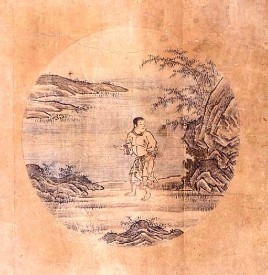
    Stage 1: Searching for the Ox (尋牛)

    The herdsman begins his search in the wilderness, representing the initial stirring of the spiritual quest amid confusion.

    從來不失,何用追尋?(From the very beginning, it has never been lost—so why search for it?)

    The ox (one’s true nature) has never actually been lost. It is inherently present, complete, and unchanging. The problem is not one of absence, but of ignorance and confusion.

    由背覺以成疏,在向塵而遂失。(Turning away from awakening, one becomes estranged; facing toward the dust [of the senses], one then loses track)

    By “facing toward the dust,” we become obsessed with external phenomena and the ego’s dramas, thereby “losing” our intrinsic awareness.

    家山漸遠,歧路俄差。(The homeland mountains grow ever more distant, the forked roads suddenly diverge)

    The practitioner feels a sense of spiritual homesickness, but is not yet able to find the road back home.

    得失熾然,是非鋒起。(Thoughts of “gain” and “loss” blaze fiercely; judgments of “right” and “wrong” clash like spears)

    And is paralyzed by endless philosophical choices, intellectual debates, and the burning agitation of desire and aversion.


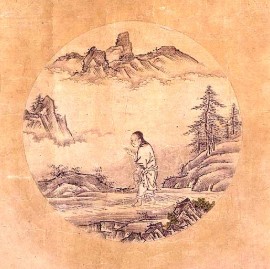
    Stage 2: Seeing the Tracks (見跡)

    This stage marks a critical turning point from blind groping to finding direction. The “tracks” (跡) are the traces of truth found in spiritual teachings, scriptures, and the examples of enlightened beings.

    依經解義,閱教知蹤 (Relying on the sutras, he understands the meaning; studying the teachings, he knows the tracks)

    The practitioner, through study (“依經解義, 閱教知蹤”), begins to see a coherent map.

    明眾器為一金,悟萬物由自己 (He becomes clear that the myriad vessels are all of one gold; he awakens to the fact that all things arise from the Self)

    Just as various vessels are all made from the same gold, all phenomena arise from the one true nature, the “Self” (自己, here meaning Buddha-nature, not the ego).

    正邪不辨,真偽奚分? ([Yet] right and wrong are not yet distinguished, truth and falsehood how can they be divided?)

    The tracks confirm the ox’s existence and general direction, but the ox itself is still not seen. The practitioner still operates in duality (“正邪不辨, 真偽奚分” – right/wrong, true/false aren’t fully discerned). He has the map, but haven’t set foot on the real terrain.

    未入斯門,權為見跡 (He has not yet entered the gate; for now, it is merely seeing the tracks)

    The “gate” is the direct, non-conceptual experience of reality. Here, one is still outside, analyzing the description of the gate rather than passing through it.


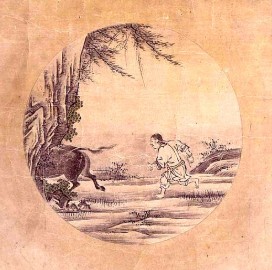
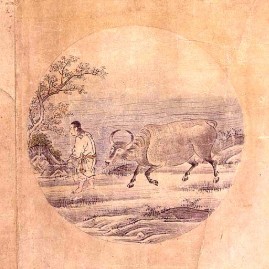
    Stage 3: Seeing the Ox (見牛)

    This stage represents the first direct, experiential glimpse of the true nature. It is a moment of profound, non-conceptual insight—a sudden “aha!” that goes far beyond the intellectual understanding of the tracks.

    從聲入得,見處逢源 (Through the sound, he enters and attains; at the place of seeing, he encounters the source)

    The description “從聲入得” (through the sound, he enters and attains) signifies a shift from thinking about reality to perceiving it directly, perhaps triggered by a sound, a sight, or a moment of silent awareness.

    六根門著著無差,動用中頭頭顯露 (At the gates of the six senses, nothing is amiss; in every movement and action, it is clearly revealed)

    The ox (true nature) is now seen as never truly separate. It is manifest in every sense experience (“六根門著著無差”) and in every action (“動用中頭頭顯露”).

    水中鹽味,色裏膠青 (Like salt in water, like pigment in indigo)

    The absolute is completely infused in the relative, inseparable yet distinct. It’s not a thing to see, but the very nature of seeing itself.

    眨上眉毛,非是他物 (Lift your eyebrows and see—it is no other thing)

    It’s an exhortation to realize that what you are seeing is you. The seeker and the sought begin to merge in this moment of recognition.

    But this is just a glimpse. The ox is “seen” but not yet held or stabilized. The experience may be brief, soon obscured again by habitual thought. Yet, it is transformative and irreversible. Having seen it once, the practitioner’s doubt is shattered. It’s the transition from belief to knowing, from hearsay to witness. The practitioner has “entered the gate.” The quest now changes from “Is it there?” to “How do I abide in this always?”


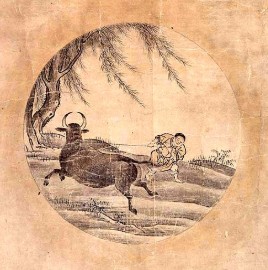
    Stage 4: Catching the Ox (得牛)

    Having had a glimpse of the ox (true nature) in Stage 3, the practitioner now attempts to “catch” it—to hold that awareness steadily and make it their own, rather than a fleeting visitor. This is often the longest and most arduous phase of the path.

    竭盡神通獲得渠,心強力壯卒難 (Exhausting all his strength and cunning to seize it, its will is fierce, its power robust—finally, it’s hard to subdue)

    This symbolizes the tenacity of habitual energies—old patterns of thought, emotional reactions, and egoic grasping that reassert themselves

    有時纔到高原上,又入煙雲深處居 (At times it wanders onto a high plain, but then again retreats to dwell deep within the misty clouds)

    There are moments of brilliant clarity and expansive vision (“high plain”), where the mind is open and awareness is steady. But just as quickly, one can be plunged back into confusion, obscuration, and doubt (“misty clouds”). The ox, symbolizing the liberated mind, keeps escaping into the fog of delusion.

    In essence, Stage 4 is the gritty, hands-on work of spiritual practice after initial insight. The initial euphoria of “seeing” gives way to the sobering realization that the ego’s habits are deeply entrenched. The goal is gradually lengthening the periods on the “high plain” and shortening the retreats into the “misty clouds.”


    Stage 5: Taming the Ox (牧牛)

    Stage 5 represents the crucial transition from struggle to mastery, from forced effort to cultivated harmony. The ox has been caught, but now it must be patiently and consistently trained.

    鞭索時時不離身,恐伊縱步入埃塵 (Whip and rope never leave his hand, lest the ox stray off down paths of dust)

    The “whip” is diligent awareness; the “rope” is mindful concentration. Without them, the mind goes back to the same old seductions of sensory distraction and egoic thought (the “paths of dust”).

    相將牧得純和也,羈鎖無拘自逐人 (When at last it is gently nurtured into purity and docility, even without tether or constraint, it follows the man of itself)

    Through continuous, patient practice, our own turbulent mind is gradually “tamed.” It becomes “pure and docile,” meaning the mind naturally settles into clarity. Mindfulness is no longer a task, but a natural state. In essence, Stage 5 is the cultivation of effortless practice. The Zen master speaks about mental states but this change has ressemblances to the change in dual practice from martial fire to civil fire, from effort to wu-wei.


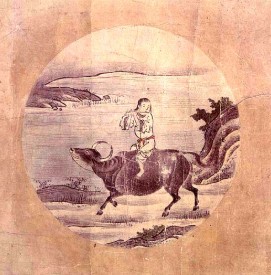
    Stage 6: Riding the Ox Home (騎牛歸家)

    This stage depicts the joyful and effortless integration of realization into the flow of ordinary life. The struggle is over; the practitioner and his true nature move as one, returning to the source from which they never truly departed.

    騎牛迤邐欲還家,羌笛聲聲送晚霞 (Astride the ox, he leisurely wends his way home, the herdsman’s flute carries the notes of the evening clouds)

    The practitioner is no longer searching, striving, or taming. He is simply going home—returning to his inherent nature in a relaxed, unhurried journey, to the “marketplace” of everyday life.

    一拍一歌無限意,知音何必鼓唇 (In every beat and song, a boundless meaning, a friend who knows the tune needs no chattering words)

    This “music” is his actions, speech, and presence in the world—now in harmony with the dharma. Every beat and song of his life carries “boundless meaning,” infused with the wisdom he has realized. Intellectual explanation and doctrinal debate (“chattering words”) are superfluous between those who share the direct experience.

    In essence, Stage 6 is the embodiment of enlightenment in daily activity. It is often seen as the culmination of the “gradual path” of cultivation. The practitioner is at peace, united with his true self, and his life becomes a natural, artistic expression of wisdom. However, a subtle duality remains: there is still a rider and an ox, a person “having” enlightenment.


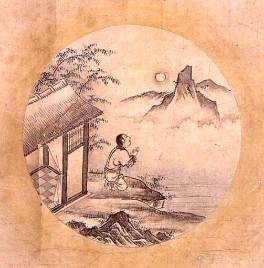
    Stage 7: Ox Forgotten, Self Alone (忘牛存人)

    This stage marks a profound internal shift from attainment to transcendence. The previous stage was one of harmonious unity, but here, the very concept of the “ox” (the sought-after true nature) as a separate object dissolves.

    騎牛已得到家山,牛也空兮人也 (Astride the ox, he has already reached home, the ox is now empty, the man at ease)

    Having fully realized and integrated his true nature, the instrument of seeking is no longer needed (the ox is “empty”). It was a conceptual construct for the journey. Similarly, the man is “at ease”, utterly free from the striving of a seeker.

    紅日三竿猶作夢,鞭繩空頓草堂 (The red sun is three poles high, yet he’s still as if dreaming, whip and rope lie idle in the thatched hut)

    The sun is high—everything is clear and illumined—yet he is “as if dreaming.” This does not mean delusion, but the disappearance of solid, separate reality. The whip and rope—the disciplines of mindfulness and effort—have served their purpose and are gratefully let go. “The raft is for crossing; once across, one does not carry it on one’s head.”

    In essence, Stage 7 is the transcendence of enlightenment as an achieved state. The practitioner no longer identifies as “someone who has attained something.” The external form of practice falls away.


    Stage 8: Both Ox and Self Forgotten (人牛俱忘)

    This stage represents the ultimate point of non-duality and absolute emptiness (śūnyatā). All distinctions, all concepts, and even the most refined sense of a realized “self” utterly dissolve. It is the consummation of the inward journey.

    鞭索人牛盡屬空,碧天遼闊信難通 (Whip, rope, man, and ox—all merge into emptiness, the vast blue sky is boundless; no message can be sent)

    Every element of the journey—the tools (whip/rope), the seeker (man), and the sought (ox) were all provisional names for aspects of the one reality. With the realization of their emptiness, they “merge” into the undifferentiated ground of being. The boundless sky describes this emptiness. No “message” (concept, teaching, or experience) can be sent from or about it. All communication falls short.

    紅爐焰上爭容雪,到此方能合祖宗 (How can a snowflake survive atop a red-hot furnace? Only upon reaching this can one merge with the Ancestors)

    The “red-hot furnace” is the absolute, non-dual reality. Any separate, conceptual entity—even the most pure and beautiful thought, is instantly vaporized upon contact. Nothing dualistic can exist here. Merge with the Ancestors means to fully unite with the primordial source, the Buddha-mind of all patriarchs and masters throughout time and see what they saw: absolute, unobstructed emptiness.

    Yet, from the Zen perspective, to linger here is to fall into the stagnation of “emptiness.” True wisdom is not an endpoint, but a turning point. The empty circle must give birth to the world of form.


    Stage 9: Returning to the Source (返本還源)

    This stage marks the return to the phenomenal world after the absolute emptiness of Stage 8. It is not a regression, but a rebirth into a completely new way of perceiving.

    返本還源已費功,爭如直下若盲聾 (Returning to the Source required exhausting effort, but how is it compared to the direct way of being like one blind and deaf?)

    The “blind and deaf” state is not ignorance, but non-discrimination. It means not being led astray by conceptual labels and preferences. The long struggle of seeking is now seen as secondary to this immediate, non-grasping presence.

    庵中不見庵前物,水自茫茫花自紅 (In the hut, he sees not a thing before the hut, the water flows of itself, boundless; the flowers bloom crimson)

    From within the hut (the abode of enlightened mind), he “does not see” the things before the hut. This means he does not perceive them through the filter of a separate self, with its desires, judgments, and projections. The subject-object division has collapsed. Water is just water, flowing boundlessly. Flowers are just flowers, vibrantly red. Everything is vividly present, self-existent, and self-luminous, “of itself”. The purified, empty mind (the hut) now rests in and perceives the world just as it is.


    Stage 10: Entering the Marketplace, Hands Hanging Down (入鄽垂手)

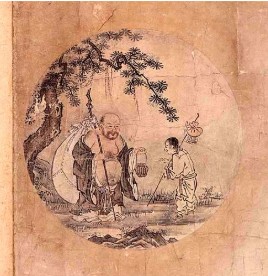
    This is the culmination of the journey: the full embodiment of wisdom as boundless, active compassion. The practitioner, utterly free from self-consciousness, re-enters the world of dust (the “marketplace”). With a humble appearance and hands resting at his side, he acts spontaneously—without intention, doctrine, or a sense of being a “helper.” His very presence, now an expression of non-dual awareness, naturally benefits all beings.

    露胸跣足入鄽來,抹土塗灰笑滿腮 (Bare-chested and barefooted, he enters the marketplace, smearing his face with dirt and ashes, a smile fills his cheeks)

    This is the antithesis of a messianic figure. It is a radical divestment of all specialness, status, and holiness. He appears as a fool, a beggar, a simpleton. The “smile” is not one of a benevolent king, but of someone who has nothing to protect, nothing to prove, and finds joy in the sheer act of being.

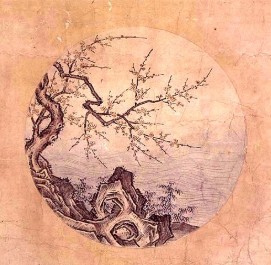
    不用神仙真祕訣,直教枯木放花開 (No need for the secret methods of the immortals, he directly causes withered trees to burst into bloom)

    He uses no esoteric rituals (secret methods of the immortals). His very presence—his unconditional compassion, his words, his actions—has transformative power, the power of awakened activity to heal, inspire, and awaken the Buddha-nature in others. This is not a regal, aloof sage, but a figure of utter non-attachment to form and status.

    The final stage warns us that the ‘savior’ role is a profound ego trap. In the stages of the spiritual journey, the ultimate goal isn’t to become a holy figure, but to return to the marketplace as a simple human—one who has bypassed the BIOS and found joy in the sheer act of being.



  • From Wells to Rain: Teresa of Ávila and the Cultivation of Qi

    A comparative exploration of Teresa of Ávila’s mysticism and Daoist qi cultivation, revealing shared stages of inner transformation beyond doctrine.


    Teresa of Ávila, the 16th-century Spanish mystic, described her inner path through a metaphor drawn from agriculture: watering a garden. The soul was the soil, and divine grace the water that allowed it to bear fruit. Read today, this imagery resonates strongly with concepts found in Daoist inner alchemy, particularly the notion of dan tian (丹田). The word tian literally means “field,” and in Daoist practice it refers to specific regions of the body where vital essence is cultivated through sustained attention and embodied discipline.

    What makes Teresa’s metaphor remarkable is not just its poetic force, but its functional precision. Her descriptions unfold as a process, a gradual refinement of effort, structure, and surrender that closely mirrors the stages of energetic cultivation found in Daoist and Tantric traditions.

    The Metaphor of Cultivation: From Effort to Wu Wei

    In her account, Teresa distinguishes four modes of watering the inner garden: drawing water manually from a well; channeling it through mechanical means; allowing it to flow from a river; and finally receiving it as rain from heaven. These stages trace a clear trajectory from exertion to effortlessness.

    “Paréceme a mí que se puede regar de cuatro maneras: o con sacar el agua de un pozo, que es a nuestro gran trabajo; o con noria y arcaduces… o de un río o arroyo… o con llover mucho, que lo riega el Señor sin trabajo ninguno nuestro, y es muy sin comparación mejor que todo lo que queda dicho.”

    A similar progression appears in Daoist internal alchemy (neidan). Practice begins with intentional activation of qi through breath, posture, movement, and focused attention. This phase is laborious and requires persistence, much like hauling water from a deep well. As sensitivity increases, practitioners work on opening and regulating the channels through which energy flows, analogous to building aqueducts or waterwheels that reduce effort while increasing reach. With time, circulation becomes spontaneous: energy moves on its own, like a river following its course. Finally, there is a stage where practice ceases to feel like practice at all. Energy descends, spreads, and permeates without deliberate intervention.

    This final phase corresponds closely to the Daoist principle of wu wei: non-forcing, non-doing. The practitioner no longer directs the process but allows it. Teresa’s “rain” and the Daoist experience of effortless circulation point to the same realization: technique prepares the ground, but completion arrives on its own terms.


    Sensual Pleasure and the Body as a Site of Revelation

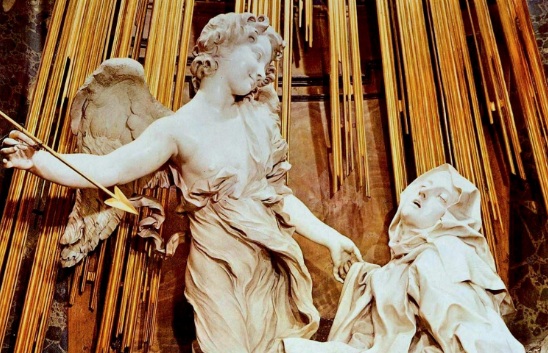
    Teresa’s descriptions of union with the divine are intensely bodily. They involve trembling, heat, sweetness, pain, and surrender—sensations that blur the line between spiritual rapture and erotic experience. This dimension of her mysticism has long unsettled interpreters, especially within a tradition wary of bodily pleasure.

    In Daoist alchemy and Tantra, however, such experiences are not anomalous. Sensual intensity is not treated as a distraction but as raw material. The body is not an obstacle to transcendence; it is the medium through which transformation unfolds. Pleasure, when refined and circulated rather than discharged, becomes a vehicle for expanded awareness.

    Teresa lacked the conceptual language to frame these sensations outside a theological context, and her historical circumstances demanded caution. Yet her descriptions suggest an embodied knowledge that exceeds doctrine. What she experienced was not abstract belief but a physiological and perceptual transformation, one that aligns closely with energetic traditions where ecstasy, heat, and dissolution of boundaries are recognized stages of inner work.

    “Veíale en las manos un dardo de oro largo… Era tan grande el dolor, que me hacía dar aquellos quejidos, y tan excesiva la suavidad que me pone este grandísimo dolor, que no hay desear que se quite, ni se contenta el alma con menos que Dios.”

    Seen from this angle, her mysticism appears less as an exception within Christianity and more as a culturally constrained expression of a universal embodied process.


    A God One Does Not Ask: Prayer as Presence

    As Teresa’s practice matured, she arrived at a conclusion that quietly subverted the dominant religious model of her time: prayer was no longer about asking, pleading, or negotiating. It became a state of presence rather than an act of will.

    “Ya no se trata de pedir, sino de entender que está Él con el alma y el alma con Él.”

    This shift is crucial. The divine was no longer something external to be persuaded or appeased, but something already present, encountered through stillness and receptivity. Effort gave way to intimacy. Desire softened into attention.

    This understanding closely parallels the Daoist view that alignment with the Tao does not arise through striving, but through yielding. One does not compel harmony; one stops interfering with it. In both cases, the practitioner discovers that the deepest form of communion occurs when intention relaxes and the sense of a separate agent diminishes.

    Teresa’s surprise at this realization suggests how far her lived experience had carried her beyond inherited frameworks. What remained was not doctrine, but a direct mode of knowing—quiet, unmediated, and internally verifiable.


    Taken together, these elements point toward a shared structure underlying mystical experience across cultures. Whether articulated in the language of divine grace or vital energy, the path follows similar contours: disciplined engagement, bodily transformation, surrender of control, and a final resting in what no longer feels separate.

    Teresa’s wells, channels, rivers, and rain are not merely devotional images. They function as a precise cartography of inner change. Read alongside Daoist internal alchemy, they suggest that spiritual realization is not owned by any single tradition, but arises wherever attention, body, and perception are refined enough to meet it.

  • The Three Layers of the Self: Where Western Psychology Meets Meditation

    For most of us raised in Western culture, the word self seems obvious. It feels like the story we tell about who we are — our memories, preferences, personality, wounds, and triumphs. But when you look closely, both through the lens of modern cognitive science and through the introspective clarity of meditation, that familiar “I” begins to dissolve.

    What emerges instead is a layered architecture of experience — three layers of the Self that Western psychology is only now beginning to map, and that meditative traditions have been pointing to for centuries: Consciousness → Minimal Self → Narrative Self

    Understanding these layers is not just an intellectual exercise. It is a way of loosening the grip of the illusion we call “me.”


    The Narrative Self: The Social Interface We Mistake for Identity

    The narrative self is the most visible layer — the one we defend, polish, and present to the world. It is built from:

    • autobiographical memory

    • language

    • cultural norms

    • social expectations

    • roles and identities

    • the stories we tell about ourselves

    This is the “I” Freud analyzed through the Ego and Superego, the “project” Sartre said we are condemned to create, and the “self-concept” Rogers tried to align with lived experience.

    But modern cognitive science has made something very clear: The narrative self is not the true self. It is a social interface.

    Psychologists like Dan McAdams describe it as a life story we continuously rewrite. Neuroscientists such as Michael Gazzaniga show how the brain invents explanations for our actions after the fact — a storyteller, not a commander. And philosophers like Daniel Dennett argue that the self is a “center of narrative gravity,” a useful fiction.

    If a self changes when we change language, culture, or social context, it cannot be essential. It is software — installed after birth, updated daily, and often buggy.


    The Minimal Self: The Biological BIOS

    Beneath the narrative lies something older and simpler: the minimal self.

    This is not a story. It is a felt sense:

    • “This is my body.”

    • “I am here, not there.”

    • “I am the one moving this hand.”

    It is pre-verbal, pre-conceptual, and shared by babies, animals, and humans alike.

    Philosopher Shaun Gallagher defines it as the pre-reflective sense of ownership and agency. Neuroscientist Evan Thompson describes it as the embodied structure of experience itself. Even Thomas Metzinger — who famously argues that “nobody ever was or had a self” — acknowledges that the minimal self is a stable biological model the brain uses to navigate the world.

    This is the layer Jung came closest to articulating. His Persona maps neatly onto the narrative self. His Ego overlaps with the minimal self. And his Self — the deeper organizing principle — hints at something beyond both.

    The minimal self is our BIOS: the pre-installed routines that allow consciousness to inhabit a body.

    But even this is not the core.


    Consciousness: The Layer Science Cannot Explain

    Strip away the narrative self. Quiet the minimal self. What remains is not a “self” at all. It is consciousness — the bare capacity to experience.

    This is not a belief. It is an observable fact in meditation: when thoughts stop and the sense of “me” fades, awareness remains. It is also a scientific mystery. Neuroscience can correlate brain activity with conscious states, but it cannot explain why consciousness exists at all.

    This is the “hard problem” articulated by David Chalmers: why should matter give rise to experience? Why should there be something it is like to be anything?

    Some contemporary hypotheses suggest that consciousness may be:

    • a fundamental property of the universe (panpsychism: Galen Strawson, Philip Goff)

    • an intrinsic aspect of information itself (Integrated Information Theory: Giulio Tononi)

    • a field-like phenomenon not fully reducible to neurons (various quantum-inspired models, cautiously explored by Stuart Hameroff and Roger Penrose)

    We know how consciousness behaves. We do not know what it is. Just like time. Or mass. Or space.


    Where Meditation and Science Converge

    Meditation does not solve the hard problem, but it reveals something crucial: Consciousness persists even when the sense of self dissolves.

    In deep practice — whether through qigong, Yidam visualization, or silent absorption — the narrative self falls away. The minimal self softens. The boundary between “me” and “world” becomes porous or disappears entirely.

    Yet awareness remains.

    This is why meditative traditions across cultures converge on similar insights:

    • In Daoism: the return to the Dao, the uncarved block

    • In Buddhism: anatta, the absence of a self

    • In Hindu traditions: Atman = Brahman, the identity of individual and universal consciousness

    • In Christian mysticism: dissolution into the Ground of Being (Meister Eckhart)

    The self is not the experiencer. The self is an appearance within experience.


    The Final Step: The Self as a Three-Layer Illusion

    If we put all this together, a radical but coherent picture emerges:

    • The narrative self is a cultural construction.

    • The minimal self is a biological construction.

    • Consciousness is not a self at all — it is the field in which both constructions appear.

    And when the body dies?

    The narrative self dissolves.
    The minimal self dissolves.
    But consciousness — if it is fundamental — may not.

    This opens the door to possibilities that science has not ruled out:

    • consciousness re-entering another organism (reincarnation)

    • consciousness merging with a universal field (Dao, Brahman, God)

    • consciousness persisting without form

    These are hypotheses, not certainties. But they are no longer confined to religion; they are now part of serious philosophical and scientific debate.

    And meditation offers a direct way to explore them — not as beliefs, but as experiences.


    Conclusion: The Last Illusion

    The deepest insight shared by meditation and modern cognitive science may be this:

    There is no self — only consciousness appearing as a self.

    The narrative self is a story.
    The minimal self is a model.
    The “deep self” is a misunderstanding.

    And consciousness is not a self — it is the space in which the illusion of self arises.

    The final step is not discovering who you are.
    It is realizing that the “you” you seek has never existed.

    What remains is what has always been here:
    awareness without a center, without a boundary, without a name.