A comparative exploration of Teresa of Ávila’s mysticism and Daoist qi cultivation, revealing shared stages of inner transformation beyond doctrine.






Teresa of Ávila, the 16th-century Spanish mystic, described her inner path through a metaphor drawn from agriculture: watering a garden. The soul was the soil, and divine grace the water that allowed it to bear fruit. Read today, this imagery resonates strongly with concepts found in Daoist inner alchemy, particularly the notion of dan tian (丹田). The word tian literally means “field,” and in Daoist practice it refers to specific regions of the body where vital essence is cultivated through sustained attention and embodied discipline.
What makes Teresa’s metaphor remarkable is not just its poetic force, but its functional precision. Her descriptions unfold as a process, a gradual refinement of effort, structure, and surrender that closely mirrors the stages of energetic cultivation found in Daoist and Tantric traditions.
The Metaphor of Cultivation: From Effort to Wu Wei
In her account, Teresa distinguishes four modes of watering the inner garden: drawing water manually from a well; channeling it through mechanical means; allowing it to flow from a river; and finally receiving it as rain from heaven. These stages trace a clear trajectory from exertion to effortlessness.
“Paréceme a mí que se puede regar de cuatro maneras: o con sacar el agua de un pozo, que es a nuestro gran trabajo; o con noria y arcaduces… o de un río o arroyo… o con llover mucho, que lo riega el Señor sin trabajo ninguno nuestro, y es muy sin comparación mejor que todo lo que queda dicho.”
A similar progression appears in Daoist internal alchemy (neidan). Practice begins with intentional activation of qi through breath, posture, movement, and focused attention. This phase is laborious and requires persistence, much like hauling water from a deep well. As sensitivity increases, practitioners work on opening and regulating the channels through which energy flows, analogous to building aqueducts or waterwheels that reduce effort while increasing reach. With time, circulation becomes spontaneous: energy moves on its own, like a river following its course. Finally, there is a stage where practice ceases to feel like practice at all. Energy descends, spreads, and permeates without deliberate intervention.
This final phase corresponds closely to the Daoist principle of wu wei: non-forcing, non-doing. The practitioner no longer directs the process but allows it. Teresa’s “rain” and the Daoist experience of effortless circulation point to the same realization: technique prepares the ground, but completion arrives on its own terms.
Sensual Pleasure and the Body as a Site of Revelation
Teresa’s descriptions of union with the divine are intensely bodily. They involve trembling, heat, sweetness, pain, and surrender—sensations that blur the line between spiritual rapture and erotic experience. This dimension of her mysticism has long unsettled interpreters, especially within a tradition wary of bodily pleasure.
In Daoist alchemy and Tantra, however, such experiences are not anomalous. Sensual intensity is not treated as a distraction but as raw material. The body is not an obstacle to transcendence; it is the medium through which transformation unfolds. Pleasure, when refined and circulated rather than discharged, becomes a vehicle for expanded awareness.
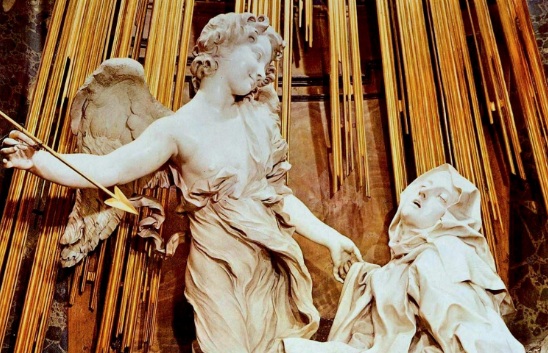
Teresa lacked the conceptual language to frame these sensations outside a theological context, and her historical circumstances demanded caution. Yet her descriptions suggest an embodied knowledge that exceeds doctrine. What she experienced was not abstract belief but a physiological and perceptual transformation, one that aligns closely with energetic traditions where ecstasy, heat, and dissolution of boundaries are recognized stages of inner work.
“Veíale en las manos un dardo de oro largo… Era tan grande el dolor, que me hacía dar aquellos quejidos, y tan excesiva la suavidad que me pone este grandísimo dolor, que no hay desear que se quite, ni se contenta el alma con menos que Dios.”
Seen from this angle, her mysticism appears less as an exception within Christianity and more as a culturally constrained expression of a universal embodied process.
A God One Does Not Ask: Prayer as Presence
As Teresa’s practice matured, she arrived at a conclusion that quietly subverted the dominant religious model of her time: prayer was no longer about asking, pleading, or negotiating. It became a state of presence rather than an act of will.
“Ya no se trata de pedir, sino de entender que está Él con el alma y el alma con Él.”
This shift is crucial. The divine was no longer something external to be persuaded or appeased, but something already present, encountered through stillness and receptivity. Effort gave way to intimacy. Desire softened into attention.
This understanding closely parallels the Daoist view that alignment with the Tao does not arise through striving, but through yielding. One does not compel harmony; one stops interfering with it. In both cases, the practitioner discovers that the deepest form of communion occurs when intention relaxes and the sense of a separate agent diminishes.
Teresa’s surprise at this realization suggests how far her lived experience had carried her beyond inherited frameworks. What remained was not doctrine, but a direct mode of knowing—quiet, unmediated, and internally verifiable.
Taken together, these elements point toward a shared structure underlying mystical experience across cultures. Whether articulated in the language of divine grace or vital energy, the path follows similar contours: disciplined engagement, bodily transformation, surrender of control, and a final resting in what no longer feels separate.
Teresa’s wells, channels, rivers, and rain are not merely devotional images. They function as a precise cartography of inner change. Read alongside Daoist internal alchemy, they suggest that spiritual realization is not owned by any single tradition, but arises wherever attention, body, and perception are refined enough to meet it.
Leave a Reply